



- Caregivers are often put at a disadvantage by health care systems that aren’t sensitive to their needs. More recently, there has been an increase in the development of collaborative relationships across disciplines leading to integrated teams. These teams may be more sensitive to caregivers’ concerns and more receptive to their participation in treatment planning.
- The National Academies of Science, Engineering, and Medicine in three recent reports, titled “Retooling for an Aging America: Building the Health Care Workforce (2008), “The Mental Health and Substance Use Workforce for Older Adults: In Whose Hands?” (2012), and “Families Caring for an Aging America” (2016), states that family members should be included as part of the healthcare team.
- Including caregivers would increase the healthcare team’s knowledge of patients’ backgrounds and living environments. This information would inform team decision-making regarding care.
References
The National Academies of Science, Engineering, and Medicine. (2016). Families caring for an aging America. Retrieved from https://www.nationalacademies.org/hmd/Reports/2016/families-caring-for-an-aging-americaopens in new window
The National Academies of Science, Engineering, and Medicine. (2008). Retooling for an aging America: Building the health care workforce. Retrieved from https://www.ncbi.nlm.nih.gov/books/NBK215401/pdf/Bookshelf_NBK215401.pdfopens in new window
The National Academies of Science, Engineering, and Medicine. (2012). The mental health and substance use workforce for older adults: In whose hands? Retrieved from https://www.nap.edu/catalog/13400/the-mental-health-and-substance-use-workforce-for-older-adultsopens in new window
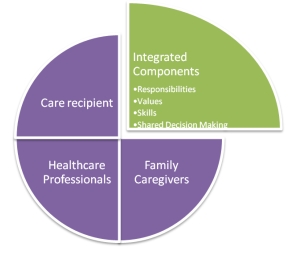
The figure below illustrates a model including families into an integrated healthcare team and demonstrates the components of the model that are crucial for an effective team.
- Increasingly, healthcare settings are using electronic medical records (EMR) with patient and family portals to share health information between family members and healthcare providers.
- In some settings, family members can access a portion of the electronic medical record (EMR), including a patient’s problem and medication lists and most recent laboratory findings, through the patient and family portal. They can also use the portal to send secure email messages to the healthcare team members that provide ongoing, real-time observations about the patient, as well as share information about what it is like to be a family caregiver. Those secure messages become part of the patient’s permanent medical record.
Building Caregiver Partnerships through Innovative Interprofessional Education was developed by Northeast Ohio Medical University to create effective partnerships between healthcare providers and family caregivers. A 20-minute film, No Roadmap: Caregiver Journeys, featuring stories of four caregiving families, companion discussion guides and resources for case-based learning and structured clinical encounters are available, freely accessible on the websiteopens in new window.
A fact sheet developed by APA for Graduate Psychology Faculty and Training Directors on integrated healthcare teams for geriatric populations is available onlineopens in new window (PDF, 2.58MB).
These suggested topics for teaching about caregiving for interprofessional teams are adapted from “Blueprint for Change: Achieving Integrated Health Care for an Aging Population” by APA. Other APA information related to integrated health care can be found online.
- The Broken Healthcare System for Older Adults
- A Basic Model of Integrated, Interdisciplinary Healthcare
- Knowledge and Skills that Psychologists Contribute to Integrated Healthcare
- Principles of Integrated Healthcare
- Interdisciplinary Collaboration in Diverse Sites of Care
- The Older Consumer’s Perspective on Healthcare
Competencies have recently been defined to guide training in service delivery on interprofessional teams. The Interprofessional Education Collaborative of which APA is a member released a 2016 update of "Core Competencies for Interprofessional Collaborative Practiceopens in new window." (PDF, 1.15MB)
The American Geriatrics Society (AGS) collaborated with APA and other organizations to develop “Partnership for Health in Aging: Multidisciplinary Competencies in the Care of Older Adults at the Completion of the Entry-level Health Professional Degree.”
In 2015, the Health Resources and Services Administration (HRSA) initiated the Geriatric Workforce Enhancement Program (GWEP). GWEP has fostered education in the interprofessional care of older adults and their families at major universities. For example, the University of South Florida GWEP has infused geriatric and gerontological principles into the primary care education of health students through curriculum development (Michael et al., 2019) and by creating a clinical rotation at a local Federally Qualified Health Center for USF students, residents and fellows interested in developing a geriatric health emphasis.
In addition, the Interprofessional Professionalism Collaborativeopens in new window has a wealth of resources for use by educators across all health professions.
References
American Psychological Association. Integrated Health Care for an Aging Population, https://www.apa.org/pi/aging/programs/integrated
Michael, M., Wilson, C., Jester, D. J., Andel, R., D’Aoust, R., Badana, A. N. S., & Hyer, K. (2019). Application of curriculum mapping concepts to integrate multidisciplinary competencies in the care of older adults in graduate nurse practitioner curricula. Journal of Professional Nursing, 35(3), 228-239. doi: 10.1016/j.profnurs.2019.01.007
Palmisano, B., Sanders, M., Radwany, R., Scott, E., Sperling, D., Thomas, J., Drost, J., Baughman, K., Jones, R., Blackie, M. (2016). Building Caregiver Partnerships Through Interprofessional Education. Retrieved from: https://www.pogoe.org/productid/21916opens in new window
The Patient-Centered Medical Home (PCMH) is a primary care model that emphasizes interdisciplinary care. In the PCMH model of care, a patient obtains most services at the “medical home”, usually the primary care setting. When referrals are necessary, the medical home cooperates with providers in and outside of the practice to improve communication and coordination of services. Many organizations and family caregiver advocates are calling for family members to be considered members of the PCMH team. Benefits to the care recipient, caregiver, provider and health care system itself result from the incorporation of family members as part of the team and the development of care plans that prioritize what matters to the patient.
References:
Wolff, J. L., Clayman, M. L., Rabins, P., Cook, M. A., & Roter, D. L. (2012). An exploration of patient and family engagement in routine primary care visits. Health Expectations, doi:10.1111/hex.12019
Wolff, J. L., Roter, D. L., Barron, J., Boyd, C. M., Leff, B., Finucane, T. E., ... & Gitlin, L. N. (2014). A tool to strengthen the older patient–companion partnership in primary care: Results from a pilot study. Journal of the American Geriatrics Society, 62, 312-319. doi:10.1111/jgs.12639