Mental Health Disparities Among Racial and Ethnic Minorities

What Providers Should Know
Girl clinging to mother's leg

What mental health providers should know about mental health disparities among racial and ethnic minorities with lived experiences of serious mental illness (SMI).

Within SMI populations, racial and ethnic minorities experience mental health disparities related to access and utilization of services, diagnosis and outcomes. Across disciplines, disparities in health and mental health for racial and ethnic minorities are well documented (American Psychological Association (APA), 2009; Smedley, Stith, & Nelson, 2003; SAMHSA, 2015; U.S. Department of Health and Human Services, 2001). As is the case with many populations, within-group differences in resources and services exist, and SMI is no exception. 

Understanding the barriers that exist can assist practitioners and researchers in eliminating mental health disparities for individuals experiencing a serious mental illness.

Data on SMI and Racial/Ethnic Minorities

Mother, father, child family
10 Million
It is estimated that 10 million individuals in the United States are diagnosed with SMI.
Medical handbag
Prevalence of SMI
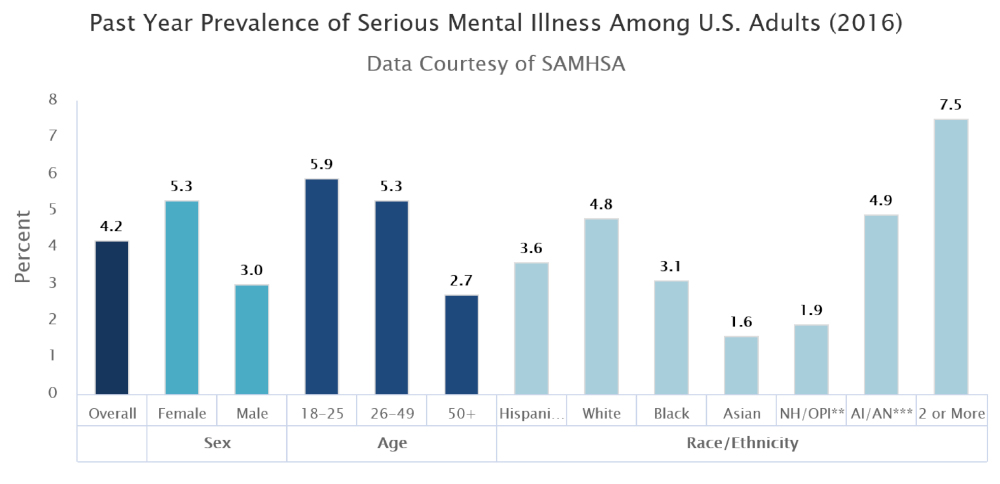
Among racial and ethnic minorities, the prevalence of SMI is highest for individuals reporting two or more races (7.5 percent), followed by American Indian/Alaskan Natives (4.9 percent), Hispanics (3.6 percent), Blacks (3.1 percent), and Asians (1.9 percent).

Past year prevalence of serious mental illness in U.S. Adults

What is SMI?

Serious mental illness, or SMI, is defined as a mental, behavioral or emotional disorder resulting in serious functional impairment, which substantially interferes with or limits one or more major life activities.

What Racial and Ethnic Minorities With SMI Experience

Among individuals diagnosed with mental health diagnoses, individuals with serious mental illness from racial and ethnic backgrounds experience additional vulnerabilities within mental health systems. 

Although racial and ethnic minorities are a heterogeneous group of individuals, there are common disparities experienced by African-American, Hispanic, Asian and American Indian/Alaska Natives. Individuals from these racial and ethnic minority populations with SMI are more likely to experience the following.

  • Use of psychiatric emergency services rather than community support services.
  • Involuntary hospitalizations as a result of seeking care.
  • Emergency treatment as a result of interactions with law enforcement.
  • Over-diagnosis of schizophrenia.
  • Higher doses of antipsychotic medications. 
  • In addition, these individuals are less likely to receive interventions for co-occurring depression.

What You Can Do

Practitioners and researchers can learn more about best practices for treatment in order to provide optimal care and support to ethnic and racial minorities with SMI. A few APA resources are listed below.

References

APA. (2009). Resolution on APA Endorsement of the Concept of recovery for People with Serious Mental illness. Retrieved from https://www.apa.org/practice/leadership/serious-mental-illness/recovery-resolution.pdfopens in new window

Smedley, B. D., Stith, A. Y., & Nelson, A. R. (2003). Unequal Treatment: Confronting racial and ethnic disparities in health care. Washington, DC. The National Academies Press.

SAMHSA (2015). Racial/ ethnic differences in Mental health service use among adults. U.S. Department of Health and Human Services Publication No. SMA-15-4906. Rockville, Md.

SAMHSA (2013). Results from the 2013 National Survey on Drug Use and Health: Summary of national findings. Rockville, Md.

Last updated: January 2022Date created: 2018