


How to use this tip sheet
Conducting a health equity assessment of your organization or business will help you uncover policies, procedures, and decisions that contribute to behavioral and physical health inequities and identify pathways to incorporate more equitable practices. This resource provides quick tips as you begin to consider conducting a health equity assessment. The resources section of this tip sheet includes examples of full health equity assessment guides.
Why health equity?
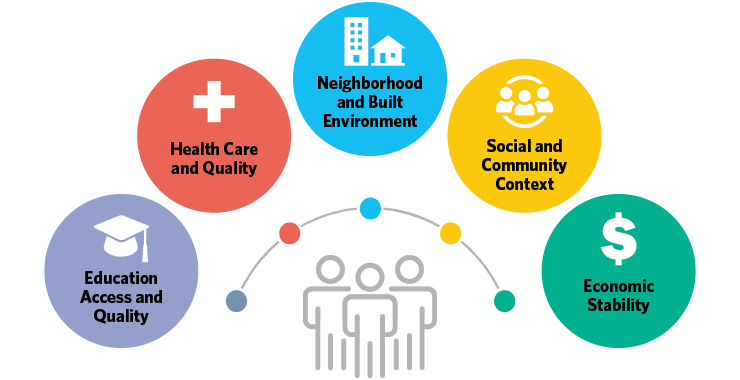
Health inequities, which are systematic differences in the health status of different population groups due to structural, societal, and economic differences (World Health Organization), prevent people from finding care options that fully meet their needs. There are many sources of health inequities, and their effects vary across different socioeconomic, cultural, and ethnic populations. Health equity and a person’s overall health and quality of life are influenced by the social determinants of health, which include economic stability, education, health care systems, neighborhood and physical environment, and one’s social and community context.
Health inequities can influence both the prevalence and risk of certain behavioral and physical disorders emerging in certain communities, a community’s ability to access health care, health care providers’ ability to offer care suited to that community's needs, and the overall outcomes of the care. Informed providers can deliver health care aimed at alleviating some of the cycles perpetuating intergenerational health inequities, as untreated mental disorders contribute to economic loss, lower rates of education, and higher rates of health care expenditure and unemployment, which all are correlated to worse mental and physical health outcomes in the future (Ngui et al., 2010).
Mental health providers influence health equity
Mental health providers play a major role in improving health care and have a responsibility to educate themselves about health inequity and how it can affect the populations they serve. Experienced and early career mental health professionals can ensure the use of best practices through continued education, self-assessment, and professional development to create as welcoming an environment as possible for everyone, as even today many populations feel that psychological professional offices are utilizing outdated language and practices that lead to certain groups feeling like their needs will not be understood (Krehely, 2009).
Psychologists and mental health care professionals are in a unique position to help inform, educate, and promote health equity not just for mental health care, but also for health care as a whole. This is only possible when mental health providers look inward and try to reduce inequity and bias within their own practice first.
Five tips to assess your organization’s role in achieving health equity

Plant the seed and commit
Start a conversation within your organization about the importance of creating an environment that champions health equity. Encourage your organization’s leadership to write and communicate goals to improve equity in health care. Your organization will also need to commit resources, such as budget and staff time, to implement the results of the assessment. It is much easier to implement any necessary changes that emerge from the assessment when everyone in your organization is invested in the same goal.

Self-reflect as an organization
Develop a list of reflection questions to assess if and how your organization contributes to health inequities, how this leads to varying mental and other health outcomes for your patients or constituents, and what adjustments your organization can make to achieve health equity. These questions will help you identify health equity weaknesses in your organization’s operations as well as opportunities to improve.
Examples of situations where you may be a bystander or upstander

Engage with stakeholders and communities
Build partnerships within communities to learn more about how your organization can better serve your local community. Engage in interviews and group dialogues with community leaders and groups to understand how your organization is perceived by local communities, the mental health needs that exist within the surrounding community, barriers the community faces in getting those needs met, and how your organization can shift to better meet those needs. Community partners can provide robust information that can help your organization build an action plan. Examples of community partners include local religious-based organizations; community centers; health and human service organizations; organizations whose mission is centered around equity, human rights, or family services; and state, county, and city associations and societies both within and outside of mental health.

Put a plan for change on paper and implement it
Develop a plan of action that includes strategies — like processes, standards, policies, funding decisions, staff skills, and accommodations — that would reduce your organization’s contribution to health inequities and better serve your local community. Your plan of action should be influenced by information from your organization’s self-reflection, feedback from patients, community groups, and other partners, as well as available performance data. After obtaining consensus and sign-off, implement your plan. Consider rolling it into your organization’s strategic plan. Your organization’s commitment to achieving health equity does not end with the assessment. It is important for staff, patients, and partners to see and feel actual movement and progress. Not moving forward with implementation can put your organization’s reputation with the local community at risk.

Monitor progress and be flexible
When implementing changes in your organization it is important to have a plan to monitor and track progress. Ongoing data will tell you if your changes are working to alleviate health inequities, or if you need to work on a different approach. Keep your community partners engaged along the way as they can continue to provide helpful feedback. Be sure to also share your successes and progress with your partners. Stay flexible – things might not work out the way your organization originally envisioned, but this is a long-term iterative process. Your organization will learn and adapt over years.
References
World Health Organization. (2018). Health inequities and their causes. World Health Organization.
Ngui, E. M., Khasakhala, L., Ndetei, D., & Roberts, L. W. (2010). Mental disorders, health inequalities and ethics: A global
perspective. International review of psychiatry (Abingdon, England), 22(3), 235–244. https://doi.org/10.3109/09540261.2010.485273opens in new window
Krehely, J. (2009). How to close the LGBT Health Disparities Gap. Americanprogress.org.
Resources
- APA Resolution on Advancing Health Equity in Psychology
- APA Health Equity Portfolio
- SAMHSA Behavior Health Equity Resourcesopens in new window
- CDC Office of Minority Health and Health Equityopens in new window
- CDC Practitioner’s Guide for Advancing Health Equity and Preventing Chronic Diseaseopens in new window