

Rural communities account for about 90 percent of the land area in the United States and about 19.3 percent of the total population (U.S. Census Bureau, 2010opens in new window). Compared to their urban counterparts, rural communities have higher rates of preventable diseases, such as obesity, diabetes and cancer, and higher rates of risky health behaviors, such as smoking, physical inactivity, poor diet and inadequate use of seat belts (Eberhardt & Pamuk, 2004opens in new window; Hartley, 2004opens in new window). America’s rural population is more likely to use tobacco especially smokeless tobacco and is more heavily impacted by tobacco use. Rural Americans are also more likely to be exposed to secondhand smoke and less likely to have access to programs that help them quit smoking (American Lung Association, 2012opens in new window).
Smoking and Tobacco Use in Rural Populations

Share and Learn
Smoking in Rural Populations
A webinar exploring smoking rates and smoking cessation efforts in rural populations.
Get the Basics
Use/Prevalence
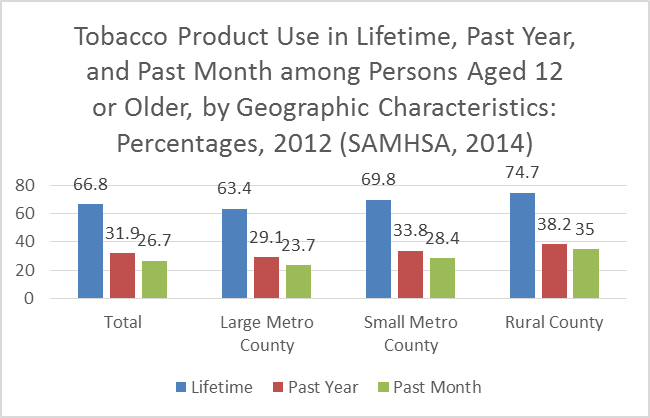
- Rural county communities have higher rates of lifetime, past year and past month tobacco use than large and small metro county areas (SAMHSA, 2014 – Table 2.47Bopens in new window).
- Patients living in rural areas have higher rates of smokeless tobacco use, particularly rural residents aged 26-49 (American Lung Association, 2012opens in new window).
- Rural residents are more likely to be exposed to secondhand smoke both at work and at home (Vander Weg, Cunningham, Howren, & Cai, 2011opens in new window).
Health Consequences
- Smoking increases risk for numerous health complications, such as chronic obstructive pulmonary disorder, lung cancer, hip fracture and heart disease, and these conditions may be exacerbated in rural areas because of limited access to health care providers ( Eberhardt, Ingram, Makuc et al., 2001opens in new window).
- Heart disease and stroke are leading causes of death in rural populations (Eberhardt, Ingram, Makuc et al., 2001opens in new window).
- Secondhand smoke is a leading cause of childhood illness and premature death, especially in rural areas (Vander Weg, Cunningham, Howren, & Cai, 2011opens in new window).
Risk Factors
- Teenagers living in rural regions smoke more and at earlier ages than their urban peers. (Epstein, Botvin & Spoth, 2003opens in new window).
- Pregnant women who reside in rural areas are more likely to smoke than their urban counterparts (Bailey & Cole, 2009opens in new window; Bullock, Mears, Woodcock, & Record, 2001opens in new window; Stevens, Colwell, & Hutchinson, 2010opens in new window).
- Unemployed rural residents are more likely to smoke (American Lung Association, 2012opens in new window).
- The tobacco industry has aggressively marketed to rural populations for decades and has more than doubled its expenditures on marketing of smokeless tobacco products between 2005 and 2008 (U.S. Department of Health and Human Services, 2012opens in new window).
- Geographical location, low socioeconomic status and lack of health insurance often bar access to preventative health care for rural Americans (Casey, Call, & Klingner, 2001opens in new window).
Treatment
- Rural populations are more likely to be uninsured, have limited access to care, have fewer available health care providers,and have limited transportation options which pose barriers for rural residents to see their health provider on a regular basis (Eberhardt & Pamuk, 2004opens in new window).
- The use of remote monitoring and reinforcement of smoking abstinence may enhance the accessibility and acceptability of cigarette smoking abstinence reinforcement programs, particularly in rural areas where transportation can be unreliable and treatment providers are distant (Stoops WW, Dallery J, Fields NM, Nuzzo PA, et al, 2003).
- Among rural medically underserved worksite participants, educational interventions can increase knowledge regarding the dangers of tobacco use and secondhand smoke exposure. Among current tobacco users, these interventions also increase family rules regarding secondhand smoke exposure in their homes and vehicles (Scott, Las Sala, Lyndaker, Neil-Urban, 2016opens in new window).
- For rural providers, consistent, strong curricula education at all health provider levels and continuing education for new and more effective strategies is essential to empower health care providers to address smoking cessation interventions consistently and effectively (Scott, Las Sala, Lyndaker, Neil-Urban, 2013).
- Rural, low-income women attempting to stop smoking benefit from social support systems that exist within the smoker's social networks in lieu of social support interventions that offer support through more distant resources (telephone, internet, professional visits, etc.) (Mitchell, Kneipp, & Giscombe, 2015).
- Smoking in rural low-income women carries social stigma, which increases their social isolation. Social isolation connected to the stigma of smoking may decrease their opportunity to engage with community members and resources that facilitate the desire and ability to stop smoking (Mitchell, 2016).
For More Information
The APA has also put together a list of external resources on smoking cessation, tobacco prevention and control, and advocacy.
expand all
Resources
- American Lung Associationopens in new window
Resources, tools and information on how to quit smoking. - Centers for Disease Control and Prevention (CDC), Office on Smoking and Healthopens in new window
Lead federal agency for comprehensive tobacco prevention and control featuring latest research, tools and resources. - Media Campaign Resource Center (MCRC)
Provides access to many CDC-licensed advertisements developed by more than 25 state health departments, nonprofit health organizations, and federal agencies. - Pathways to Freedom: Leading the Way to a Smoke Free Community©opens in new window
From NAAPTPN (National African American Tobacco Prevention Network). - Smoking Cessation Leadership Centeropens in new window
Works with health professional organizations and institutions to increase their motivation and capability to assist smokers in quitting.
References
- American Lung Association (2012). Cutting tobacco’s rural roots: Tobacco use in rural communities. Chicago, IL: Author. Retrieved from https://www.lung.org/our-initiatives/research/lung-health-disparities/tobacco-in-rural-communities.htmlopens in new window
- Bailey, B. A., & Cole, L. K. J. (2009). Rurality and birth outcomes: findings from Southern Appalachia and the potential role of pregnancy smoking. The Journal of Rural Health, 25(2), 141-149. doi: 10.1111/j.1748-0361.2009.00210.x
- Bullock, L. F., Mears, J. L., Woodcock, C., & Record, R. (2001). Retrospective study of the association of stress and smoking during pregnancy in rural women. Addictive Behaviors, 26(3), 405-413. doi: 10.1016/S0306-4603(00)00118-0opens in new window
- Casey, M. M., Call, K. T., & Klingner, J. M. (2001). Are rural residents less likely to obtain recommended preventive healthcare services? American Journal of Preventive Medicine, 21(3), 182-188. doi: 10.1016/S0749-3797(01)00349-X
- Centers for Disease Control and Prevention. Vital Signs: Disparities in Nonsmokers’ Exposure to Secondhand Smoke—United States, 1999–2012. Morbidity and Mortality Weekly Report 2015; 64(04):103–8 [accessed 2016 Mar 29].
- Centers for Disease Control and Prevention. Best Practices for Comprehensive Tobacco Control Programs—2014opens in new window. Atlanta: U.S. Department of Health and Human Services, Centers for Disease Control and Prevention, National Center for Chronic Disease Prevention and Health Promotion, Office on Smoking and Health; 2014.
- Centers for Disease Control and Prevention. A Practitioner’s Guide for Advancing Health Equity: Community Strategies for Preventing Chronic Disease. Atlanta: U.S. Department of Health and Human Services, Centers for Disease Control and Prevention, National Center for Chronic Disease Prevention and Health Promotion, Division of Community Health; 2013.
- Centers for Disease Control and Prevention. CDC health disparities and inequalities report — United States, 2013. Morbidity and Mortality Weekly Report. 2013;62(suppl 3):1-187.
- Eberhardt, M., Ingram, D., Makuc, D., et al. (2001). Urban and Rural Health Chartbook. Health United States, 2001. Hyattsville, Md. National Center for Health Statistics.
- Eberhardt, M. S., & Pamuk, E. R. (2004). The importance of place of residence: examining health in rural and nonrural areas. American Journal of Public Health, 94(10), 1682.
- Mitchell, S.A. (2016). An inside view: Using photovoice to study smoking in rural low-income women (Unpublished doctoral dissertation). The University of North Carolina at Chapel Hill, Chapel Hill, NC.
- Mitchell, S. A., Kneipp, S. M., & Giscombe, C. W. (2015). Social Factors Related to Smoking among Rural, Low‐Income Women: Findings from a Systematic Review. Public Health Nursing. Article first published online: Sept. 25, 2015, DOI: 10.1111/phn.12233
- Scott, Linda D, Las Sala, Kathleen B., Lyndaker, Carolyn Z., Neil-Urban, Sherry, Smoking Cessation Practices of Rural and Urban Health Care Providers. Online Journal of Rural Nursing and Health Care, vol. 3, no. 2, Fall 2013.
- Scott, Linda D, Las Sala, Kathleen B., Lyndaker, Carolyn Z., Neil-Urban, Sherry. Smoking Cessation Practices of Rural and Urban Health Care Providers. www.sciencedirect.com/science/article/pii/S209379111630001, 2016.
- Stevens, S., Colwell, B., & Hutchison, L. (2010). Tobacco use in rural areas: a literature review. Rural Healthy People, 237-249.
- Stoops WW1, Dallery J, Fields NM, Nuzzo PA, Schoenberg NE, Martin CA, Casey B, Wong CJ. An internet-based abstinence reinforcement smoking cessation intervention in rural smokers. Drug Alcohol Depend. 2009 Nov 1;105(1-2):56-62. doi: 10.1016/j.drugalcdep.2009.06.010. Epub 2009 Jul 16.
- Substance Abuse and Mental Health Services Administration (SAMHSA). (2013). Results from the 2012 national survey on drug use and health: Summary of national findings, NSDUH Series H-46, HHS Publication No. (SMA) 13-4795. Rockville, Md.: Author.
- Substance Abuse and Mental Health Services Administration. (2014). Results from the 2013 national survey on drug use and health: Summary of national findings, NSDUH Series H-48, HHS Publication No. (SMA) 14-4863. Rockville, Md.: Author.
- U.S. Census Bureau. (2010). Metropolitan and micropolitan. Washington, D.C.: Author. Retrieved from https://www.census.gov/population/metro/
- U.S. Department of Health and Human Services. (2012). Preventing tobacco use among youth and young adults: A report of the surgeon general. Rockville, Md.: Office of the Surgeon General. Retrieved from: https://www.surgeongeneral.gov/library/reports/preventing-youth-tobacco-use/opens in new window.
- Vander Weg, M. W., Cunningham, C. L., Howren, M. B., & Cai, X. (2011). Tobacco use and exposure in rural areas: Findings from the Behavioral Risk Factor Surveillance System. Addictive Behaviors, 36(3), 231-236. doi: 10.1016/j.addbeh.2010.11.005
Acknowledgments: This fact sheet has been made available through funding from the Agency for Healthcare Research and Quality (AHRQ).
Date created: 2016