

Royleen Ross, 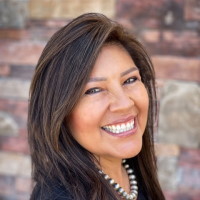 PhD
PhD
Eight Northern Indian Pueblos Council, Inc. as a cultural psychologist
Norton Sound Health Corporation Behavioral Health Services Department as a clinician
Royleen Ross, PhD
I am Psyched! Vignette Series
1. How do you and your family/friends celebrate Native American Heritage month?
Native American heritage month is celebrated yearlong in Native communities including mine! We celebrate family, markers across the lifespan, and eco sociological events through ceremony, as all things are intertwined and interconnected. Nationwide, Rock Your Moccs Day is celebrated in the month of November. Professionally, as a member, the Psychologists in Indian Country (APA Div. 18, Sec. 4), Society of Indian Psychologists, and Indigenous Women (APA Div. 35, Sec. 6) are sponsoring a virtual Walk/ Run in honor of Missing and Murdered Indigenous People, Native American children who were lost and harmed in boarding schools, and Native American Veterans, November 11–18, 2021.
2. What words of wisdom or advice do you give to students from marginalized communities that are interested in studying psychology?
Though the educational arena may be daunting and at times not feel BIPOC friendly, continue to persevere regardless of the challenges students may encounter. The worldviews, values, and beliefs of students are important, and the field of psychology needs you. I would encourage students to challenge the narrative! Currently, this is an exciting time in psychology as ethnic scholars are rewriting the psychology narrative. The more the field is exposed and educated in different capacities, including various ways of knowing, psychology will grow to reflect accuracy in our narratives.
3. Throughout your personal and professional trajectory, which leadership skills were the most difficult to develop?
In my professional life, assertiveness has been a difficult leadership skill to employ. While assertiveness is a valued skill and interpersonal characteristic in dominant society, the Native values instilled in me from a collectivistic orientation conflict with being outspoken or behavior characteristic of individualism. As a law enforcement officer, exercising authoritative commands was a part of the occupation; advocating for others comes naturally; but development of assertiveness as a personal skill remains challenging at times. From a traditional Native standpoint, the tenets of storytelling narratives are nurtured to convey a position and assertiveness is discouraged, thus balancing the scales in this area will be ongoing.
4. Who have been your role models? What about them do you admire?
My role model throughout my life has been my maternal grandfather, Benjamin Lorenzo. He was born in 1915, three years after New Mexico became a state. In reflection of his life, he endured enormous educational, social justice, government, and career challenges that are difficult to conceive, but absorbed these trials in a cultural humility tradition. My grandfather exemplified compassion, trustworthiness, honesty, and integrity in his relationships with people in all his roles as a family man, tribal leader, cattleman, and state livestock inspector. Consequently, my professional role models, Justin “Doug” McDonald, PhD, Iva GreyWolf, and Joseph Gone, PhD, embody the honorable characteristics my grandfather lived, thus my admiration for these revolutionaries in their respective roles.
5. In this period of racial reckoning, what advice do you have to people who want to make a change in their communities?
The most meaningful community change and solutions originate in the communities themselves. Oftentimes outside entities infiltrate communities and implement ideas of change which do not resonate with the community values and norms. I would encourage the people to pursue their ideas for change and stand strong in their truth.
6. In your opinion, what is the biggest challenge the field of psychology is currently facing?
APA recently acknowledged the field’s contributions to systemic racism. In my opinion, one of the biggest challenges the field will encounter is equalizing, and accepting, various perspectives on theory, research, psychological testing instrumentation, service delivery, and culturally relevant authored publications. The endeavor to attain equality will be worth the struggle and challenge.
Last updated: November 2021Date created: November 2021