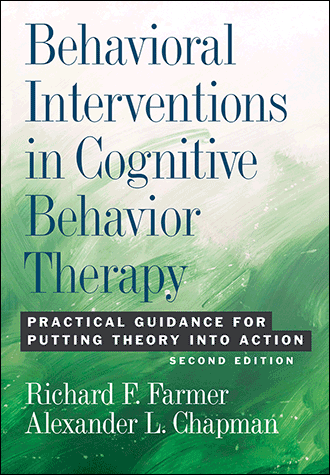
Behavioral Interventions in Cognitive Behavior Therapy
Although cognitive behavior therapy (CBT) is the most widely practiced evidence-based clinical approach in mental health today, CBT is a broad term that encompasses a wide array of approaches and techniques that can be difficult for even experienced clinicians to navigate.
In this fully updated edition, the authors provide a detailed, step-by-step guide to behavioral interventions in CBT. They discuss case formulation and treatment planning, core behavioral intervention strategies, and innovative approaches such as acceptance, mindfulness, and a behavioral approach to cognition. They look at key behavioral techniques, such as self-monitoring, behavioral activations, exposure therapy, and skills training, that are essential features of CBT practice. The behavioral framework they describe is practical and accessible to clinicians and students with varying degrees of behavioral training.
Alongside a comprehensive update of the research literature, this edition features new chapters on enhancing interpersonal effectiveness, emotion regulation, and navigating particularly difficult therapeutic challenges.
- Overview
- Principles, Goals, and Structure of Initial Assessment Sessions
- Behavioral Case Formulation and Treatment Planning
- Changing Behavior by Changing the Environment
- Targeting the Functional Aspects of Maladaptive Thinking
- Changing Behavior by Building Skills
- Enhancing Interpersonal Effectiveness
- Behavioral Activation
- Exposure-Based Interventions
- Enhancing Emotion Regulation
- Navigating Therapeutic Challenges
- Bringing Therapy to a Close and Aftercare
References
Index
About the Authors
Richard F. Farmer, PhD, is a licensed psychologist and research scientist currently affiliated with the Oregon Research Institute in Eugene, Oregon. After completing an internship at Duke University Medical Center in Durham, North Carolina, he earned a doctorate degree in clinical psychology from the University of North Carolina at Greensboro. Since then, he has served as an associate professor of psychology at Idaho State University and East Carolina University and as a senior lecturer in psychology at the University of Canterbury in Christchurch, New Zealand.
Dr. Farmer's main areas of research and clinical interest include behavioral assessment and therapy, emotional and behavioral disorders over the life span, impulsivity, and substance use disorders.
Alexander L. Chapman, PhD, RPsych, is a registered psychologist, an associate professor, and coordinator of the clinical science area in the department of psychology at Simon Fraser University in Burnaby, British Columbia, Canada, and the president of the DBT Centre of Vancouver.
Dr. Chapman received his BA from the University of British Columbia in Vancouver, British Columbia, Canada and his MS and PhD in clinical psychology from Idaho State University in Pocatello after an internship at Duke University Medical Center in Durham, North Carolina. He completed a 2-year postdoctoral fellowship with Dr. Marsha Linehan (founder of dialectical behavior therapy) at the University of Washington in Seattle.
Dr. Chapman directs the Personality and Emotion Research Laboratory at Simon Fraser University, where he studies the role of emotion regulation in borderline personality disorder, self-harm, impulsivity, and other behavioral problems.
He has coauthored six books and published numerous scientific articles and chapters on these and other topics and has given many scientific conference presentations on his research. He regularly gives local, national, and international workshops and invited talks on dialectical behavior therapy and the treatment of borderline personality disorder; has consulted with and trained clinicians in Canada, the United States, and the United Kingdom; and trains and supervises clinical psychology students.
He has received the Young Investigator's Award of the National Education Alliance for Borderline Personality Disorder (2007), the Canadian Psychological Association's Early Career Scientist Practitioner Award (2011), and an 8-year Career Investigator Award from the Michael Smith Foundation for Health Research.