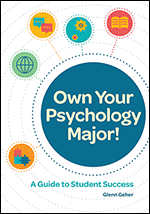
Own Your Psychology Major!




Chi Wang, APA Books Marketing Manager: Welcome to APA Book Talk, the podcast about the latest psychology books from the American Psychological Association.
It is our pleasure today to have Dr. Glenn Geher in this episode to talk about his new book, Own Your Psychology Major! He is professor of psychology as well as founding director of evolutionary studies at the State University of New York at New Paltz.
Welcome, Glenn.
Glenn Geher: Thank you so much for having me on the show. I'm always glad to talk about my work, and this particular book, I think, is really special for me in a lot of ways, because it's a compilation of the advice and guidance that I have given to psychology students pretty much going back to the 1990's.
I do a lot of things as the professor of psychology at the State University of New York at New Paltz. I've always seen developing students as primary. You know, I take that very seriously.
For eight years between 2009 and 2017, I was the department chair. The department chair, while a lot of people will say all kinds of things about that position, that it's complicated, that it's difficult, is also an amazing opportunity to really reach a lot of students directly and help shape their future in a positive way.
So when I was finishing up my term as department chair, I said to myself, Gosh, I really got to put this on a book. I feel like I've met with so many students over the years and just because of my experience I had so much specific nuts and bolts kinds of guidance that has been beneficial for students and that I didn't know when I was a student back at the University of Connecticut a long time ago.
And so I wrote this book, trying to seize that opportunity, to provide a succinct, clear and accessible set of guidance and guidelines to help shape the future of psychology students wherever they are.
Chi: So what are the common things that psychology students wish they had known before they enrolled in a psychology program?
Glenn: Well, probably the number one thing that most psychology faculty anywhere would agree with is the fact that psychology students often go into the major or into the program thinking that psychology and psychotherapy are one and the same.
I certainly thought that when I was 18 years old and I went to my first psychology class, Introductory Psychology, fall semester in my freshman year. It was a giant room. 400 students were in there, one very smart seeming lady at the front who was putting up these transparencies and started talking about the chemical and electrical properties of neural transmission.
And the next class period, she started talking about statistics and how to compute standard deviation. I was so thoroughly confused as to what was going on. I feel like that's actually a pretty common experience.
So people delivering a psychology curriculum, we know that this is a large scientific-based field that is — really we think of it as the scientific study of behavior and behavior cutting across all species. It's not even dedicated to human behavior.
Some psychologists study rat behavior. Some study birds. Some even study insects, for instance. Let alone the idea of all psychologists being therapists.
So that insight that I developed slowly across my major, I was like, you know, psychology is not what I thought it was, that something that I feel like students now can benefit from understanding relatively early.
So one of the goals of this book is to start by saying, here's a bird's eye view of the field. Here's a bird's eye view of what the major in psychology is, and here are the many different areas and sub areas and pathways that exist within psychology generally defined.
Chi: So is it fair to say a lot of students feel overwhelmed when they start their first semester?
Glenn: Yeah, absolutely. I think that's very common.
One of the things that students regularly will run into is they will look at the curriculum and they will see statistics. It's usually these days a standalone class in the curriculum. There's usually an additional standalone class in the curriculum called research methods or something similar to that. And those two classes often do seem overwhelming to students.
And I think another problem is that initially, students don't really understand why they even have to take those classes. It's very common for a new psychology major to say, "Statistics? I went into psychology to get away from this kind of material. Why in the world I have to take this?"
So in my book, I kind of walked them through in several different ways. I walked the reader through that reasoning and explaining statistics is a basic part of the curriculum for a lot of good reasons. All behavioral scientists must understand statistics so that they can do their science, so that they can be consumers of research findings from other behavioral scientists, so that we can really make sense of and understand the research that comprises the field of psychology.
The other thing about statistics, is that it has lots of practical applications. And we think about we asked statistic-based questions all the time. A student who is studying for an exam might say to him- or herself, "Should I read the text book chapters with the next two hours of my time? Or should I instead go over my notes for the next two hours of my time?"
And then the question is, which one of those is going to on average likely lead to me doing better on the exam? That is a statistical question, and that is a research method, a logical question as well.
So in the book, I tried to use a lot of little examples like that that are highly relevant to a student's everyday life. So they see that the ideas in those classes, the ones that seem quite sciencey or potentially overwhelming, actually are not that difficult. They're not designed to be difficult, and those classes provide useful tools for understanding the human experience.
Chi: What will you say to those students when they had already enrolled in a psychology program so they don't have to study math again? Now they realized they have to because that's a very important part of this science. What will you say to them?
Glenn: Absolutely. You know, I have a senior student right now and she's a super bright student. And she's going into our grad program next semester. Yesterday she was in my office and she said, "You know, when I took your statistics class about a year ago, I hadn't told you that I had gotten a D the first time I took statistics a year earlier."
And she was like, "I was so frightened by that material and so not wanting to learn it." She essentially said, which was a compliment, "Your stats class kind of made me understand why I was learning it." And she said that made a really big difference in the way that she approached the class.
So what I tell students in terms of the statistics component of the major is a few things:
I promise you that once you understand this stuff, if you take this approach, you will see it as useful. You'll see it as applicable. You'll see it is applicable to questions in your own world and you'll understand your other classes.
When you hear some research findings, you'll have the skills to be able to challenge a finding or understand why a finding is important or why it is something that we should be making a big deal out of and so forth.
But the second thing, I guess, is the relevance part. You know, I try to underscore this stuff is relevant, I promise you. But the second thing that I tell students is it's easy. It is easy math. It looks scary. There's Greek symbols. There's formulas. It's got all that. But for students who take it seriously, come to every class, do the work and believe in themselves and meet with the professor.
If they have any speed bumps whatsoever, then that's exactly why professors have office hours. If you look at the math involved in psychological stats at the undergrad level, you're looking at 8th grade algebra. Sometimes college professors like to dress it up real fancy, but at the end of the day, it's accessible math that we pretty much know that you can do if you have made it into our program.
So I try to take away the scary component, and I try to underscore the relevant component.
Chi: So could you tell us what topics the book covers?
Glenn: The book kind of starts in the first few chapters by explaining what the curriculum is.
So the American Psychological Association or the APA sets up criteria for what an undergraduate psychology curriculum should be. And it's not arbitrary. It's very well thought out. And it largely takes the experience of lots of faculty from several different schools into account.
So the five basic goals are:
1 — you should develop a knowledge base. So any student in a psychology major should have a sense that psychology is not just therapy, but it's also the scientific study of memory. It's also the scientific study of learning processes. It's also the various ways that biology interfaces with behavior. It's also understanding human development and how that effects behavior. It's understanding the effects of culture on behavior and so forth. So the knowledge base is critical.
The second goal that the APA puts out is the scientific inquiry and critical thinking goal. So we want students to be active in their learning. We want them to have the skills needed to produce their own knowledge related to scientific psychology and to effectively consume and understand scientific psychology presented by others. So there's various classes related to that goal.
There's another goal, third goal, which is very important to myself and a lot of faculties — the ethical and social responsibility in a diverse world. Historically, psychology has been studied in a very limited way on very limited samples, largely in North America, largely on individuals who are between 18 and 25, of European descent, for instance.
There's been a huge push in the last 20 or 30 years to advance that. And to get beyond that and have psychologists study people on a much more diverse way from a diversity of backgrounds across the entirety of humanity and to use our research and our findings to try to advance what I'd like to call the greater good. We were trying to cultivate leaders in the future.
When you're 18, 19 years old, you don't necessarily think of yourself that way. But I'd look at them in the eye and I'm like, "Yes, you are a future leader. And this is partly why I need to make sure that you're getting this strong and clear sense of ethics and social responsibility."
The fourth goal that the APA puts out there is communication. We want our students to develop writing skills, which are absolutely critical, and speaking skills as well, because no matter what you do when you grow up, you're going to be doing both of those things. And the ability to get your ideas across clearly and effectively is critical no matter what you go into.
So that's the reason that the psychology curriculum will have you writing scientific research reports. That's the reason that several classes will have you give an oral presentation on a research project at the end of the semester. It's because when you grow up, we want you to have those communications skills because they will benefit you.
Goal number five is what's called the professional development goal. We really want students to have the understanding, "What are the different pathways? What are the different careers and how does a student get there?"
So partly there are things in a psychology curriculum that speak to professional development. There might be a career in psychology course. There might be an internship class or multiple internship classes.
I'm always encouraging students to take advantage of those classes. I see time and time again that students who take advantage of those classes end up getting jobs, getting into graduate programs.
To some extent this book is like laying out these goals as they relate to the psychology major. And then the later chapters are really specific. It's nuts and bolts. Now you understand why the psychology major is what it is and what the different goals are that we're trying to achieve in giving you this education. How can you make the most of it?
So I have chapters on going above and beyond and ways that you can do that. Meeting with your professors outside of class, taking advantage of research opportunities, taking advantage of internship opportunities, taking advantage of opportunities to get involved in your academic community.
Any psychology department is a community. And there are student leaders within that community, such as student officers and clubs that are connected with the psychology department, which exists at most universities. Students who take advantage of those opportunities and get involved in those clubs and work in collaborative fashion with other students and with faculty on events and activities that advanced the goals of the psychology experience for the community, time and time again, those are the students who, 10 years later, are on a real strong path to success.
I'd say this book is about laying out the ground work, even what I like to call the bird's eye view of the major and then giving lots and lots of nuts-and-bolts, step-by-step guidance on what can you do so that you can make sure that you're the student who takes the psychology major and is nothing but successful at the end of it.
Chi: I see. So I want to go back to one of the goals that you just mentioned, which is ethical and social responsibility. I noticed that you decided to present that topic before all the other goals in the book. I just want to know why is this topic so important?
Glenn: Starting with that particular content area was kind of a decision to put the entire psychology educational experience in a broader perspective.
This book is about developing you, the student. But partly this book is kind of giving the message that you, the student, are part of something bigger, and we're all part of something bigger. We're part of a larger community. And a critical aspect of what we're trying to do in our education is to cultivate a community-oriented mindset.
We really are at a point right now that the world is not perfect, and we really need future leaders who think in ways that are not just self-serving but think in ways that are about what I can do, how I can do my part to help make this better.
In the United States right now there are major political divisions, and any adult would agree. This is a real problem right now. We really need to cultivate the next generation of leaders for their own good and for our greater good to think, "What can I do? What's going to be my part? What is going to be my mark on helping improve that situation for the broader community, for our children and for the next generation beyond that?"
So that is in my own scholarship in my own thinking in psychology, that idea of humans as part of something bigger and pushing for the greater good is something that's been very important to me.
So when I saw that, that was one of the goals, one of their five basic goals, I said, "Well, let's start the book that way." In specific, this is one of the other questions you asked, "What specifically can students learn or take away to sort of help advance that?"
There are a lot of lessons in various aspects of psychology that, I think, have the capacity to advance an ethical worldview. Research on cross cultural psychology is classic that way. Most students have not been out of the country. Most students have been, maybe to Florida. That's been their experience.
In the American South, for instance, I'm currently leading a group of probably 10 to 20 students who are going to join me on a trip this summer to Chung Ching in China, which is a place where I've been teaching and will continue to teach in the next couple of years.
That experience of seeing how people, in a very different part of the world with a very different language in a very different history, deal with the same kind of issues in the same kind of problems that we deal with. That kind of cross-cultural experience is absolutely invaluable in helping people advance their own understanding of "What can I do to help make things better?"
You go to another country and you see how people organize groups, for instance, and see improvements that you don't see in your own country. You can bring some of that back and help integrate that into your own work. Cross-cultural psychology and cross-cultural experiences, I'd say, are extremely important. And this is partly why APA puts diversity into the goal related to ethical responsibility.
In addition to cross-cultural based learning and experiences, there are a lot of content-based lessons in a psychology major that really can benefit students.
As a quick example, some of most famous research in psychology is found in social psychology, specifically, research on the degree to which people will blindly obey authority. Famous research done by Stanley Milgram in the 1960's at Yale University on obedience to authority.
And the real short version of what he found was that if you put people in a situation where there's an authority who is telling them or telling you to do something that you know is ethically wrong but the authority is telling you to do it, people are very likely to actually comply. So people are very likely to comply with what an authority figure is saying, even if they know that the orders are ethically suspect.
In that specific study, people were ostensibly giving another person a shock, so it wasn't really an electric shock. But they thought they were giving an electric shock to someone who had a heart condition simply because the guy was not learning words correctly.
So when you step back, it's like almost bizarre what the people are being asked to do. But the meta message is that the majority of participants in that study blindly listened to the authority to the point that they really would have hurt that other guy and possibly actually killed him if the shocks were real.
So I think that any student who learns about that research, they usually pause. It usually leads to a conversation about whether they would do that themselves or not, which is always interesting and important kind of self-reflective activity.
But it also gives an insight into how powerful situations are and how ethical behavior often is the result not of dispositions of individual people, but a result of situations that we shaped, some of which will cultivate more ethical behavior than others.
So I feel like those kinds of lessons are so important for cultivating an ethical mindset in psychology students.
Chi: I noticed there's a chapter on careers and graduate schools. Can you tell us a bit about that chapter? More specifically, we want to know if you have any suggestions for undergrad students when they're about to choose an area to focus on.
Glenn: Yeah, absolutely. This is another misconception I had, by the way.
When I was a young undergrad 100 years ago, I thought there was one thing called the graduate school. I thought there was a psychology major, and then I thought there was something called graduate school. Now that I'm in the position I'm in, I realized how naive and limited that perception is.
In fact, the number of graduate programs that follow a psychology major is dizzying. There might be a dozen completely different kinds of programs that psychology majors might end up following depending on your interest, depending on the experiences that you've had.
For instance, if you've done a lot of research as an undergraduate student and you love research and that's really all you care about, then there's research-based programs. There are master's programs in psychology research. There are PhD programs in psychology research. There's PhD programs that are specific to research on particular topics, such as a social psychology, developmental psychology, personality psychology, perception, physiological psychology, there are neuroscience programs.
And then there's a whole bunch of other kinds of programs that are totally unrelated to advancing research in psychology. There's a lot of what I call "applied programs".
I would say, in my experience working at a state university, about 40 to 50 percent of our alumni from our program will go on and get their master's degree in some kind of applied field, mental health counseling, school counseling, Master's of social work, school psychology.
These are some of the most common ones. These are usually two- or three-year programs. You can find them in any state, and there are very clear jobs, sometimes with the state, sometimes with county or another municipal agency, sometimes in private practice in all of those fields.
And so that chapter about graduate programs and careers walk students through "What are the different kinds of graduate programs out there? How can you set yourself up to apply for them? What is a timeline so that you can make sure that you apply in a way that you're not missing a year just because you didn't know the timeline?"
So I walked students through that as well. What are the careers? How do you get into those careers? And if you're in those careers, what you do on a day to day basis?
So I really try to be very, very nuts-and-bolts specific in that chapter, as well as pretty comprehensive in terms of the many different kinds of graduate programs and career paths that follow.
Chi: I also notice that you provided a cheat sheet in the book and the 10 take away points at the end of the book. Can you tell us a bit more about that?
Glenn: Sure. You know, this is my 10 takeaways.
I'm not sure if every psychology professor would necessarily agree, but this is, I think, consistent with themes that I've presented the students without the book or throughout the book. I have these ten bottom lines. I would tell my students this, "When you're writing, write assuming that your reader has at least slight attention deficit issues."
And I say that because A) a lot of people do. And B), if you take that approach to writing, you keep reminding your reader what he or she is reading or what your main points are. And this last chapter was kind of designed in that vein. It was kind of like, OK, so here's in brief recapitulation of everything that we've sort of gone through.
So briefly, #10 — Psychology is huge. That's a lesson that I think students really can benefit from off the bat — understanding all the different fields of the discipline.
#9 — Applied psychology is more than just therapy. So while there is therapy and therapy is a big area that follows from psychology, it's not the only thing that follows. And it's not even the only kind of applied work that follows from a psychology undergraduate education. So students need to realize what those other options are. What is industrial psychology? What is organizational psychology, what is health psychology, what is educational psychology and so forth?
#8 — is that a good education extends beyond the classroom. So one of the themes that comes out again and again in this book is, you know, get involved outside the classroom. There were so many opportunities at any university. You know, your student paying money for opportunities and a lot of ways. There's going to be clubs. There's going to be activities. There should be research opportunities. There should be internship opportunities, volunteer opportunities. Every one of those above and beyond kind of experiences has the capacity to really help advance a student.
#7 — I have is that psychologist do science. Students need to realize that from the get go. Why am I taking statistics? Why am I learning about neural activity? Why am I learning about research methods designs? Everything that we know about the behavioral sciences, we know because scientific researchers have studied these things and have produced results.
#6 — psychologists produce and analyze a lot of numbers and they can critically evaluate all kinds of statistics. So partly being an expert in psychology, and a lot of people don't realize this off the bat, is being an expert in statistics.
Some of our best alumni are in offices of research, such as my student, who is the director of research at Pace University. And he just is using his statistical background all the time. And it's a very critical job for the university.
Realize that you're going to be doing a lot with numbers and don't be afraid of it. You know, I think students who embrace that really do well.
#5 — Psychology is not just about humans. The nature psychology extends beyond humans. A lot of the best psychologist such as B. F. Skinner have studied exclusively nonhumans. Skinner studied rats, goldfish, and pigeons in his research as an example. So behavior is actually broader than just understanding human behavior in particular.
#4 — Psychologists look for what all human share, human universals. You know, we talk about diversity quite a bit, and diversity is very important. But sometimes we forget about the importance of the shared aspects of the human experience.
In so many of your psychology classes you'll be learning about the shared aspect of the human experience and about human universals. And that's a very important part of a scientific understanding of psychology.
#3 — I have is humans are extremely sensitive to their environment, and this is something that students will learn in a broad array of their classes, such as developmental classes, social psychological classes, classes related to abnormal or psychopathology. This is a very important lesson in understanding how the environment affects human behavior across the life span is another critical, large scale piece of information students should get.
#2 — is really about personality psychology. Each person is an individual. Each person has his or her own unique environment that he or she has encountered. People have their own traits that are affected. I have a broad array of factors, and a lot of times two different people will see something very differently.
So when you see conflict or arguments between two people, a lot of times they're arguing because they're seeing the situation entirely differently. And that realization can really be helpful in understanding conflict between individuals and between groups.
The appreciation of everyone as an individual is my final one. It ends where the book starts. It is that psychology can help us leave a positive mark on this world. It's up to the future leaders to make this world a better place. And hopefully this book provides students with helpful guidance.
On that point, the final few sentences I have in the book, I say, it's up to you to own your education and use it to leave a positive mark. After all, you only get one chance. Make it count. So this is kind of like a final message that I'm hoping students will take away from the book.
Chi: I see. And I love that. You just mentioned that this book is geared toward students. Can you see this book be used in the psychology classroom by an instructor, a teacher or a professor?
Glenn: Yeah, I think so. It's designed to hit anyone with an interest, with a vested interest in the psychology education process.
So while I'm sort of speaking to students directly, I also speak in many cases to faculty who are putting together a curriculum. So if you're putting together a psychology curriculum, you should understand what the APA guidelines are. You should understand why those guidelines are what they are, and you should understand how cultivating students is really at the core of our work. And every aspect of the curriculum should bear on that.
So I do think that it should be useful for psychology faculty.
I feel like advisors will find it useful as well, because it really is advice. You know, it's really advice on how to make the best out of your program, what steps you should take to get into different graduate programs and careers and so forth.
And I do think that it might make for an interesting ancillary book given out in introductory psychology classes. It's because anyone who's starting out in the psychology major, they usually give you this, like 500-page, 20-chapter, massive looking introductory textbook, which is fine.
I know there's a lot of good books out there, and people put a lot into it, but my book, Own Your Psychology Major, it's less than 200 pages. It's friendly, it's accessible, and it's almost like a compendium to that big, scary book.
It's kind of like this is why you're learning that stuff. It's kind of like an interpretation. It's almost kind of like a translation of that in simple, in accessible terms that are really speaking more directly in a narrative fashion to students.
So I'm hoping that people will find it useful as a book offered an introductory psychology classes as well.
Chi: Thank you again, Glenn, for joining us today.
Glenn: Sure, thank you so much for having me on the show.
Chi: I want to thank everyone who's listening to this episode. You can learn more about Dr. Glenn Geher's book, Own Your Psychology Major! at www.apa.org/books.
We look forward to the next episode of APA Book Talk!