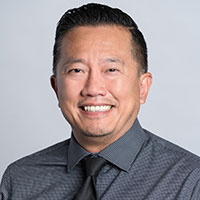
 Liu is currently a professor of counseling psychology at the University of Maryland.
William Ming Liu, PhD
Journal of Counseling Psychology
Background
Tell us a bit about your background: What is your area of research? What is your most recent journal-editing experience?
I am a first-generation college student and an Asian American raised by immigrant parents. As the oldest of three boys, I started working in my parents’ diner in Southern California at the age of 7 years. I funded my college education with the help of work-study programs and Pell Grants. I certainly drew on these lived experiences as I developed my scholarship on social class and classism, men and masculinities, and systemic racism and white supremacy. I feel privileged to serve as a professor of counseling psychology and chair of the Department of Counseling, Higher Education, and Special Education at the University of Maryland. As a counseling psychologist, I worked on developing theories and frameworks to understand how complex systems of white supremacy, anti-Blackness, and racial capitalism, for instance, work in people’s lives; how these systems affect therapy and people’s mental health; and how people can work toward social justice and recognizing others’ humanity.
Before my start as the editor for the Journal of Counseling Psychology, I was an associate editor for and then the editor of Psychology of Men and Masculinities. During my time as editor of Psychology of Men and Masculinities, we changed the name of the journal (from Psychology of Men and Masculinity to Psychology of Men and Masculinities) to better reflect the journal’s focus on theories and research on various masculinities rather than a single form of masculinity. We published a special issue addressing health and masculinity among military populations and a special issue on fathering. I also served on editorial review boards, most recently for The Counseling Psychologist. For me, being a reviewer for other journals helps me connect with a wider range of research and scholarship in various fields and understand what questions are being asked and which communities are being served.
Priorities
Briefly, what are your main priorities? For example, how will you grow readership, what type of scholarship would you like to see in the journal, and what kind of content are you hoping to attract?
The Journal of Counseling Psychology is the flagship journal for the profession and sets the standard for research and theory for counselors, mental health practitioners, and other psychologists. The journal has a long history of advancing research on identifying and elevating people’s strengths and positive development. It is also known for promoting mental and physical health; well-being and resilience; the psychotherapy process and outcomes; theory and research on vocational and work psychology; education and training; and work on eradicating systems of injustice, dehumanization, and marginalization. This means that the Journal of Counseling Psychology is often at the forefront of publishing on critical mental health issues from communities affected by systemic racism and oppression. Authors published in the Journal of Counseling Psychology have also advanced psychologists’ understanding of and practices around liberation, justice, and humanization; developed theories; and applied these concepts to practice.
As the editor of the Journal of Counseling Psychology, I will continue the journal’s enduring connection to the core areas of the field. I want the journal to amplify works that advance understanding of anti-Black racism, transphobia, white supremacy, sexism, classism, and other forms of systemic marginalization that affect mental health and well-being. I would like authors to apply a critical understanding of intersectionality, liberation, radical healing, and strength-based approaches to leverage psychological sciences for the purpose of building healthy communities.
Journal importance
Why is this journal important for the field? What is its relevance to society/public health? What are the hot issues in your area right now?
Psychologists need to continue identifying and recognizing the systems that have created and amplified many mental health problems for individuals and communities. It is also important for psychologists to examine the ways that people are doing more than coping and surviving. How, for example, are Black and non-Black people of Color thriving and living? How have people’s ways of knowing about the world endured for generations? As the editor of the Journal of Counseling Psychology, I would like to see the journal continue to publish works grounded in the epistemologies of Black, Indigenous, Latino/x/e, Asian, and other communities of Color. In addition to psychotherapy traditions and methodologies, many of which I believe are critical in helping to advance the field, scientific and practice concepts need to be expanded to include healing, learning, teaching, and development rooted in the knowledge and lived experiences of Black, Indigenous, Latino/x/e, Asian, and other people of Color. The full array of onto-epistemologies will be needed as people confront societal challenges like gun violence, climate change, anti-immigrant hostility, anti-Black racism, misogyny, and other inequities. Communities are regularly displaced, dispossessed, and exploited, and compelling and rigorous qualitative and quantitative research is needed to move people toward a more humanizing world.
Challenges
What challenges, if any, lie ahead for the field?
One of the main challenges for those of us in the field of counseling psychology is the translation of our research, methods, and findings to our communities. One of these communities is the community of professionals—researchers, academics, and others. We need to be talking about the implications of our science so that it can be useable in practice. Additionally, we need to do better with broad community engagement and outreach. We need to engage with the people from whom we learn, and we need to exchange knowledges with racially and ethnically diverse communities. How might we work with communities, for example, to humanize research and practice? How might these kinds of knowledges inform and transform our science? As a field, we see ourselves as scientist-practitioners, which means we are constantly moving back and forth between our scholarship and how it is used and regarded by our communities. Building trust and confidence between researchers and the communities of which we are a part is such an important process.
Plans
Do you have plans for a special issue or changes to the editorial process? Have you introduced or are you planning to introduce any changes?
One new addition to the editorial process has been the inclusion of editorial fellows. This is an incredible funded opportunity supported by the American Psychological Association to help early career professionals enter the journal editorial process. I intend to maintain that program. The journal editorial board and I are also envisioning a program that would invite graduate students and their institutional mentors to participate in the editorial process as well. We hope that this program will create a more expansive base of critical reviewers for the journal. As the editor, I also intend to use social and other forms of media to present research published in the Journal of Counseling Psychology. This would help researchers talk about their work outside of academic spaces, in ways that reach public audiences. I also hope during my tenure as editor to publish several special issues. One special issue I would like to do would focus on critical analyses of theories and methodologies—in particular, on the topic of critical racial theoretical perspectives. In it, authors could explore theories and methods in ways that reveal how systemic racism is promulgated in the current science and practice.
Date created: July 2023