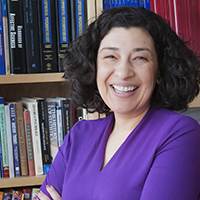
 Pérez-Edgar is a McCourtney Professor of child studies and professor of psychology in the Department of Psychology at The Pennsylvania State University.
Koraly Pérez-Edgar, PhD
Developmental Psychology
Background
Tell us a bit about your background: What is your area of research? What is your most recent journal-editing experience?
I am a developmental psychologist. My work is often seen as somewhat interdisciplinary because it is informed by and can speak to work in clinical, cognitive, and neuroscience fields. However, I often think of those components of my work as my second language. My first language is development, as I always come back to questions centered on the underlying mechanisms that help shape observed trajectories of change over time. I embrace this approach because I think it provides insight into such a broad range of questions—plus APA once identified me as an example of what a developmental psychologist is, so I can’t shirk the label now!
The specific focus of my work is early temperament—especially negative reactivity in infancy and behavioral inhibition in childhood—and its impact on socioemotional development. In this work, I tend to use behavioral observation, eye tracking (stationary and mobile), attention tasks, and biologically based measures (electroencephalography and magnetic resonance imaging). This work reflects my own development as a scientist and my training under Jerome Kagan at Harvard University and Nathan A. Fox at the University of Maryland.
My editing experience began in 2011, when I started as an action editor for Emotion. I became an action editor for Child Development in 2019, but I stepped down from both positions to become the editor of Developmental Psychology. In those eight years, I helped colead special issues at Child Development, Depression and Anxiety, and Infancy.
Priorities
Briefly, what are your main priorities? For example, how will you grow readership, what type of scholarship would you like to see in the journal, and what kind of content are you hoping to attract?
My main goals are to highlight the highest quality research in the field and to enhance the journal’s ability to reach out to and communicate with the broadest possible readership. Relative to comparable journals, Developmental Psychology has distinguished itself by traditionally having a broader portfolio, publishing work addressing issues across the life span and across species. Thus, it is well-placed to be the central interdisciplinary outlet for developmental science, highlighting interdisciplinary work within the field and serving as a hub for interdisciplinary conversations across fields. I want the journal to be a place for researchers at any point in their careers to communicate their science and contribute to the expansion of the field by embracing new questions and approaches to developmental work.
Journal importance
Why is this journal important for the field? What is its relevance to society/public health? What are the hot issues in your area right now?
Developmental psychology is a hub field that addresses a wide breadth of questions across multiple levels of analysis, using sophisticated methods applied over time. Thus, the journal represents an opportunity to speak to multiple scientific communities. Many of the most pressing questions from scientific and policy perspectives rely on interdisciplinary approaches that take into account multiple embedded mechanisms and agents of change. Developmental psychologists are often uniquely suited to tackle these types of questions.
Challenges
What challenges, if any, lie ahead for the field?
For the field as a whole, the challenge is to fully capture development in all of its various forms and functions. To date, developmental psychologists have had only a limited view, in that much of their work focuses on thin slices of humanity (Western, relatively rich, and White) engaged in thin strips of activity (often in the lab, removed from context). Development science is now pushing to include more experiences in the context of place and culture and to expand the questions asked regarding the mechanisms of development and change. This necessitates shifts in which questions are considered central to the field, which methodologies are judged to be rigorous, and which voices are amplified in conversation. The journal’s role is to provide a forum and at times mediate these conversations and their cultural and scientific shifts.
With respect to the publication process, the last few years have laid bare tensions in the scientific publication model, including its reliance on communities of scientists that regularly contribute through both publication and manuscript review. One component is visible and rewarded, whereas the other often is not. Given the multiple pressures people are under, the review process has become more difficult. I am not sure that I have a ready solution to the problem: Collective problem-solving will likely be needed to address these concerns. Part of the challenge is to find ways to diversify and broaden the range of voices included throughout the scientific process, from study to publication. Relying on scientists to continue to perform difficult and time-consuming work with few supports directly hinders this goal.
Plans
Do you have plans for a special issue or changes to the editorial process? Have you introduced or are you planning to introduce any changes?
These are still the early days of my editorship, but additions to the journal are already underway. First, the journal now publishes registered reports. This mechanism will allow researchers to receive a rigorous review of their work and make changes as needed before they launch their study. Conditional acceptance at the very start of a project can help reassure researchers that they can concentrate on conducting the best science without being pressured to reach a specific but ill-defined finding. To further support open science, the journal has also implemented the Level 2 Transparency and Openness Promotion (TOP) Guidelines, and authors are asked to specify contributions through the Contributor Roles Taxonomy, or CRediT. Further, the journal will participate in the editorial fellows program, which supports early career researchers from historically marginalized groups. They will participate in the editorial process as action editors during the fellowship period and may eventually move into more permanent action editor roles.
Two special calls are planned for later in 2022. The first will be for an issue focusing on the long-term consequences of events occurring during prenatal development that affect trajectories into childhood and adolescence. The second will be for a special section dedicated to the work of Jerome Kagan that will consist of articles critiquing, building on, and contextualizing his research. My next goal is to create cross-journal special issues that can focus on a shared topic, with articles illustrating different approaches from the journals’ specific subfields. Another idea is to publish an invited special issue for which a significant question of interest is posed and interdisciplinary teams of psychologists, anthropologists, economists, and others weigh in on how people in their field view the issue. The goal of such an issue would be to generate discussion and broaden the scope of researchers turning to the journal. For example, the long-term effect of early academic interventions (e.g., Head Start) could be assessed through different lenses across disciplinary boundaries. The journal can showcase multiple perspectives on the form and function of effective early interventions.
Date created: July 2022