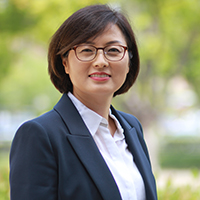
 Kim is a professor in the School of Education at UC Irvine, with courtesy appointments in language science and Asian American studies.
Young-Suk Kim, EdD
Journal of Educational Psychology
Background
Tell us a bit about your background. What is your area of research? What is your most recent journal-editing experience?
I grew up in South Korea, where I briefly taught in high school, and then moved to San Francisco, where I taught in elementary, high school, and community college. I later attended Harvard University for my doctorate, where I worked with Catherine Snow on language and literacy development. That early experience teaching children and adults, and later studying literacy development across the English, Korean, and Spanish languages, still shapes how I think about research questions.
I’m drawn to work that takes children’s full linguistic and cultural backgrounds seriously rather than treating English-speaking contexts as the default lens for understanding how children learn to read and write. My research focuses on reading and writing development across languages and on building and testing theoretical models of reading and writing that hold up across different linguistic and cultural contexts. These models have formed the foundation for my work on language and literacy instruction and intervention.
In addition, I was editor-in-chief of Scientific Studies of Reading from 2021 to 2026, and I served as an associate editor of the Journal of Education Psychology (JEP) from 2013 to 2020, so I’m returning to this journal with a real appreciation for what makes it work.
Priorities
Briefly, what are your main priorities? For example, how will you grow readership, what type of scholarship would you like to see in the journal, and what kind of content are you hoping to attract?
My priority is that JEP publish work that moves understanding forward and is not just technically well done, including holding a high bar on theory–method–analysis alignment, clear reporting of samples and measures, and appropriate data-analytic strategy, while also actively welcoming a wider range of contexts. I am seeking more submissions grounded in diverse linguistic and cultural populations, more work that takes theory-building seriously as a contribution in its own right, and continued strength in intervention and meta-analytic research.
Journal importance
Why is this journal important for the field? What is its relevance to society/public health? What are the hot issues in your area right now?
Educational psychology stays close to real-world practice. It shapes classroom instruction and intervention, community education, teacher development, policy, and public understanding across a wide range of topics, including reading, writing, and language; cognition; science, technology, engineering, and medicine; history; and social studies, civics, and democratic thinking. JEP has been the leading outlet for that kind of psychologically grounded education research for decades, and I take that seriously. Currently, some of the liveliest issues in the field involve how we build generalizable knowledge across languages, cultural contexts, and both single-case and group designs, rather than assuming findings from one population travel automatically to another. Artificial intelligence is also on my mind, both as a tool reshaping how we do research and as a topic educational psychology needs to be studying directly, given its growing footprint in classrooms.
Challenges
What challenges, if any, lie ahead for the field and/or the journal? What issues do you see as important for the field to address more broadly, such as replicability, publishing concerns, communicating science to the public, and translating psychological findings to policy change?
Reviewer capacity remains a growing challenge. As submissions increase across the field, finding enough qualified reviewers who can work quickly gets harder every year, and this issue is not unique to JEP. More broadly, I think the field still has work to do on generalizability: making sure our evidence base isn’t quietly built on a narrow slice of contexts, languages, and populations while claiming broader relevance. Also, we owe the public clearer translations of what we find—not just publishing rigorous work but also making sure it’s legible to teachers, policymakers, and families whose lives it’s meant to inform.
Advice
What advice would you offer new authors hoping to publish in the journal? What are you looking for in a manuscript?
Ground your study in current theory that actually motivates your specific questions. Draw a clear line from your rationale to your design to your conclusions. Be explicit about your sample and context: Report the languages spoken and age or grade level, and don’t treat English-speaking samples as the unmarked default while flagging everything else. Report reliability evidence for your own sample rather than leaning only on prior studies, and make sure your conclusions don’t outrun what your design can actually support. Also, don’t assume methodological soundness alone will get your paper accepted. The journal is seeking work that meaningfully advances how we understand something, not just work that checks every technical box.
Date created: September 2026