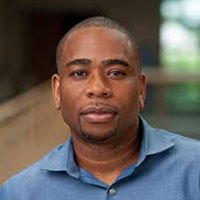
 Coker is an assistant professor of psychology at Connecticut College.
Kendell L. Coker, PhD, JD, and Ryan P. Kilmer, PhD
American Journal of Orthopsychiatry
 Kilmer is a professor of psychology and chair of the Department of Psychological Science at the University of North Carolina at Charlotte.
Background
Briefly, what are your main priorities? What type of scholarship would you like to see in the journal, and what kind of content are you hoping to attract?
Kendell L. Coker: I am a clinical psychologist with a specialization in forensic psychology. I am also an attorney. My research focuses on trauma, violence, and juvenile and criminal justice involvement—particularly in Black and Brown marginalized communities. I also have an interest in the importance of mental health services access and the impact of systemic racism on outcomes for minoritized populations. These interests are driven by personal experiences growing up in low-income housing in Brooklyn, New York. I have fond, positive memories of my upbringing, but I was also exposed to the topics I have mentioned, which led me into the field and these areas of research. In an ironic, fortuitous twist of fate, it was an article in the American Journal of Orthopsychiatry (AJO) that served as the foundational article for my dissertation. The article piqued my interest in AJO as a journal that publishes articles that speak to my experiences as a youth, and I appreciated the journal’s publication of studies that deeply explored the psychological harms that some members of marginalized communities face. Now, 20 years later, I am the coeditor of this journal. Prior to serving as the coeditor, I served on AJO’s editorial board. I have also served on the American Psychological Association’s (APA’s) Ad Hoc Committee on Legal Issues.
Ryan P. Kilmer: I am a child clinical-community psychologist, and I engage in applied research and evaluation that can help to (a) identify and understand the factors and conditions that influence the development of children at risk, (b) address the needs of children and families involved in service systems (e.g., mental health, education, child welfare), and (c) guide improvements in how programs and systems function. Across these efforts, a key objective has been to enhance the services and supports provided to children and families, many of whom have been marginalized or underserved, have experienced adversity, or have faced socioeconomic disadvantage. My research is driven by the goals of application and utility: I do this work to achieve something for the broader good. The values that guide my research and evaluation also lead me to value AJO and the coeditor role. I am a former president of the Global Alliance for Behavioral Health and Social Justice and a current fellow of the Society for Community Research and Action, the Society for Child and Family Policy and Practice, and APA. I served on AJO’s editorial board from 2011 through June 2022, when Kendell and I assumed coeditorship. I also serve on two other editorial boards; was previously a co–guest editor of special issues of AJO, the American Journal of Community Psychology, and two special sections of AJO; and was the lead editor of two books (published by APA and Sage).
Priorities
Briefly, what are your main priorities? What type of scholarship would you like to see in the journal, and what kind of content are you hoping to attract?
Kendell L. Coker and Ryan P. Kilmer: We both resonate with the Global Alliance for Behavioral Health and Social Justice’s (AJO’s parent organization) and AJO’s value-guided priorities and emphasis on action across key domains of social justice, policy, prevention, social and cultural context, human rights, and practice. In addition, we are invested in the journal as a key source of innovative, interdisciplinary, and applied scholarship.
Given that AJO is committed to publishing articles that have practical implications for behavioral health practice and policy and social justice, we have several priorities. We want to attract rigorous research—the quality of the science is critical. Beyond that, cross-cutting issues affecting marginalized and minoritized populations are a priority. Put another way, we want to attract content on problems that threaten basic and fundamental rights across the country and around the world. For example, we welcome submissions on the effects and consequences of racism and discrimination, immigration and forced migration, firearm and other types of violence prevention, reproductive rights, access to health and behavioral health care, global mental health, justice reform, the experiences of Indigenous peoples, the enhancement of wellness, and interventions or strategies that promote advocacy and empowerment for minoritized communities. Although this is not an exhaustive list, these are the types of research topics that we are committed to seeking out and publishing.
APA recently recognized its role in perpetuating racism and discrimination. It is important to remind people in the profession and in other disciplines that although such acknowledgments are positive steps in the right direction, much work remains to be done. Research that draws attention to this reality is needed, as is work that examines efforts to address structural barriers to well-being and to care. The results can then inform initiatives that improve the degree to which systems and practices are culturally and contextually sensitive and appropriate.
Journal importance
Why is this journal important for the field? What is its relevance to society/public health? What are the hot issues in your area right now?
Kendell L. Coker and Ryan P. Kilmer: AJO is a key source of innovative and applied scholarship that holds direct relevance to issues, interventions, and policies related to the broader good, particularly of those who have been marginalized and minoritized in U.S. society and abroad. As an APA-published journal, AJO’s authors and audience include scholars, practitioners, and other professionals from multiple areas of psychology, social work, counseling, education, nursing, law, psychiatry, sociology, anthropology, public health, and other disciplines.
AJO is a critically important outlet for interdisciplinary research reflecting the intersections of social justice, behavioral health, human rights, practice, and policy. We hope the journal will serve as a prime home for work examining how psychologists, health care professionals, attorneys, educators, advocates, practitioners, policymakers, and other stakeholders can develop more responsive systems and settings, grow the connection between research and action, remove barriers, amplify community voices, and facilitate social justice.
In today’s society, a number of legislative and policy efforts threaten social justice and undermine equity, diversity, and inclusion (EDI) initiatives. Some coordinated efforts at the national level will undoubtedly affect research and practice. Threats to cut funding and stifle the intellectual freedom to explore important societal issues are significant problems. As editors of a journal dedicated to social justice, the principal publication of the Global Alliance for Behavioral Health and Social Justice, we will not allow these anti-EDI efforts to prevent us from seeking out and disseminating studies that emphasize the practical implications of promoting social justice and behavioral health in relation to topics that disproportionately affect minoritized communities. This challenge must be met at AJO and in the field in general.
Social justice is also about equity. We are unapologetic in saying there is nothing equitable about researchers conducting their research on communities rather than with and for the benefit of the communities. Thus, individuals and communities should be the primary beneficiaries of scientific research. Ideally, researchers will engage with community members to guide their aims and methods. It is also important for researchers to share the results of their research with the community in a way that creates a space for community members to amplify their voices. As the editors of AJO, we are focusing our efforts on strategies that put such values and goals into action. AJO is a social justice journal, and these are important considerations that we want the field to reconcile.
Challenges
What challenges, if any, lie ahead for the field?
Kendell L. Coker and Ryan P. Kilmer: One major challenge is the ongoing targeting of science, research, data, and higher education by a host of sources nationally. It increases the weight on and responsibility of authors, editors, educators, and others to ensure that work is conducted ethically, that its story is communicated clearly and effectively, and that the dots between study results and their applied implications are connected appropriately. It is imperative that the degree to which data and research are linked to consequential real-world impacts is improved and strengthened.
An additional significant challenge relates to the accessibility of research, which may be limited by paywalls, jargon, or the less digestible framing of most journal articles. The field needs to enhance its capacity to communicate findings to policymakers, the press, and the general public. To this end, research intended to benefit groups or communities should reach them.
Unfortunately, there are many obstacles to disseminating research in an equitable manner. For instance, access to articles can be cost-prohibitive. Although open access is a potential solution, it still relies on funding, and disparities exist in who gets funded. A significant dilemma is at play here: Journals (and publishers) need money to be sustainable, but where does that money come from if the information is made too accessible? In addition, to increase accessibility, disseminated research should be relatable rather than reflect the overuse of jargon. In this vein, there can be important benefits in using person-centered language rather than focusing solely on effect sizes, relationships between variables, and the like. Further, researchers need to find creative ways to bring research to communities as opposed to expecting communities to know where to look for and find research. Some researchers put considerable effort into finding a community for recruitment and data collection but put forth substantially less effort and intentionality into sharing the learned information and its implications with community members. This is where social media and improved community partnerships might offer fruitful solutions. To be clear, we know that strong academic–community partnerships that cocreate research and research products exist. There are also organizations, journals, and academics maximizing the use of social media and finding creative ways to communicate their work to communities (e.g., summary sheets, community meetings, podcasts). Nonetheless, talking about social justice issues such as research accessibility should not stop merely because progress has been made. The more the issues are discussed, the more researchers can strive to find new innovative ways to maximize equitable access.
Plans
Do you have plans for a special issue or changes to the editorial process? Have you introduced or are you planning to introduce any changes?
Kendell L. Coker and Ryan P. Kilmer: We are following multiple strong editorial teams, including Oscar Barbarin and Gary B. Melton and Jill D. McLeigh and Will Spaulding. We seek to uphold the journal’s distinguished reputation and legacy and will continue to emphasize the need for submitted work to have clear implications for behavioral health practice, policy, and social justice.
The Global Alliance for Behavioral Health and Social Justice recently celebrated its 100th anniversary. In honor of this occasion, AJO released a special issue titled “Looking Back, Moving Forward.” The title represents the hope for a future in which everyone’s behavioral health is promoted through a social justice framework. This special issue’s perspective is that lessons learned from the past can be applied to create a better future.
AJO is also releasing a special issue titled “Leveraging Inner Transformation for Social Transformation.” This issue focuses on how mindfulness can foster empowerment, social action, and critical consciousness.
More broadly, we are open to special issues or special sections that spotlight the priority topics we already identified; other topics reflecting the manifold challenges facing societies, communities, and individuals; and any threats to social justice that may arise in the future.
Date created: January 2025