Laura K. Taylor, PhD
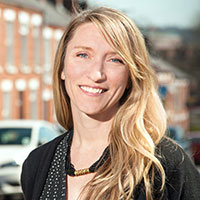 Taylor is dedicated to fulfilling the journal’s goal of promoting positive peace across the social ecology.
Background
Tell us a bit about your background: What is your area of research? What is your most recent journal-editing experience?
I have a dual PhD in psychology and peace studiesopens in new window from the University of Notre Dame. I research how political violence affects children, families, and communities, focusing on their prosocial and constructive responses to adversity, such as intergroup helping, collective action, and peacebuilding. I work in both conflict-affected societies and lower and middle-income countries. Since 2017, I have led the Helping Kids! labopens in new window.
I am currently an associate editor at the Journal of Research on Adolescence, and I am in my final year as the editor of the Social Psychological Review, a biannual publication of the British Psychological Society’s Social Psychology Section. In the recent past, I have been an associate editor for the Journal of Social and Political Psychology and on the editorial board for Peace and Conflict (PAC). I also serve in leadership of a number of international associations; I am an elected member of the Governing Council of the International Society of Political Psychology, and represent the Society for Research on Adolescence to the International Consortium of Developmental Science Societies.
Priorities
Briefly, what are your main priorities? For example, how will you grow readership, what type of scholarship would you like to see in the journal, and what kind of content are you hoping to attract?
I am committed to APA’s aim to advance psychological knowledge to benefit society and improve people’s lives. Aligning with Division 48’s mission, the journal aims to promote positive peace across the social ecology, ranging from the individual and interpersonal to broader, cross-national relations. This open, inclusive, global approach to communicating the science and practice of peace psychology will guide me as editor of PAC.
I plan to expand the digital future in three ways. First, I will continue PAC’s practice of publishing early online-first articles. This speed is essential for cutting-edge research; it also increases citations, which benefits both the authors and the journal. Second, I will work with the library team to support authors in asking their institutions to subscribe to PAC. Third, I will develop a strategy for online uptake, which will include social media (e.g., asking authors to provide tweets for accepted papers) and integrating PAC content into syllabi so that students are familiar with the journal and may return to read other articles.
Given my guiding philosophy and the aims of the journal, I will seek and cultivate submissions that emphasize an inclusive and diverse approach to peace psychology. This approach will include trying to establish data on submissions and publications in PAC by authors from the global South, with non-WEIRD (Western, educated, industrialized, rich, democratic) samples, and minoritized groups. I envision the journal as an outlet to amplify those voices and experiences, bringing them to a global audience.
PAC is also actively seeking submissions from activist scholars and practitioners engaged in peacebuilding. For example, our first special issue, which I will coedit with Boaz Hamieri and Samantha Moore-Berg, focuses on “Putting Science to Work for Peace,” in memory of Emile Bruneau and his incredible legacy of working in partnership with local communities to develop lasting peace.
Journal importance
Why is this journal important for the field? What is its relevance to society/public health? What are the hot issues in your area right now?
Peace psychology is increasingly diverse. For example, there is an increasing focus on integrating neuroscience, zooming in on what can be learned from a more fine-grained approach to the human experience. At the same time, informed by peace science, our field is also zooming out to study cross-national patterns using macro data in multilevel models. These complementary approaches are positioned alongside rich, in-depth qualitative work that uses creative methods to allow participants and communities to name their realities and peace practices. PAC aims to be a home to these conversations and perspectives on peace psychology.
Challenges
What challenges, if any, lie ahead for the field?
One of the challenges for the journal is how to increase open science practices in a way that also respects and recognizes the diversity of voices, methods, and prior experiences of our authors. For the field more broadly, there is often a gap in those with access to global academic publishing and content. PAC will continue to be active in opportunities such as the World Health Organization’s HINARI program.
Plans
Do you have plans for a special issue or changes to the editorial process? Are you making any changes?
As part of our digital outreach, we have launched a new Twitter accountopens in new window (@PAC_Journal); when papers are accepted for publication, we ask authors to give us text and images for a tweet. We are also sharing current online-first articles and reviewing past pieces with the #ThrowBackThursday hashtag; we hope that this approach builds a wider recognition of PAC’s existing content.
In Spring 2021, we are introducing the new associate editors with the hashtag #OurTeamTuesdays. We have an incredible team from universities in Australia, Chile, Israel, Ireland, the Netherlands, South Africa, Sweden, the United Kingdom, and the United States. Many come from conflict-affected countries, and all us do cutting-edge research on local, national, and global peace psychology.
We will also be announcing a series of special issues in the coming year. Following us on Twitter @PAC_Journalopens in new window to hear more about future calls for work on decolonizing peace psychology, territorial conflicts, and mental health in Latin America, among other topics!