

 When it comes to distraction, the causes are often assumed to be external. However, a wandering mind can also derail the train of thought that is supposed to be taking priority. In some cases, the inattention resulting from a wandering mind may lead to minor annoyances — how did the car keys get in the freezer, anyway? — but, in other cases, the consequences, such as reduced academic performance or car crashes, can be much more serious.
Attention research has traditionally focused on external distractions, but their relation to internal distractions (i.e., mind wandering) and overall distractibility has not yet been fully explored.
Given that both external distraction and mind wandering can impede task performance, sometimes to dangerous effect, Forster and Lavie (Journal of Experimental Psychology: Learning, Memory, and Cognition, 2013) investigated their relationship. They also examined whether mind wandering propensity could be predicted.
In three experiments, they asked participants to complete a reaction time test while attempting on some trials to distract the participants with either task-relevant distractors or task-irrelevant distractors consisting of cartoon characters at the periphery of the screen. Mind-wandering propensity was measured with the Daydream Frequency subscale of the Imaginal Processes Inventory.
Forster and Lavie's work uncovered a link between the tendency toward a wandering mind and susceptibility to external irrelevant distractors. This vulnerability to distraction by internal and external task-irrelevant stimuli may be driven by common mechanisms, which are not only stronger in some than in others but can also be measured (see, e.g., Figure 1).
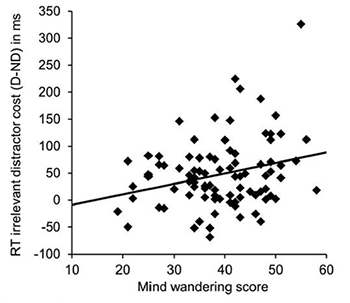
Figure 1. Mind wandering and irrelevant distractor interference in Experiment 1. Mind wandering (score on the Daydreaming Frequency subscale) correlated positively with mean irrelevant distractor cost (mean RT for distractor trials − mean RT for no-distractor trials, in milliseconds). RT = reaction time; D = distractor; ND = no distractor.
Forster and Lavie also notably found that task-relevant distraction was unrelated to mind wandering. This suggests that different executive functions may be behind the turning of attention caused by relevant versus irrelevant distractors.
In addition, they suggest that to achieve a full understanding of the daily disruption caused by irrelevant distractors, future researchers should consider both internal and external forms of distraction.
Citation:
Forster, S., & Lavie, N. (2014). Distracted by your mind? Individual differences in distractibility predict mind wandering.
Journal of Experimental Psychology: Learning, Memory, and Cognition, 40
(1), 251–260. doi:
10.1037/a0034108
Note: This article is in the Basic/Experimental Psychology topic area. View more articles in the Basic/Experimental Psychology topic area.