

 What image first comes to mind when you think about Asian American women? You may imagine a woman who is docile and subservient; one who is sensual or erotic ("The Geisha"); the manipulative and untrustworthy "Dragon Lady"; or the hardworking, conscientious worker bee.
Largely, Asian American women are thought of as faceless, quiet and invisible, or as sexual objects. In addition to the myth of the "Model Minority" and the "Forever Foreigner," these depictions and others have persisted in the media and popular culture.
What are the current experiences of discrimination in terms of racism and sexism for Asian American women?
Shruti Mukkamala and Karen Suyemoto set out to answer this question in a research study recently published in Asian American Journal of Psychologyopens in new window.
The study sought to provide evidence that, contrary to popular belief, Asian American women face discrimination in their lives, both professionally and personally. The researchers hope that their work might lead to a better understanding of the effects of discrimination on the lives of Asian American women in the U.S.
The research included both online open-ended surveys as well as in person group interviews with adult women who self-identified as Asian American. Participants were asked about their experiences with discrimination.
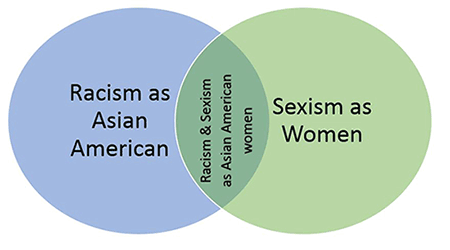
Out of the 107 participants in the study, only four said they had never experienced discrimination. The researchers identified 15 types of discrimination, 6 of which were specific to how race and gender interact in discrimination toward Asian American women in particular.
A brief explanation of these six themes provides a glimpse into the participants' experiences:
- Exotic — Experiences related to being exoticized and objectified. These are historically related to the stereotypes of Asian women as exotic "Geisha girls" who possess a special sexuality.
- Not a leader — Experiences where participants are seen as incapable of being or becoming leaders. Related to the stereotype of the busy "worker bee" who can work as part of a team, but is incapable of leading due to stereotypes of Asian women as quiet and lacking leadership qualities. This experience is also shared with women of other racial groups who are often not considered leaders.
- Submissive — Experiences where participants are considered submissive/passive/quiet, expected to be agreeable, not speak up or stand up for themselves. Related to stereotypes of Asian women as deferential and controllable.
- Cute and small — Expectations put on the participants about how they should or should not look.
- Invisible — Experiences related to participants feeling like they or their group was ignored in some way, or lacked voice, agency or power.
- Service worker — Assumptions that the participant works at a low-level gendered job, such as being a maid or working in a nail salon, which are stereotypically associated with Asian American women.
Other types of discrimination included
- being considered a spokesperson for all Asians
- being mistakenly identified as someone from another Asian ethnicity
- thought to be foreign or international
- being considered smart and naturally successful
- stereotyping as bad drivers
- other people's negativity about cultural beliefs and practices
These particular experiences are not gender-specific and are experienced by Asian Americans in general.
The results showed that stereotypes of Asian American women are alive and well in the current social context of America. These stereotypes contribute to experiences of marginalization, invisibility, and oppression that these participants have faced in the past and continue to face today.
These results support other research findings that Asian American women face both subtle and blatant discrimination in their personal relationships and their professional lives, from bosses, professors, colleagues, subordinates, partners, family, and friends.
The authors hope that those who interact with Asian American women become more aware of ways in which they may be contributing to discriminating against this group and creating professional and personal barriers. They hope to make these often invisible experiences visible, so that we may empower Asian American women and prevent discrimination against this group.
Citation
- Mukkamala, S., & Suyemoto, K. L. (2018). Racialized sexism/sexualized racism: A multimethod study of intersectional experiences of discrimination for Asian American women. Asian American Journal of Psychology, 9(1), 32–46. https://dx.doi.org/10.1037/aap0000104
Note: This article is in the Social Psychology & Social Processes topic area. View more articles in the Social Psychology & Social Processes topic area.