

 The Patient-Reported Outcomes Measurement Information System® (PROMIS®) is a collection of person-centered measures of physical, mental, and social health in children and adults.
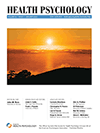
The May special issue of Health Psychology presents articles that illustrate the use of PROMIS measures to advance health behavior research across a wide range of health studies.
Guest editors Susan Yount, David Cella, and Shelley A. Blozis discuss the issue's significance and practical implications.
What is the special issue about?
This special issue of Health Psychology features outcomes research and applications of the Patient-Reported Outcomes Measurement Information System (PROMIS).
PROMIS is a collection of self-report measures of physical, mental, and social health that have become widely-used in research and clinical settings. The articles span various research and clinical applications using PROMIS, illustrating its value and pointing to future opportunities and challenges.
What is the significance of the issue?
PROMIS development by a cooperative group of researchers was funded by National Institutes of Health (NIH) Roadmap/Common Fund initiatives from 2004–2018. PROMIS fulfills an expressed NIH desire for brief, accurate, and valid patient-reported outcomes tools suitable for use with a range of acute and chronic conditions across the life span.
Today, PROMIS includes more than 2,000 self-report adult, pediatric, and parent-proxy items that measure physical, mental, and social health domains. PROMIS users can select efficient assessment options from domains relevant to their work.
How did the issue come about?
Currently, PROMIS measures are widely used in clinical research across a range of clinical specialties and in clinical trials, and we see emerging use in submissions to support labeling claims for new drug development, healthcare quality, and government population health tracking. The biggest area of growth in use of PROMIS is in clinical care, including integration in electronic health records.
Given the relevance of PROMIS measures for health psychology research and clinical practice, an introduction to the health psychology community through this special issue is timely.
Tell us about a few key takeaways.
This collection of articles is divided into four sections: Extending PROMIS Validity, PROMIS in Intervention Studies, Clinical Applications of PROMIS, and Facing Challenges and New Directions.
The section about Extending PROMIS Validity includes articles that advance what we know about the validity of PROMIS measures. PROMIS is a relatively new measurement system, and the accumulation of validity evidence is building rapidly and will continue to accrue.
In the PROMIS in Intervention Studies section, we feature two examples of clinical trials that use PROMIS outcome measures, which represents an original primary purpose of the NIH-funded effort.
The Clinical Applications of PROMIS section represents the most unanticipated and rapid growth of PROMIS. The three articles in this section describe some of the clinical applications of patient-reported outcomes measures.
In the Facing Challenges and New Directions section, three article focus on explorations of the performance and application of PROMIS measures and what remains to be learned about the measures.
What are some practical implications of the articles featured in the issue?
The use of PROMIS measures has expanded beyond what was initially envisioned, and these representative papers allow us to present the diverse range of health psychology applications of PROMIS.
Knowledge about and user experiences with specific health conditions will continue to accumulate and enhance the value of PROMIS.
We hope this issue helps readers appreciate the value of PROMIS measures in bringing the patient voice and experience into their research and clinical practice.
For more information, visit the PROMIS websiteopens in new window.
Special Issue
- View the table of contents and abstracts on APA PsycNET
- Purchase the special issue
PDF Format ($24.95)
Note: This article is in the Health Psychology & Medicine topic area. View more articles in the Health Psychology & Medicine topic area.