

If we're going to out-innovate and out-educate the rest of the world, we've got to open doors for everyone. We need all hands on deck, and that means clearing hurdles for women and girls as they navigate careers in science, technology, engineering, and math.
—First Lady Michelle Obama
 Women, historically, have been underrepresented in professional science, engineering, and technology (SET) jobs. Concerns that talent and diversity in thinking are being lost as a result of this discrepancy have compelled companies to attempt to remedy the problem in a number of ways, although their success has been mixed.
Approaching the problem from the angle of SET middle managers, who strongly influence how employees are treated, developed, promoted, and compensated, Shirley Braun and Rebecca A. Turner, in a study published in the June issue of Consulting Psychology Journal: Practice and Research (PDF, 117KB)opens in new window, reported the results of their investigation of the intentions of these managers to hire, develop, and promote women in SET professions.
Braun and Turner used the theory of planned behavior to assess and predict managers' intentions to engage in women-friendly behaviors (WFBs) in the workplace.
First, they interviewed middle managers in public SET organizations to identify common behavioral beliefs, beliefs about norms, and beliefs about their own control over the situation. They were impressed with the apparent candor of managers to discuss not only the benefits of developing women but also their concerns about how effectively they can manage women SET professionals (e.g., "women are more sensitive"; "less flexible").
The interview responses were used to create a survey instrument, which was administered online to an additional 233 managers through several professional and talent group sites. The survey explored how these theoretical factors (beliefs, company practices, and affect) may be influencing middle managers' engagement with WFBs.
Braun and Turner found that attitudes, perceived behavioral control, past behavior, and affect toward women in SET jobs were the strongest factors associated with the managers' intentions to engage in WFBs. They also found that gender moderated the relationship between subjective norm and intention. This means that female managers, compared with male managers, felt more affected by other people's potential impressions of them (i.e., the subjective norms) in terms of hiring, promoting, and retaining women.
The study's robust findings have a number of implications for SET companies in the area of future hiring and training practices, starting with companies taking steps to know and understand their managers' beliefs, attitudes, and intentions with respect to SET women. Effective programs and processes to foster change can be developed once a decision is made on the goals they will try to reach regarding hiring, promotion, and retention of female SET employees. Companies must then ensure that their managers feel empowered to address these goals and are equipped with the competencies to take the steps necessary to manage this more diverse workforce.
This figure shows the strength of association among the variables assessed in their survey. Consulting psychologists should look closely at individual managerial and system-level factors that may contribute to greater success for SET women and greater competitive advantage for companies needing to innovate.
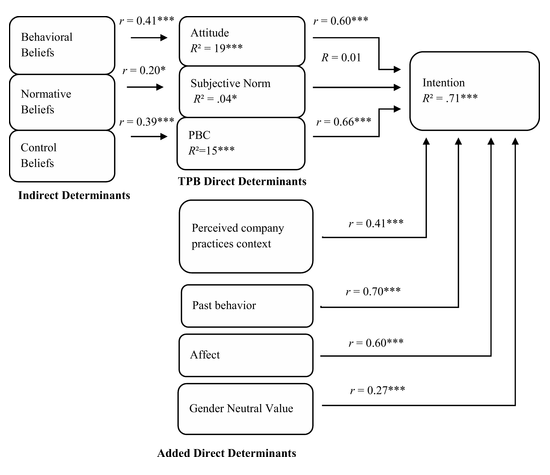
Figure 3. Diagram of study results. * p < .05; ** p < .00l; *** p < .000l; R2 = .71*** = R square for intention with all direct determinants of TPB plus four exploratory variables (perceived company practices, past behavior, affect, gender-neutral value).
Citation:
Braun, S., & Turner, R. A. (2014). Attitudes and company practices as predictors of managers' intentions to hire, develop, and promote women in science, engineering, and technology professions. Consulting Psychology Journal, 66, 93–117.
Note: This article is in the Industrial/Organizational Psychology & Management topic area. View more articles in the Industrial/Organizational Psychology & Management topic area.