

 Globalization brings about increasing diversity that changes the demographic landscape and affords opportunities for greater intercultural contact. As recent political outcomes in both Europe and North America have demonstrated, increased globalization can create tension between immigrants and majority group members.
For example, on April 22, 2020, President Trump released a proclamation that “suspend[s] entry of immigrants who present risk to the U.S. Labor Market during the economic recovery following the COVID-19 outbreak.” Similarly, concerns about immigration have been cited as a primary motivator in Britain’s vote to leave the European Union; a recent British Social Attitudes Survey found that 73% of those who were worried about immigration voted in favor of Brexit.
It seems logical that these negative attitudes from the majority group would influence immigrants’ desire to interact with majority group members. These majority group attitudes likely have implications for how bicultural individuals view their own cultural identities as well.
In the past, researchers have primarily measured how bicultural individuals negotiate their two cultural identities (ethnic and national). Other researchers have explored how intergroup relations are affected by majority members’ perceptions. However, it is possible to jointly examine how individual variables, such as the relationship between ethnic and national identity, interact with contextual variables, such as majority group perceptions, to ultimately influence bicultural individuals’ behavioral responses toward majority members.
Although hostile social contexts perpetuated by majority members are usually associated with detrimental consequences for minorities, a study published in Cultural Diversity and Ethnic Minority Psychologyopens in new window found that perceptions of identity integration between ethnic and national identity buffer the adverse effects of these contexts on bicultural individuals’ relations with majority members.
Across two studies, bicultural participants completed surveys measuring bicultural identity integration, impressions of majority group attitudes, and behavioral intentions to interact with majority group members. Not surprisingly, people who report more positive majority group perceptions are more likely to want to spend time with majority group members. This is true when people self-report majority group perceptions and when they read fictitious news stories depicting positive (vs. negative) majority group perceptions.
Regardless of majority group attitudes, bicultural people who perceive greater integration between their ethnic and national identity report greater intentions to engage with majority group members. In other words, integration between both cultural identities buffers against the negative intergroup outcomes associated with hostile social contexts.
These findings highlight the importance of both individual and contextual factors in intergroup relations. Additionally, these studies have implications for encouraging more positive intercultural relationships between majority and minority group members. They highlight the power of integrating identities to protect oneself from negative contexts.
Future research should aim to take the burden off of bicultural individuals by improving the contexts created by majority group members.
Figure
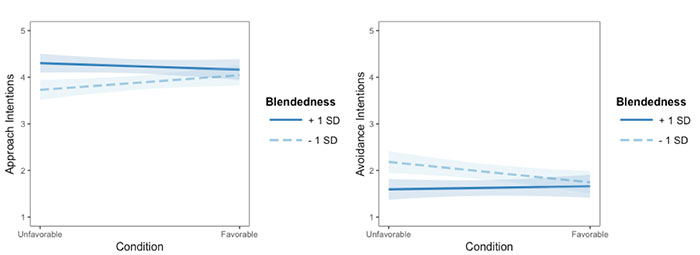
Figure 3. Study 2: This figure shows the relations between majority group attitudes and behavioral intentions as moderated by integration between ethnic and national identities (Bicultural Identity Integration [BII] blendedness). These two figures show that bicultural individuals who are low in integration (-1 SD on BII blendedness) are less likely to want to approach (left) and more likely to avoid (right) majority group members when their attitudes towards bicultural individuals are unfavorable. However, those bicultural individuals who perceive greater integration (+1 SD on BII on blendedness) are more likely to approach (left) and less likely to avoid (right) majority group members regardless of majority group attitudes. These figures demonstrate the buffering effect of bicultural identity integration against unfavorable social contexts. Shaded areas represent 95% confidence intervals.
Note: This article is in the Social Psychology and Social Processes topic area. View more articles in the Social Psychology and Social Processes topic area.