

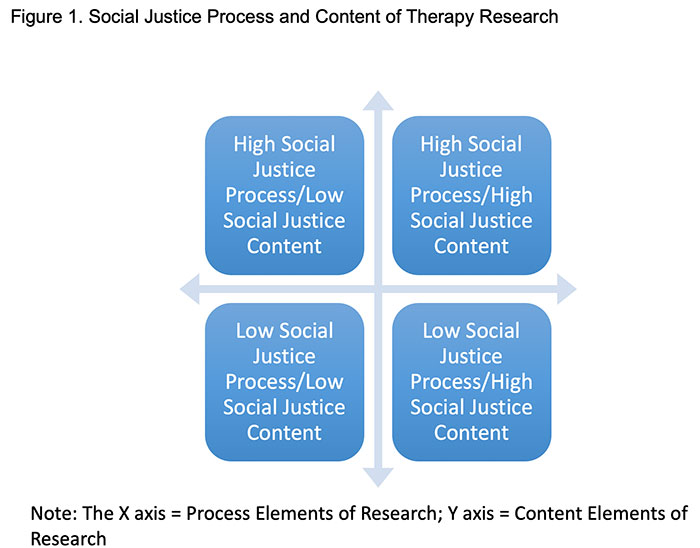
 When a White heterosexual cisgender middle-class college-educated person seeks psychotherapy services, that person can feel fairly confident that therapy will be helpful. After all, an extensive body of research demonstrates as much. This is because most psychotherapy research is about people who fit that profile. But the same cannot be said for individuals who belong to other groups or have different social identities—they are all too often ignored in psychotherapy research. In their Psychotherapy articleopens in new window, “Creating a Psychotherapy Science for All, Not Just Some: Conducting Socially Just Research,” Jill Paquin, Karen Tao, and Stephanie Budge articulate a framework for evaluating and generating psychotherapy research that is consonant with social justice principles and practices in order to address this important gap in psychological science1.
Bridging the gap between social justice work and psychotherapy research
As a result of systemic oppression and psychology’s exploitative history with specific populations, less is known about how contemporary psychotherapy helps individuals from nondominant groups. This includes individuals belonging to groups who have historically been marginalized by racism, classism and poverty, cissexism, sexism, heterosexism, ableism, colonialism, and the criminal justice system in the United States and abroad. Psychologists have inherited a complex history of oppression. Evidence-based practitioners have an incomplete picture of how psychotherapy helps (or does not help) diverse groups of people with whom they work. If they do not have the data, how are they to engage in practice that is evidence-based?
Paquin and colleagues address that overarching questing through the exploration of four main themes:
- How is ethical research different from socially just research?
- How do researchers go about gathering the data that are missing from the cannon of psychotherapy science?
- How do they center the experiences of marginalized voices in that process?
- How do researchers use their expertise and power to undo injustices and empower others in the research process?
Key stages of a research project: Opportunities and challenges for social justice work
To illustrate the opportunities and challenges that psychologists who seek to conduct socially just research face, the authors use concrete examples from their own psychotherapy research with incarcerated individuals, community- and school-based research with racial/ethnic minority youth, and psychotherapy research with sexual/gender minorities to illustrate ideas. For instance, when designing a randomized controlled trial with transgender client participants, Budge’s research team was concerned about using a waitlist control for people who were subjected to high levels of minority stress and should not be made to wait for treatment. As a result, they changed the design of the study.
The authors also discuss systems-level and institutional issues, including how universities can support and reward community-based research and innovative dissemination practices designed to ensure that useful study results are shared with community stakeholders. Finally, the authors provide practical guidance for students and seasoned researchers alike, by articulating their core beliefs and practices of social justice researchers2, which can be used by researchers of all experience levels to navigate the choice points within each of the key stages of a research project. They also introduce a model that can be used to develop and evaluate the social justice process and content components of any research study.
Core beliefs and practices for socially just psychotherapy research
- A socially just therapy researcher consistently considers “the frame,” which means asking, “what are we not seeing?” “who is missing from the narrative?” “who sets up the frame (participants? researcher?)”
- Building trust is paramount, and requires engaging in real-world relationships with our participants, research team, and coinvestigators; it requires consistent movement toward transparency.
- Researchers should engage stakeholders in the development of research questions and research should serve the needs of the community.
- The intentional and unintentional silencing of voices can be considered violations of social justice ethical principles, as well as acts of violence.
- Critically question our default reference groups; for example, when engaging with or writing about our participants, who are we comparing them to? What language are we using? How do we position marginalized individuals in the center?
- All of a researcher’s intersecting identities enter into the research frame; research is a whole body and whole self-endeavor (positionality).
- Research should seek to empower research participants, thus reducing the chances of marginalizing and stereotyping study participants. This does not mean pretending everyone has the same expertise, nor does it mean abdicating leadership responsibilities; this means owning one’s expertise while honoring and valuing the expertise of others and making informed decisions consonant with one’s leadership style and with community values to move a project forward.
- Researchers entering culturally diverse and/or communities historically exploited or ignored by research should demonstrate genuine interest in the lives of participants, treat all persons with respect, and be willing to engage in a process of mutual transformation.
- An underlying question must always be “how and for whom is this research useful?”
- Research is a political act that encompasses many agendas, including our own. We must ask ourselves what is underlying our questions, design, method, and interpretations.
- Research can seek to empower participants to effectively navigate complex and often oppressive systems.
- Research should lead to developing, implementing, and/or evaluating therapy interventions in schools, organizations, and agencies that positively contribute not only to individual change, but also to systemic and social change.
- Research should not force participants to respond to predesigned instruments or protocols that were not developed without at least a critical mass of participants from the target group, or entirely with members of the target group. If this is not possible, researchers should assume that is a limitation so significant that it necessitates the development of an alternative research design.
1Figure 1
2Thumbnail photo credit: A photo from multimedia artist rafa esparza’s 2019 performance “bust: indestructible columns.” Photo: Natalia Mantini. Retrieved from: https://www.nytimes.com/2020/06/29/t-magazine/queer-bipoc-artists.htmlopens in new window
Notes: Many of these core beliefs and practices are long-held tenets traditionally applied to qualitative inquiry and Community Based Participatory Research (CBPR) however we posit that these tenets also apply to researchers using quantitative methods. The last three tenets are adapted from Ponterotto (2005).
This article is in the Clinical Psychology topic area. View more articles in the Clinical Psychology topic area.