

 Approximately half a million people in the United States are in jail awaiting trial and have not been convicted of a current crime. Many of these individuals pose little threat to public safety and are likely to return to court for trial but are unable to post cash bond. Pretrial detention, which often occurs in dangerous, crowded, and unsanitary conditions, can have significant negative consequences including loss of employment and disruption of family and social relationships. This leads many individuals to plead guilty in exchange for a reduced sentence or time served so that they can be released from custody. This burden is borne disproportionately by Black and Hispanic or Latinx persons, who are held in pretrial detention significantly longer than non-Hispanic White persons for the same charges, are more likely to plead guilty to or be convicted of the charges, and receive longer and more severe sentences for the same alleged conduct.
If not bond, then what?
Most policy experts agree the bond system should be curtailed or abolished, but controversy surrounds what, if anything, should take its place. One approach is to perform standardized assessments of defendants’ risk for committing a new crime or fleeing prosecution and impose release conditions if warranted, such as drug and alcohol testing or mental health treatment. Although research is sparse, growing evidence suggests that using risk assessment instead of bond may reduce pretrial detention and racial disparities in release conditions—assuming, of course, that the tools are valid and bail magistrates heed the assessment results and impose suitable conditions where appropriate. Nevertheless, some advocacy groups object to pretrial risk assessment because it may contribute unwittingly to racial inequity. A recent study found that at least one risk tool overpredicted risk for Black respondents, leading potentially to disproportionate detention. This finding has damaged faith generally in risk assessment and led some advocates to assert that pretrial release should be the presumed disposition in most cases, with risk assessment or detention reserved only for the most serious offenses or incorrigible individuals who have demonstrated a propensity for repeated crime or avoidance of prosecution through their conduct. Before abandoning risk-based decision making, more information is needed on how risk assessments affect public health, public safety, and racial justice.
Pretrial reform in action
To shed light on these issues, researchers Douglas Marlowe, Timothy Ho, Shannon Carey, and Carly Chadick examined efforts by a trial court serving two counties in southern Mississippi to base pretrial release decisions on risk assessment rather than bond. In their study published in Law and Human Behavioropens in new window, participants (N = 521) completed the Risk and Needs Triage (RANT) within 2 weeks of arrest. Outcomes examined included the length of pretrial detention, dispositions in the instant case, and new arrests. The researchers hypothesized that lengths of pretrial detention and new arrests would be lower using risk assessment, but Black persons would be misclassified as high risk more often than White persons and detained longer because of higher risk scores or assessment overrides by justice officials.
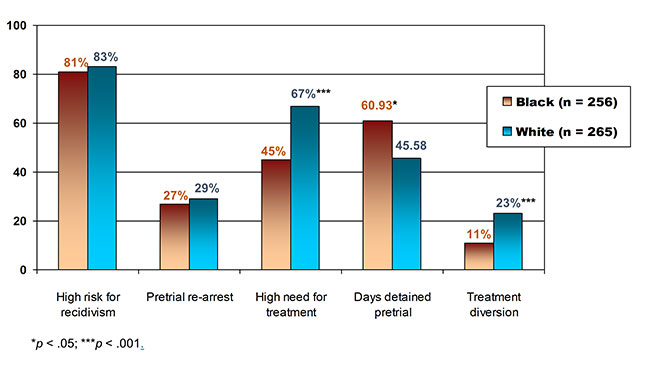
As predicted, pretrial detention averaged less than 60 days; prevailing detentions relying principally on bond averaged approximately 90 and 180 days in the same two counties, respectively. Contrary to predictions, there were no racial disparities in risk prediction, the direction of risk misclassifications, or rearrest rates. Nevertheless, despite equivalent risk scores and criminal records, Black persons were detained significantly longer than White persons and were less likely to be diverted to a treatment program such as drug court in lieu of prosecution (see Figure 1). Just over one quarter of all participants (28%) were rearrested during the pretrial period, but nearly all alleged crimes were relatively minor nonviolent offenses such as drug possession or larceny. Less than 3% of participants were arrested for offenses that would jeopardize public safety, such as a violent crime or driving while intoxicated.
How can we achieve racial equity?
Lacking a randomized or matched control group who did not receive the RANT, causal conclusions are not justified; however, results suggest that risk assessment may be superior to cash bond for reducing unwarranted pretrial detention and racial inequities in pretrial conditions without jeopardizing public safety and may improve behavioral health outcomes. Had authorities paid closer attention to the assessment results, racial disparities in pretrial conditions would likely have been attenuated or eliminated. And if more persons, especially Black persons, needing treatment had received it rather than going to jail, crime rates, racial disparities and other negative social indicators would likely have improved even further. Whether, as advocated by some reformists, removing all preconditions for pretrial release other than in the most extreme cases would produce better outcomes is unknown because it has never been tried. What can be said more confidently is that scientifically valid risk tools outperform professional judgment and current business as usual in the criminal justice system and may help rectify systemic racial injustices.
Figure 1. Pretrial outcomes by race using risk assessment: % or M
This article is in the Forensic Psychology topic area. View more articles in the Forensic Psychology topic area.