

 Although the link between narcissism and aggression has been studied extensively, findings from around the world need to be integrated to form a global picture of how they are linked and to determine the factors that may lead narcissistic people to attack others.
In Psychological Bulletin, researchers Sophie L. Kjærvik and Brad J. Bushman report on a comprehensive review of the link between narcissism and both aggression and violence. Narcissism is characterized by a sense of entitlement (the core of narcissism), grandiose self-views, a sense of superiority, abusive authority and control over others, excessive need for admiration, vanity, intolerance of criticism, a selfish orientation, and a lack of empathy for others.
In their analysis of 437 studiesopens in new window involving more than 123,000 participants, Kjærvik and Bushman found that narcissism is related to a 21% increase in aggression and an 18% increase in violence. They were surprised to find that the link between narcissism and violence (i.e., actually intending to cause extreme physical harm, such as injury or death) was nearly as strong as the link with less serious forms of aggression. However, the results are consistent with research that suggests narcissism might be a risk factor for violent acts such as mass shootings.
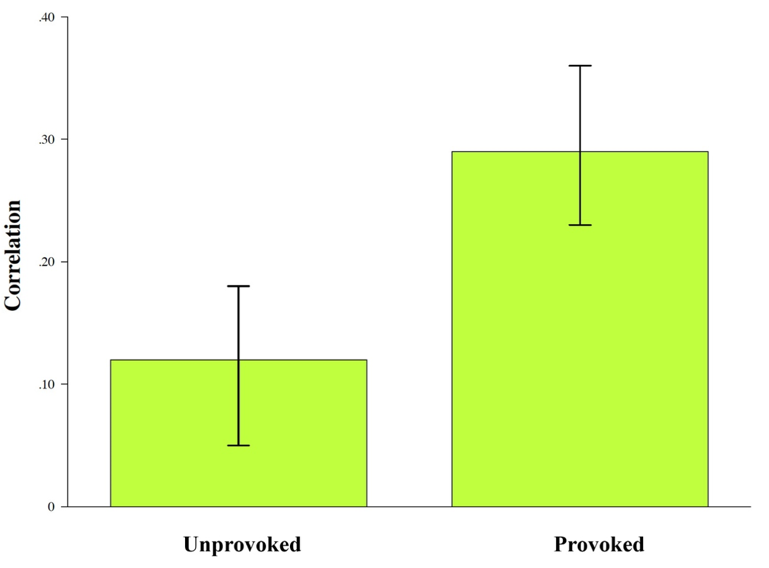
The key link between narcissism and aggression was provocation. Individuals high in narcissism were especially aggressive when threatened or provoked in some way, such as being ignored or insulted (see Figure 1). But findings showed a link even under conditions with no provocation.
Pathological levels of narcissism (e.g., narcissistic personality disorder) are not necessary to produce aggression. Higher levels of narcissism were linked to aggression even before it got to pathological levels.
Participants with high levels of narcissism showed elevated levels of all types of aggression, including physical, verbal, and indirect aggression (e.g., spreading gossip); bullying (both online and offline); and even displaced aggression against innocent bystanders. Narcissism was related to impulsive, hot-headed aggressive acts as well as deliberate, cold-blooded aggression.
Findings showed a link between narcissism and aggression in individualistic countries, like the United States, where people emphasize personal rights. But narcissism and aggression were related even in collectivistic countries. The link between higher levels of narcissism and aggression was similar for males and females of all ages; the similarity persisted between college students and a more general population.
Overall, the analysis shows that feelings of superiority and entitlement can lead narcissistic people to attack others in an aggressive manner, sometimes even violently. People high in narcissism believe they are special and deserve special treatment. Their thin skins and fragile egos lead them to lash out when they fail to get the special treatment they believe they are entitled to.
People high in narcissism are especially likely to act aggressively when they are provoked, insulted, humiliated, shamed, criticized, or threatened by others. But they need not be provoked to attack.
Visual
Figure 1. The link between narcissism and aggression is stronger under provocation conditions than under no-provocation conditions. Capped vertical bars denote 95% confidence intervals.
Note: This article is in the Core of Psychology topic area. View more articles in the Core of Psychology topic area.