

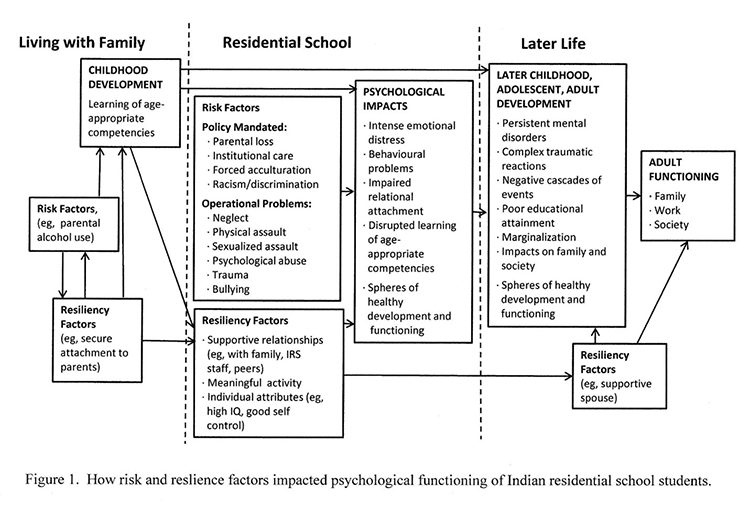
 Between 1867 and 1996, thousands of Aboriginal children were taken from their parents by the Canadian government and forced to live at Indian residential schools for months or years. These institutions were designed and operated to accomplish two goals: assimilate Aboriginal children into Euro-Canadian society and obliterate their familiarity with their Aboriginal heritage. Staff forced students to adopt a Christian Euro-Canadian way of life, limiting students’ family contacts while prohibiting and denigrating Aboriginal language and culture. When assessing former Indian residential school students, psychologists Rosemary Barnes and Nina Josefowitz found almost no research describing the extent and complexity of the former students’ psychological difficulties. Using research from non-Aboriginal populations, they developed a risk and resiliency model relevant to former Indian residential school students (see Figure 1), which they shared in an article recently published in Canadian Psychology/Psychologie canadienneopens in new window.
This model identifies four universal aspects of Indian residential school students’ experiences that directly resulted from Canadian laws or policies: parental loss, institutional care, forced acculturation, and discrimination or racism. Although these conditions are known to increase risk for emotional distress, impaired relational attachment, acculturation stress, and mental disorders, their effect on Indian residential school students has received little or no attention in previous research. The model also identifies forms of maltreatment and trauma the students experienced due to Indian residential school operational problems: (a) neglect in the form of inadequate food, clothing, housing, or medical care or dangerous conditions; (b) physical assault, such as extreme corporeal punishment; (c) sexualized assault; and (d) psychological abuse, including physical and verbal bullying. Maltreatment and trauma are well-known to adversely affect psychological functioning and development. Many students experienced multiple forms of maltreatment and trauma over extended periods, thus compounding their risk for psychological difficulties. With their model, Barnes and Josefowitz posit that concurrent parental loss, institutional care, and forced immersion in a hostile Euro-Canadian culture amplified the adverse effects of maltreatment and trauma.
Some students’ psychological resilience was enhanced by supportive relationships with sympathetic staff members, family, or peers; meaningful activities, such as acts of resistance to school conditions; or personal attributes such as good intellectual abilities or self-control. However, in general, Indian residential school conditions exposed many students to multiple risk factors while offering few tools they could use to boost their resiliency. After leaving Indian residential schools, former students faced discrimination in Euro-Canadian society. As residential school staff had forbidden and denigrated use of Aboriginal language and cultural practices, many former students also had difficulty communicating with Aboriginal family and friends and readjusting to Aboriginal communities. Former students who were unable to adapt to either Euro-Canadian or Aboriginal society became socially marginalized.
The risk and resiliency model developed by Barnes and Josefowitz identifies some important and not generally understood potential psychological impacts of Indian residential schools, including increased risk for mental disorders and complex traumatic reactions arising from impaired relational attachments and development. Such difficulties place former Indian residential school students at risk for negative cascades of later life events, including negative impacts on education and employment (Barnes et al., 2006). The model provides a framework for understanding how Indian residential school policies and operations harmed Aboriginal students and also highlights the resilience of many of those students. The authors hope better understanding contributes to healing and to more respectful relationships between Aboriginal peoples and the people who came from Europe and elsewhere to live in the lands now known as Canada.
Figure 1
Note: This article is in the Social Psychology and Social Processes topic area. View more articles in the Social Psychology and Social Processes topic area.