

 Removing students from the classroom through exclusionary school discipline leads to negative long-term outcomes, including academic underachievement, dropout, and incarceration. Moreover, racial inequities in exclusionary discipline (known as the discipline gap) are widespread and long-standing. Decades of research show that Black students receive a disproportionate number of office discipline referrals, even when controlling for alternative explanations such as poverty. Unfortunately, many interventions used in schools to increase equity have yet to prove effective in decreasing the discipline gap.
In an article published in School Psychologyopens in new window, Kent McIntosh and colleagues from the University of Oregon describe the effectiveness of an intervention to reduce the use of exclusionary discipline and decrease the discipline gap. The intervention, a whole-school professional development intervention based on the positive behavioral interventions and supports (PBIS) framework, is called ReACT (Racial equity through Assessing data for vulnerable decision points, Culturally responsive behavior strategies, and Teaching about implicit bias and how to neutralize it). In ReACT, school teams are led through a process in which they examine their discipline data, identify specific discipline decisions more susceptible to racial bias (e.g., disruption in the classroom just after lunch), and implement a tailored school-wide intervention plan. Examples of intervention components include a praise preference assessment (to identify how students would like to be acknowledged for prosocial behavior), the personal matrix (a lesson to help students connect expectations across school, home, and community), and a neutralizing routine (to help teachers respond instructionally to unwanted behaviors instead of with a biased reaction).
The authors used a randomized controlled trial to test the intervention in eight elementary schools with discipline disparities in a rural school district in the southeastern United States. Four elementary schools were randomly assigned to receive the yearlong intervention, with four control schools receiving it during the next school year. The results showed the intervention significantly decreased the discipline gap as well as rates of office discipline referrals for all students. Hence, all student groups benefited from the intervention. Further, the intervention was implemented well and was viewed positively by the teachers.
These results show that racial disparities in school discipline can be significantly decreased through equity-focused professional development within a PBIS framework. The intervention provides feasible strategies teachers can use in the classroom to make their behavior support systems more culturally responsive and effective, while also enabling them to respond to unwanted behavior more instructionally. Educators can implement elements of the intervention to increase racial equity in discipline in their own schools using resources available on the Center on PBIS websiteopens in new window.
Figure 1
Change in Black-other office discipline referral risk difference by condition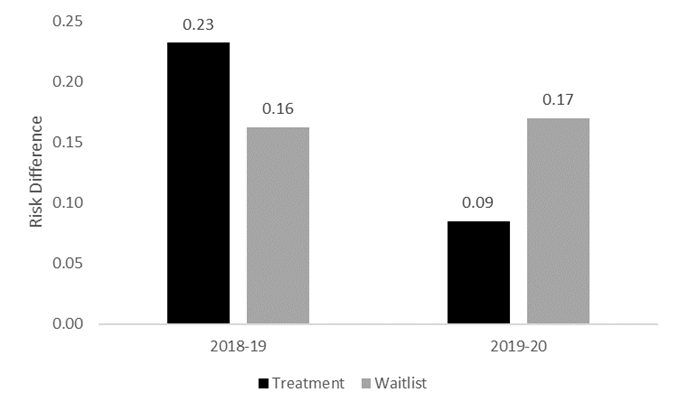
Note: This article is in the Educational Psychology, School Psychology, and Training topic area. View more articles in the Educational Psychology, School Psychology, and Training topic area.