

 In his recently published article in the Canadian Journal of Experimental Psychology/Revue canadienne de psychologie expérimentaleopens in new window, Harinder Aujla examined how a computational model of semantics can help to understand how people can talk past one another, even when those people are using the same words.
As people spend more of their social lives online among like-minded individuals, these echo chambers increasingly influence individuals’ understanding of language meaning. This is particularly evident in discussions involving political views. But how do the same words take on different meanings for different people? To answer this question, researchers have turned to computational models to generate semantic representations of words from large amounts of text. Although there are differences between various computational techniques, a common approach to understanding semantics often boils down to the proposition put forward by Firth (1957): “You shall know a word by the company it keeps” (p. 11). Traditionally, researchers have worked to find text that is representative of an average individual’s language experience to use in their analyses. This approach has been fruitful in understanding a wide range of psychological observations, but it does not address why individuals differ in their understanding of the meanings of specific words.
Aujla applied Firth’s (1957) proposition to the problem of how humans acquire different meanings from the same words. He first extracted text from news websites with liberal or conservative political leanings—CNN and Fox News, respectively. He then generated numerical vector representations of words separately from each news source. These vectors allow for similarity comparisons with other words via quantitative methods.
Do these vectors reflect differences between readers of liberal and conservative news websites? Aujla sought to confirm that computer-generated representations of word meanings correspond to humans’ understanding of word meanings. This required a test of the predictions made by computer representations against human performance. Similarity in word meaning understanding of human participants was assessed using lexical decision time to a semantic prime. Semantically related or unrelated cue–target pairs were constructed on the basis of the similarity of semantic vectors for each news website. The prediction was that these cue–target pairs would differentiate liberal and conservative news website readers. Results confirmed that readers of the right-leaning Fox News website showed a greater priming effect for cue–target semantic vector pairs that were highly similar on the Fox News website but not on the left-leaning CNN website. CNN readers, however, showed similar priming effects for cue–target pairs that corresponded to semantically similar vectors from either news website. Critically, results were significant on the basis of only the news readership but not the political ideology of the participants.
The results illustrate the power of computer-based semantic representations to generate testable predictions about groups who have come to have different understandings of the same words. This is important to consider when comparing discourse between, for example, liberal and conservative sources.
Writers should always choose the words they use with care, but they should also be mindful that the same words may not convey the same message to different readers. The wealth of text online provides opportunities to better understand how different groups understand words differently so that people may communicate more effectively.
Figure
Fox and CNN readers show different patterns of priming effects for cue–target pairs generated from text taken from the Fox and CNN news websites.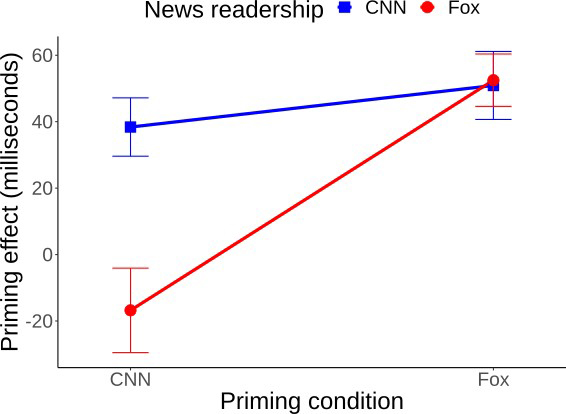
Note: This article is in the Basic/Experimental Psychology; Neuroscience and Cognition topic area. View more articles in the Basic/Experimental Psychology; Neuroscience and Cognition topic area.
Citations
Aujla, H. (2021). Language experience predicts semantic priming of lexical decision. Canadian Journal of Experimental Psychology/Revue canadienne de psychologie expérimentale, 75(3), 235–244. https://doi.org/10.1037/cep0000255opens in new window
Firth, J. R. (1957). Papers in linguistics, 1934–1951. Oxford University Press.
About the author
Harinder Aujla, PhD, is an associate professor in the Department of Psychology at the University of Winnipeg. He is interested in applying computational approaches to understanding how experience influences semantic representation. He is also interested in developing alternatives to traditional signal detection theory measures.