

 Cognitive biases can affect experts’ judgments and decisions. In a recent article publishedopens in new window in Law and Human Behavior, Tess M.S. Neal, Pascal Lienert, Emily Denne, and Jay P. Singh provided a broad descriptive model of how bias affects human judgment along two continuous dimensions: depth of cognitive processing and susceptibility to bias. More intuitive, low-effort cognitive processes can lead to bias in predictable circumstances but protect against bias in others. Likewise, more reflective and deliberative cognitive processes can also lead to bias in predictable circumstances but protect against bias in others. A better understanding of when and how bias is likely to influence judgments and how these biases can be systematically reduced could improve justice and fairness in society in general and in the legal system in particular.
Cognitive biases can affect experts’ judgments: A broad descriptive model and systematic review in one domain
May 4, 2022
Figure
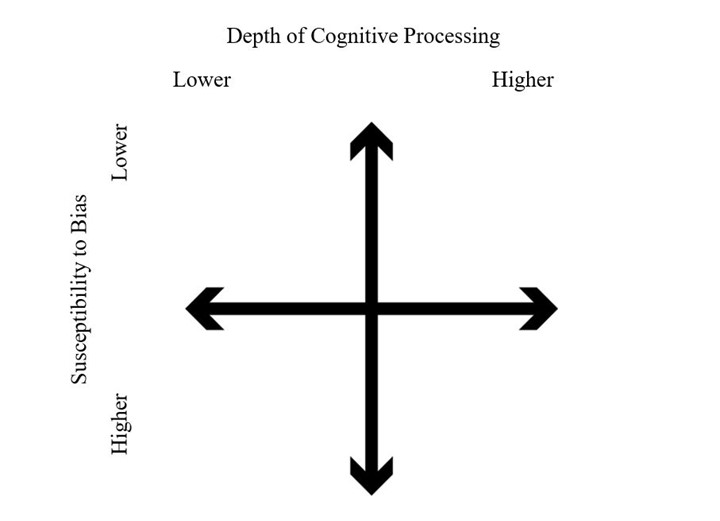
Specifically, intuitive low-effort cognitive processes can increase susceptibility to bias in particular circumstances (lower left side of figure). And deliberative effortful cognitive processes can override some of these biases to reduce their effects in others (upper right side of figure). When these situations are well understood, the power of intuition can be harnessed to reduce bias and/or decision environments can be altered to manage the ways in which biases infect intuitive cognitive processes to reduce their influence (upper left side of figure). Finally, and perhaps counterintuitively, deliberative and effortful cognitive processes can sometimes exacerbate bias in judgment—and experts may be especially vulnerable to this problem.
Given the authors’ interest in legal decision-making, particularly in cases where psychologists offer expert evidence, they also conducted the first systematic review to identify, evaluate, and summarize the role of cognitive biases and debiasing techniques in one particular domain: forensic mental health.
Considerable clinical and methodological differences between the 22 publications (one encompassing two separate studies, for a total of 23 studies) included in the review limited the authors’ ability to quantitatively summarize results. Further, 64% of the studies did not define “bias.”
Most studies focused only on biases (69.6%), with fewer investigating ways to address them (30.4%). Of the 17 studies that tested for biases, 10 found significant effects among forensic mental health experts (58.8%). Four additional studies found partial evidence of bias (23.5%). Adversarial allegiance was studied most, a phenomenon in which forensic experts are unaware of the extent to which they tend to interpret data and reach conclusions that support the view of their adversarial retaining party. Four of the six studies investigating adversarial allegiance found a significant effect. Other types of biases studied included the bias blind spot, hindsight bias, confirmation bias, moral disengagement, cross-cultural bias, suggestibility, primacy and recency effects, and gender and racial bias.
Only two studies tested the effectiveness of specific debiasing strategies in forensic mental health. Just one had any effect: A strategy called “consider-the-opposite” reduced confirmation bias among forensic mental health experts.
Is bias a problem for the field of forensic mental health? The authors’ interpretation of the judgment and decision-making literature broadly, as well as the results from this specific context, is that bias is an issue that deserves attention. Evidence of bias in forensic mental health emerged in ways consistent with what is broadly known about human judgment. However, less is known about how to debias judgments—an important frontier for future research. The broad decision science field and the specific forensic field need more research into how to debias judgments. Neal et al.’s model could assist in the design and testing of new, effective debiasing strategies.
Note: This article is in the Forensic Psychology topic area. View more articles in the Forensic Psychology topic area.
Citation
Neal, T. M. S., Lienert, P., Denne, E., & Singh, J. P. (2022). A general model of cognitive bias in human judgement and systematic review specific to forensic mental health. Law and Human Behavior, 46(2), 99–120. https://doi.org/10.1037/lhb0000482opens in new window
About the authors
Tess M.S. Nealopens in new window, PhD, is an associate professor of psychology and founding member of Arizona State University’s Law and Behavioral Science Initiative. She is a scientist; a clinical psychologist trained to assess, diagnose, and treat mental and behavioral disorders; and a forensic psychologist trained to bring psychology into legal contexts. She studies the nature and limits of expertise, with her basic work focusing on understanding and improving human judgment processes, especially among trained experts, and her more applied work on forensic experts’ judgments in particular. She is currently a Fulbright Scholar at the University of New South Wales, Sydney Australia. Clinical and Legal Judgment Lab's websiteopens in new window.
Pascal Lienert, PhD, is a Research Associate at the Zurich University of Applied Sciences, where he currently focuses his research interest on the advancement of the energy transition in Switzerland. He has a masters degree in Social, Economic, and Decision Psychology from the University of Basel and completed his doctoral studies at ETH Zurich. In his work, Lienert has investigated the role of human decision-making in a variety of socially-relevant contexts. He has published peer-reviewed articles in the field of energy research as well as in forensic psychology.
Emily Denne, MS, is a PhD candidate in the School of Social and Behavioral Sciences at Arizona State University. With the support of a Graduate Research Fellowship from the National Science Foundation, she studies the intersection of psychology and law. Within this field, she conducts research exploring evidence and testimony in child sexual abuse cases. Specifically, through studying the investigation and prosecution process for cases involving child victimization, she aims to advance theory and practice related to the prosecution of child abuse.
Jay P. Singh, PhD, PhD is the Founder and CEO of Publication Academy, a premiere online training platform for researchers seeking to become thought leaders by expanding their skills in academic, technical, and grant writing. Singh is a Fulbright Scholar who has authored over 90 peer-reviewed publications as well as 4 books published by Routledge, Wiley, Sage, and OUP. He completed his doctoral studies in psychiatry at the University of Oxford and clinical psychology at Universitat Konstanz, as well as a Post-Doctoral Fellowship at USF. He has since been the keynote speaker at conferences on six continents.