

 There has been a growing acceptance of same sex relationships, marriages, and partnerships within the United States. Past research has identified that in some situations being married can provide an advantage for heterosexual men (seen as more reliable and more likely to stay loyal to their employer in order to support their family) and a disadvantage for heterosexual women (seen as more likely to divide their attention between work and home life and more likely to leave the workforce to focus on children) (Malcolmson & Sinclair, 2007).
Separately, gay men and lesbians self-report high levels of discrimination in the workplace (Croteau, 1996) and are often seen as less competent and hirable compared to their heterosexual co-workers (Blashill & Powloshta, 2012). The present study sought to update the research on the interaction between gender and marital status trends in the modern workforce and to include sexual orientation.
Nadler and Kufahl (2014), in a recent article titled "Marital Status, Gender, and Sexual Orientation: Implications for Employment Hiring Decisions" (PDF, 161KB)opens in new window that was published in Psychology of Sexual Orientation and Gender Diversity®, used an experimental design that manipulated the gender, marital status, and sexual orientation of a videotaped interview of a job applicant and then examined participants' (N = 365 working adults) hiring ratings of the applicant. Each participant only viewed one of the eight videos.
Gender was manipulated by the use of male and female actors who were pre-tested and found to be perceived as similar in attractiveness, age, and competence. All eight (four male, four female) video interviews were identical with the exception of one sentence that conveyed sexual orientation and marital status:
Married: "No, I am more than willing to move. My spouse (John / Lisa) is currently between jobs and is more than willing to relocate. Plus we do not have any children yet, so relocating is not a concern."
Single: "No, I am more than willing to move. I broke up with my spouse (John / Lisa) 6 months ago so I am currently single, plus I do not have any children yet, so relocating is not a concern."
The researchers did not find the expected differences between heterosexual men and women based on their marital status in the evaluation of the videotaped interviews. However, there was a significant three-way interaction such that single lesbian women received significantly higher hirability ratings when compared to married lesbian women, and married heterosexual women received significantly higher ratings compared to single heterosexual women.
The study revealed that sexual orientation interacted with marital status in women's ratings but not for men. Men's ratings did not significantly differ based on marital status or surprisingly sexual orientation. Interestingly, married heterosexual women received higher ratings than did married lesbian women.
Based on this research, the authors suggest that hiring managers should recognize that marital status, gender, and sexual orientation biases do effect hiring decisions and introduce unwanted bias.
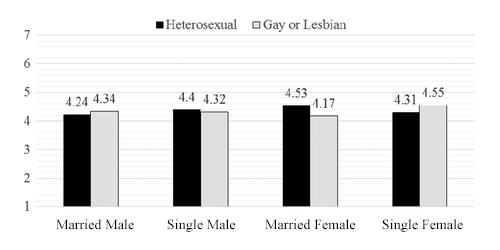
Figure 1. Three-way interaction between sexual orientation, marital status, and gender.
Note: This article is in the Social Psychology & Social Processes topic area. View more articles in the Social Psychology & Social Processes topic area.