

 In 2004, the FBI wrongfully arrested and detained an Oregon lawyer named Brandon Mayfield after mistakenly identifying him as the source of fingerprints recovered on a bag of detonators near the site of the Madrid commuter train bombings.
In the wake of this high-profile error, many people wondered whether Mayfield's personal characteristics might have played a role in the FBI's misidentification. Mayfield had recently converted to Islam, was married to an Egyptian immigrant, and had once been an attorney for a convicted terrorist — facts that fit the FBI's theory that the bombings were a terrorist attack carried out by radical Muslims.
Indeed, in an official investigation of the FBI's handling of the case, one FBI forensic examiner admitted that their lab might have been more skeptical of their initial identification of Mayfield had he been someone like the "Maytag Repairman" (Department of Justice, Office of the Inspector General, 2006, p. 12).
This forensic examiner's candid remark reflects an important issue, which Smalarz et al. (2016) addressed in their paper recently published in Law and Human Behavior (PDF, 99KB)opens in new window: Are forensic examiners' match judgments biased by criminal stereotypes?
Criminal stereotypes are people's beliefs about the typical characteristics associated with perpetrators of particular crimes.
For example, Smalarz and her colleagues found that people have shared beliefs about the typical characteristics of terrorists (Middle Eastern, Muslim male immigrants); child molesters (White, middle-aged married men); drug dealers (uneducated, young African-American men); as well as many other types of crime perpetrators.
The researchers examined whether these criminal stereotypes have the potential to bias evaluations of forensic evidence. This question is particularly pertinent to the domain of forensic fingerprinting given that the FBI's fingerprint system, which contains more than 70 million individuals, includes not only fingerprints, but criminal histories; mug shots; scars and tattoo photos; physical characteristics like height, weight, hair and eye color; and aliases (FBI, 2016). Hence, fingerprint examiners are routinely exposed to stereotype-relevant information that could influence their forensic judgments.
Participants in the experiment read a mock police incident report about one of two crimes: child molestation, which was shown to be strongly associated with a criminal stereotype (middle-aged White men); or identity theft, which was not shown to be strongly associated with a criminal stereotype. Participants were informed that a fingerprint had been recovered from the crime scene and had been submitted to a fingerprint database, which returned a number of potential matches.
Participants then viewed a profile of one of the supposed database matches: for half of the participants, the profile depicted a middle-aged White man named Steve Johnson; for the other half of participants, the profile depicted a middle-aged Asian woman named Mei Lee. Participants then studied the pair of fingerprints and indicated whether they believed the prints were a match.
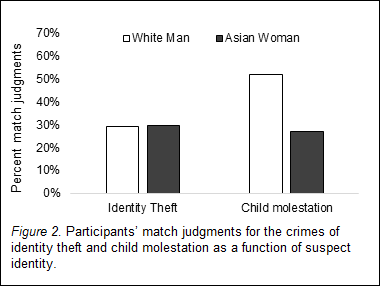 The identity of the suspect had little effect on evaluations of the fingerprints for the crime of identity theft, which is not strongly associated with a criminal stereotype. For the crime of child molestation, however, participants were nearly twice as likely to judge the prints as a match when the suspect was a White man versus an Asian woman.
Hence, it wasn't simply that participants were biased against the White man; the bias occurred only when the White man was suspected of a crime of which he was stereotypic. Moreover, the fingerprints used in the experiment did not actually match; hence, all match judgments were erroneous.
Forensic science errors were involved in more than 50% of the wrongful convictions exposed through post-conviction DNA testing (see The Innocence Project - Unvalidated or Improper Forensic Scienceopens in new window).
Although forensic analysis techniques have been criticized for lacking scientific basis and being subject to bias, the featured study provides the first empirical demonstration that widely-held social beliefs about the typical characteristics of crime perpetrators might operate as a particularly pervasive source of bias in forensic analysis domains. These findings lend further support to calls for reform of the forensic sciences (National Academy of Sciences, 2009).
One potential avenue for reform is to implement a "forensic filler control method," in which the suspect's forensic sample is presented alongside other "filler" samples that are known to be unassociated with the crime (Wells, Wilford, & Smalarz, 2013).
For example, instead of comparing the crime scene fingerprint to a single suspect fingerprint, forensic examiners would compare the crime scene fingerprint to a "lineup" of fingerprints and determine which, if any, matches the crime-scene print. Because forensic analysts do not know which sample is from the suspect and which samples are fillers, the filler-control method neutralizes the effects of potentially biasing information.
Moreover, the filler-control method has the added ability to provide estimates of error rates (because all filler identifications are known errors) and thus can quickly expose fraudulent analysts and invalid forensic techniques.
In the absence of such forensic science reforms, we must confront the possibility that suspects who fit a criminal stereotype are likely disadvantaged in the evidence-gathering process and, as a result, may be at increased risk of wrongful conviction.
Citation:
- Smalarz, L., Madon, S., Yang, Y., Guyll, M., & Buck, S. (2016). The perfect match: Do criminal stereotypes bias forensic evidence analysis? Law and Human Behavior, 40(4), 420–429. https://dx.doi.org/10.1037/lhb0000190
Note: This article is in the Forensic Psychology topic area. View more articles in the Forensic Psychology topic area.