Artificial intelligence (AI) is transforming professional practice across many fields, yet its adoption in school psychology largely has remained undocumented. Given persistent workforce shortages and significant time demands associated with assessment and report writing, understanding how practitioners are integrating AI into their work is essential for developing appropriate professional guidelines and training.
In a study to be published in School Psychology, Ryan L. Famer, Adam B. Lockwood, Randy G. Floyd, and Alec D. Sisco surveyed 199 school psychologists across the United States to examine their current AI use, attitudes toward its application, and ethical concerns. Participants represented diverse practice settings and geographic regions, with demographic characteristics closely matching those from national surveys of the profession.
Results indicate that about two-thirds of participants had used AI in the past 6 months, with roughly one-quarter integrating it into their practice weekly or more frequently.
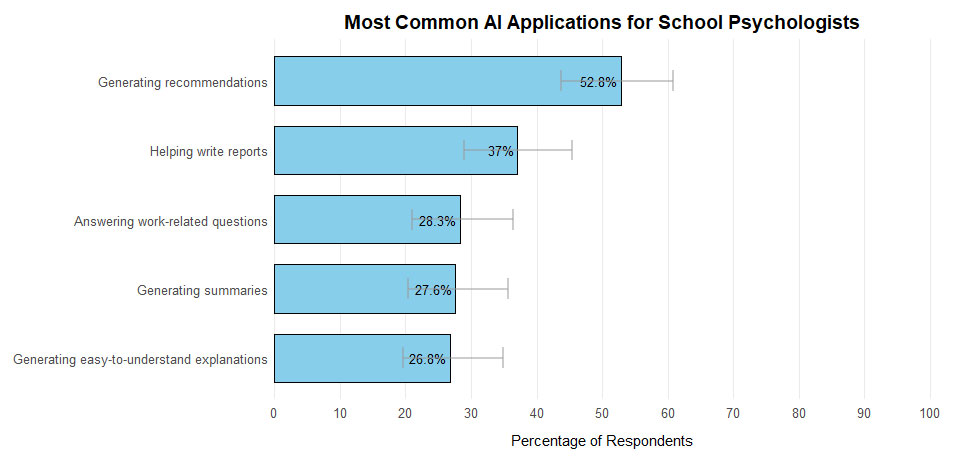
The most common applications include generating individualized recommendations, assisting with report writing, answering work-related questions, and creating accessible explanations of evaluation results for parents. Users estimated that AI saved them a median of 3 hours of work per week.
Note. This horizontal bar chart displays the five most common generative AI applications among school psychologists who reported using AI in their professional work (Farmer et al., in press). Bars represent the percentage of AI-using respondents who endorsed each application, with error bars indicating 95% Wilson confidence intervals. The most common application was generating recommendations (52.8%), followed by help writing reports, answering questions, generating summaries, and generating simplified explanations.
When asked to evaluate AI-generated content, the most common response across all categories was neutral, indicating substantial uncertainty among practitioners. This pattern suggests neither strong endorsement nor strong rejection of AI’s capabilities. That said, half of the participants rated AI-generated recommendations favorably, while opinions were more skeptical regarding AI-written reports and test interpretations. Notably, 94% reported editing AI-generated content before including it in final documents.
Significant ethical considerations emerged. Only 5% of participants reported having workplace AI policies, and most had received no formal training. Disclosure rates were low, with practitioners rarely informing stakeholders when AI assisted with their work. While most school psychologists reported never entering identifiable student information into AI tools, about 6% had done so and 3% were unsure—raising important questions about data privacy and compliance with confidentiality protections.
When asked who bears responsibility for ethical AI use, participants overwhelmingly placed accountability on themselves as individual practitioners, ranking personal responsibility above organizations, professional bodies, and AI developers. This finding aligns with existing ethical codes but also underscores the burden practitioners face when institutional guidance is lacking.
These findings highlight both the potential benefits of AI for addressing workload demands and the urgent need for professional guidance. As AI tools become increasingly more sophisticated, the field would benefit from clear ethical guidelines, formal training opportunities, and institutional policies that support responsible implementation. When integrated thoughtfully, AI can help practitioners allocate more time to direct student services.
Farmer, R. L., Lockwood, A. B., Floyd, R. G., & Sisco, A. D. (2025). How are school psychologists using artificial intelligence in 2024? A descriptive study. School Psychology. Advance online publication. https://psycnet.apa.org/doi/10.1037/spq0000713
About the authors
Ryan L. Farmer, PhD, is director of the Psychological Services Center and of the MA/EdS school psychology program at the University of Memphis. His research examines how school psychologists adopt, maintain, and move away from professional practices, including emerging technologies like AI. Contact Ryan L. Farmer.
Adam B. Lockwood, PhD, is an associate professor at Kent State University. His research examines AI applications in school psychology, including AI-assisted report writing and decision-making.
Randy G. Floyd, PhD, is chair and professor in the Psychology Department at the University of Memphis. His research focuses on psychoeducational assessment, psychometric evaluation, and publication trends and practices in school psychology.
Alec D. Sisco, MA, is a graduate student in the school psychology program at the University of Memphis, working in the research labs of Floyd and Farmer.


 Artificial intelligence (AI) is transforming professional practice across many fields, yet its adoption in school psychology largely has remained undocumented. Given persistent workforce shortages and significant time demands associated with assessment and report writing, understanding how practitioners are integrating AI into their work is essential for developing appropriate professional guidelines and training.