

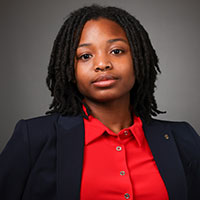
 Chanel Hamilton is a senior at Bowie State University (BSU), majoring in psychology. She is interested in developmental disorders such as attention-deficit/hyperactivity disorder and autism spectrum disorder, specifically in underrepresented communities. Hamilton aspires to conduct research that not only helps the scientific community but also has a lasting beneficial effect on the individuals impacted. Once she completes her bachelor’s degree at BSU, she plans to obtain a doctoral degree in clinical psychology. Hamilton hopes to specialize in assessment, prioritizing early diagnosis and providing lifetime support to ensure certain psychological disorders are not disproportionately affecting people who are members of particular racial groups or of a specific gender.
Student Researcher of Color:
Chanel Hamilton
Research
Tell us about your research.
This summer, I had the honor of representing BSU in the University of Maryland’s (UMD’s) College of Behavioral and Social Sciences Summer Research Initiative. My research partner—Brooke Mengitsu of UMD—and I were selected as the inaugural BSU–UMD Social Justice Alliance research fellows to explore aspects of public perceptions of police brutality in Prince George’s County. I was on an exceptional team with Brooke and our faculty mentors, Ayanna Lynch, PhD, from BSU and Jeanette Snider, PhD, and Rashawn Ray, PhD, from UMD. At the end of this program, I presented my research as a poster titled But How Do You Really Feel?: An Analysis of Empathy Towards Black People in Social Justice Dialogues (PDF, 142KB)opens in new window.
My research was based on data collected by Ray’s Lab for Applied Social Science Researchopens in new window regarding body-worn cameras in Prince George’s County, Maryland. I noticed a pattern in the way the interviewees spoke about social justice issues at the time. Although some interviewees supported the use of body-worn cameras, their reasoning and tone varied. I wanted to understand how there was near unanimous support for body-worn cameras but some interviewees seemed to care less than others. This led to my research centering around how empathy for communities of color can be expressed through spoken and unspoken words.
I analyzed interviews with Asian American and White participants to code for empathetic and nonempathetic responses. I found that most interviewees expressed empathy toward Black and Brown communities of color, but only by a slight margin, which I found surprising. I was honored to present my research at the celebration of the 25th anniversary of the College of Behavioral and Social Sciences Summer Research Initiative. During the event, I even got to meet APA’s CEO, Arthur C. Evans Jr., PhD, which was a highlight of the night.
Area of study
What inspired your interest in this area of study?
Social justice has always been a topic of interest to me, especially as a person of color. The current social–political climate of America is concerning and has been for most of my life, as well as for my generation. Seeing cases like Trayvon Martin and Freddie Grey while I was growing up, I struggled to understand why a just outcome is expected but not received. I constantly felt like my community cared about social justice issues but others—especially legislators and others involved in legal processes—appeared not to. Observing this lack of engagement was extremely frustrating, especially when most social justice issues are resolved within a court of law and by a jury of peers. The subject of empathy became a particular focus for me after I learned about the important role it plays in altruism. As humans, we are more inclined to help those who we identify with; it makes sense to advocate for issues within our own communities. While empathy cannot be completely proven, I wanted to see if it could be analyzed.
Field of psychology
How do you see your research moving the field of psychology?
While conducting my research, I never really thought about how my research could affect or move the field of psychology. During the Summer Research Initiative, I was eager to learn and enjoy my research experience because it would be my first, I hope of many. I also hope that my research could have beneficial applications in identifying harmful biases.
Significance
What policy, practice, and public health significance does your research have?
In the current social–political climate, we are witnessing significant policy changes that are removing the protections and rights of marginalized groups. These changes are often made with harmful rhetoric alleging that they are no longer needed, yet social justice issues continue to arise. The application of my research could help recognize the lack of empathy that underlies such beliefs and rhetoric and find ways to combat it.
Empathy is an essential element of human life. Without it, issues involving the greater good rather than an insular community would not be solved, because people simply would not care. Empathy is needed to find solutions to problems that may not directly involve us but actively harm others. Especially with issues regarding race and gender, when we do not identify as the “other,” we must have empathy to help.
Process
What is something you wish you knew about the research process before you started?
The entire process of my summer research was eye-opening and beneficial to my concept of research, which, until the Summer Research Initiative, I had only seen in classroom settings. I was hands-on with the data that I collected and coded. I was able to learn and truly absorb what happens behind the scene. Going into this process, I was anxious about saying the right thing and making the right decisions when working with my partner and mentors, but in the end I learned that having a team is the best part of conducting research. I was so grateful for the support and feedback I was given along the way, not only from my research team but also from others in the Summer Research Initiative, such as Kim Nickerson, PhD, Britney Robinson, and my Summer Research Initiative cohort. I am not certain there is anything I wish I knew before starting this journey, but one thing I wish I could have told myself before starting was to breathe and fully embrace being on a team.
Plans
What's next for you?
I am excited to continue my academic journey. After graduating from BSU, I plan to gain some postbaccalaureate experience in the workforce before applying to graduate school to pursue a doctoral degree in clinical psychology. The PsyD programs at George Washington University and Loyola University are high on my list.
My contact information is as follows: LinkedInopens in new window
