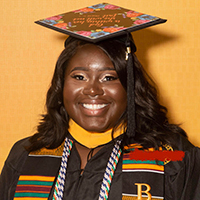
 Fiona Gilpin-Macfoy is a postbaccalaureate fellow at the National Human Genome Research Institute in the Social and Behavioral Research Branch. She received her Bachelor of Science degree in psychology from Bowie State University in 2019. She is a Ronald E. McNair Scholar and served as the undergraduate student liaison and community service chair of the Bowie State chapter of the Psychological Society. Her research interests include psychosis assessments and interventions and mental health stigma in health care. Gilpin-Macfoy’s research has been recognized with honors for her poster presentations during the 2019 and 2020 National Human Genome Research Institute. She plans to pursue admission to a doctoral program in clinical psychology for the 2022–23 academic year.
Student Researcher of Color:
Fiona Gilpin-Macfoy
Research
Tell us about your research.
As an undergraduate, I worked on two research teams at Bowie State University. The first project was entitled “#MeToo? Perceived Cultural Differences in the Current Feminist Movements,” mentored by Dr. Ayanna Lynch and Dr. Derrick Bullock during the Summer Undergraduate Research Initiative. This study explored whether women of color felt included in current cyberfeminism, such as the #MeToo and #TimesUp movements. During this mixed methods study, I analyzed posts on social media platforms, including Twitter and Instagram. I also helped create and disseminate the survey to assess diverse women’s attitudes, experiences, and perceptions of intersectionality and inclusion in current feminist movements. I presented the team’s findings at several regional and national conferences. During the following semester, I worked with Dr. Patricia Westerman on a project titled, “Correlations Between Technology Use and HBCU Students’ Spelling, Grammar, and Recall Accuracy.” This study assessed whether students who frequently used technology for academic purposes (i.e., taking notes, reading electronic books, watching videos) performed poorly compared to students who did not rely on technology for these tasks. I shared these findings in a poster presentation at the APA Annual Convention.
Currently, I am a postbaccalaureate fellow in the National Human Genome Research Institute at the National Institutes of Health. Under my current principal investigator, Dr. Laura Koehly, my primary research focuses on developing a community education program and workbook to highlight the importance of family health history in determining risk for developing certain diseases. The workbook highlights ways to lower risk for heart disease, Type 2 diabetes, breast, colon, and prostate cancer.
Area of study
What inspired your interest in this area of study?
I was initially motivated to be involved in research because I knew it would look good on graduate school applications. What has kept me going and gives me the energy to learn and contribute to research are the people my research will affect. One hundred people may read an article, maybe even cite it for their own work. However, for my research to have a personal impact on even a few people gives fulfillment a whole new meaning. My involvement in the Community Education Program allows me to look at the relationship between health literacy and family health history and communication and how this affects individuals and their entire family network. I get a chance to know the research participants and provide them with a space to talk about health behaviors, family relationships, and their role in their family’s health. This encourages participants to think differently about their own health and their family’s well-being. Although not everyone has a picture-perfect close-knit family, taking a moment to acknowledge even the smallest detail about how they maneuver the topic of health calls for great reflection. Behavior and health outcomes can significantly shape and determine the quality of life.
Field of psychology
How do you see your research moving the field of psychology?
I believe our community education research project provides an excellent framework to disseminate health education and improve health literacy. The Families SHARE workbook and community education program have provided an opportunity to teach participants about various diseases that disproportionately affect people of color. Preliminary findings suggest that communication improves among families as a result of participating in this program. The materials provided and the community education health literacy may affect health choices and behaviors.
Significance
What policy, practice, public health significance does your research have?
Although much of the information we provide has been available for some time, there are still gaps in knowledge within African American communities and among people of color. When you account for income and education, the disparity is even more significant. I can only imagine the gap in knowledge about mental health. During this current political and health climate, more people are opening up about their struggles. The influx of mental health awareness posts on social media has helped people feel more open about their own journey. However, as with all trends, there is bound to be misinformation and pseudoscience, which can be detrimental, especially to those dealing with more severe ailments. Therefore, it is vital to continuously conduct mental health and disease-related research across diverse communities so that findings, interventions, and treatment are culturally appropriate. It is also important to disseminate information and equip people with the tools to improve their overall health.
Process
What is something you wish you knew about the research process before you started?
I have enjoyed my various research experiences, from the mock presentations in my psychology classes to presenting during the APA Convention and now winning awards for my displays at the National Human Genome Research Institute. I have had the opportunity to contribute my ideas and visions, but, most importantly, I’ve been provided the space to learn. One of the most challenging yet rewarding aspects of research is the data. How you collect data is one thing, but having the skills and knowledge to use the appropriate analytical approach is vital. Most of my undergraduate experience was with qualitative data. However, I wish that I had a more robust quantitative-statistical analysis background. Statistics was never my strong suit. Thankfully, Dr. Laura Koehly and the NIH have provided resources and assistance to ensure I am well trained.
Plans
What’s next for you?
During my time as a postbaccalaureate fellow, I have had many opportunities to observe and explore career options. I have solidified my plans to pursue a PhD in clinical psychology. I have several interests, including developing more culturally competent assessments and expanding the ability to identify people at risk for or suffering from severe and aggressive mental health symptoms. I am also interested in helping educate those in prison on their stressors and triggers before their release back into society. In the meantime, I’ll continue to work on my current projects and hone my skills while discovering how my future research can best affect those around me.