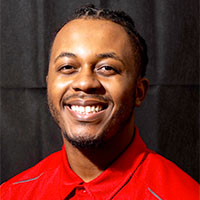
 Kendell Kelly is a second-year master’s candidate in the School Psychology Program at Bowie State University in Bowie, Maryland. A graduate of two historically Black colleges and universities (HBCUs), Kendell received an associate’s degree from Southwestern Christian College in Terrell, Texas, and a bachelor of science degree in psychology from Bowie State University. His research interests include restorative justice, race-related stress, the school-to-prison pipeline, and other disparities that negatively affect the Black community.
Student Researcher of Color:
Kendell Kelly
Research
Tell us about your research.
I had the chance to be part of research teams and institutes in my undergraduate education, which strengthened my interest in research. The “Hidden Struggles”* study, which looked at race-related stress, was my first opportunity to design a study. It focused on how racism and police brutality were affecting Black men in college. There was a gap in the literature as it related to the experiences of young Black men. I wanted to explore commonalities in the experiences of Black men attending college to see if they were experiencing similar things and if these issues were affecting their studies. Much like now, events in society were triggering feelings of anxiety and depression in Black men. I was studying at an HBCU, and I noticed that little effort being made to address these issues. So I told one of my professors that I was interested in the effect of race-related stress among men who were dealing with these issues at an HBCU. My current research is investigating the implementation of restorative justice practices in predominately Black schools, and the results from those practices.
Area of study
What inspired your interest in this area of study?
For the Hidden Struggles study, I really wanted to be part of the solution instead of complaining about the problem. As an HBCU student, I wanted to use my voice, and research was a great way to do that. My current research on restorative practices is consistent with my interest in researching disparities that negatively affect the Black community, finding inadequacies, and improving them. Research suggests that restorative justice can be an effective option to reduce suspension, improve the school environment, and prevent infractions from occurring. The systems change that comes with the proper implementation of restorative justice can disrupt the school-to-prison pipeline. I hope to further this research particularly within predominately Black schools, to improve environments where restorative justice currently exists and effectively expand proper implementation to other areas.
Field of psychology
How do you see your research moving the field of psychology?
I think that my research on race-related stress among Black male students will ultimately help increase retention and graduation rates among this group. Stress, coupled with financial need, is one of the primary factors that lead to college dropout and prolongs matriculation. Dealing with the mental health needs of students will increase retention, improve the overall student experience, and enhance the sense of community on campus. It will also focus on student needs instead of numbers. Sharing this research humanizes students, particularly Black males. The culture of HBCUs has historically focused on caring for students versus seeing them as a business transaction, which unfortunately is where I think most schools are now. I see my research as continuing to examine issues that disproportionately affect the Black community. More specifically, I am interested in researching effective trauma counseling among Black men and women, effective marriage and family therapy practices among Black families, and the psychology of Black Christianity.
Significance
What policy, practice, public health significance does your research have?
My research has significant policy implications. Restorative justice practices can improve disciplinary policies that attempt to isolate and exclude as opposed to treat and build community. One improvement that could be taken from my research would be intentional steps to build communities that include people of all backgrounds. Schools historically have left in place policies and practices that are detrimental to minority populations. The results will shed light on the importance of continually adjusting to the students’ greatest needs and accepting the responsibility to ensure a healthy community for all. The race-related stress that affects those in oppressive environments can negatively affect the entire school community. The results of my research will be a step in the right direction to influence change in the way that we think about structuring environments that include Black students and closing the gap in the field and practice that exists for Black mental health.
Process
What is something you wish you knew about the research process before you started?
Although I started research early in my undergraduate career, I wish that I had known more about research and its impact even before I started. A feeling of never knowing enough exists within research, which can be motivating. But it can also limit the freedom that you have as a researcher. Had I known more about the research process earlier, I would have retained more from all my classes. Research has an interdisciplinary approach to it that is not always explicitly taught. For example, psychological research may include aspects that are specific to the medical field outside of psychology. If I had been able to tie my biology class to my psychology research, I believe my experience would have been tremendously enhanced.
Plans
What’s next for you?
Once I receive my master’s degree in school psychology, I hope to move forward into a doctoral program in either school psychology or counseling psychology. I am looking to hone my research skills and further research in areas near my interests where there are gaps.
Date created: December 2020