skip to main content

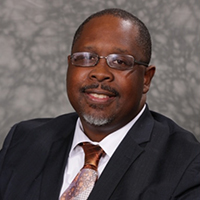
Michael McGee Micheal McGee is a graduate student in the counseling psychology program at Bowie State University (BSU). A former health care senior management professional, McGee worked in the disability field for over 20 years, serving people from diverse populations with developmental or intellectual disabilities and mental health disorders. McGee has been the director of residential services at EPIC (formerly Southern Maryland Vocational Industries), director of employment services at MVLE, mid-Atlantic executive director at Sunrise Community Services, executive director for United Cerebral Palsy of Maryland, a member of the 2021 cohort of the White House HBCU Scholars Recognition Initiative, and the Maryland Counseling Association Emerging Leader of 2020–2021.

With a generous heart, McGee passionately gives back to his community. He is a researcher for the Atikal Foundation, a nonprofit organization that celebrates survivors of domestic violence and cancer while bringing awareness to the mental health issues often precipitated by traumatic experiences. He serves as a court-appointed special advocate for foster youth.

Research

Tell us about your research.

My research focuses on traumatic stress and how generational trauma correlates with psychological development over the human lifespan, beginning with fetal development. Consider that at 20 to 25 weeks of pregnancy, the fetus’s nervous system and brain are developing while the fetus is taking on the mother’s hormones. So, if the mother’s world is not right, the environmental stressors in her world are going to affect the child that she’s carrying. This child experiences all the mother’s stress, which affects the child’s ability to handle stress later in life. If you look at the diathesis–stress model and you take one mother who had two children at different stages of her life—with one child, she did not have ecological community supports; with the other child, she did have those ecological supports—now we can observe using research why her children may be responding to the same stressors in different ways later in life. I am working to connect the beginning of life to Erik Erikson’s trauma-focused theory.

Area of study

What inspired your interest in this area of study?

The phenomenal Dr. Joy DeGruyopens in new window inspired my interest. She has coined the term “post traumatic slave syndromeopens in new window” and is trying to get it into the Diagnostic and Statistical Manual of Mental Disorders. The effects of generational trauma on oppressed groups, especially marginalized communities of color, need further investigation. The role multigenerational trauma plays in human development and how it can be genetically coded from individual to individual theoretically is the missing link to certain behaviors.

I became very excited when I saw her work because she’s filling in a knowledge gap. It also gave me what I needed to say, “I can do this too.” Then, with BSU supporting me in every area, from research to all the different opportunities that they have gifted me, I think that I’m moving in the right direction. I’m so excited to be a part of the psychological community as a scientist. I can say that now.

I believe that God put me on this earth for one reason and one reason only: to serve others. Through that service, I can give back. However, in 2015, I lost the ability to walk due to workplace stress. I had a supervisor who made it very difficult for me as I led a team of 19 managers, 17 group homes, and 132 staff members. He terminated all my managers and told me I had to do the work of my director’s position, the work of all the house managers, and the work of the program managers. I went on and said, “OK, I’m going to just go ahead and deal with this and see what I can do.” In retrospect, that was the wrong thing to do, because the stress that decision brought demobilized me.

In October 2015, my wife and I were at an event, and I passed out. By the time I got to the hospital, I had lost the ability to walk. Literally, I couldn’t catch my balance, I couldn’t stand, I couldn’t do anything. The doctors could not figure out what was going on. At that point, I decided that if the doctors couldn’t tell me, then I needed to look at the research and figure it out for myself. With support from my therapist and my professors, I did the research and found a couple of potential diagnoses. It turned out that my traumatic work experience brought on posttraumatic stress disorder, anxiety, major depression, and insomnia. Although I am now permanently disabled, I can walk with assistance.

I chose to pursue my master’s degree in counseling psychology because I wanted to understand what was happening to me, and I wanted to be that person who could help someone else get through what I was just starting to come out of.


Field of psychology

How do you see your research moving the field of psychology forward?

Right now, I am building a research firm. We will support young researchers of color, helping them to advance their research agenda. I am currently applying for a business license, building a team of student researchers, and searching for grants. I already have two community clients.

Significance

What policy, practice, or public health significance does your research have?

I am conceptualizing a stage theory that addresses how human behavior is influenced before birth. It extends the nature-versus-nurture discussion, which I believe will push psychology forward the same way that the insights of Erik Erikson, Sigmond Freud, Jean Piaget, and all the others did back in their day. The only difference is that the technology available now can give us better insight into the human brain and the physiological makeup that makes people who they are. At this pivotal point, we can use nanochips to identify and measure stress and virtual reality to address human behaviors.

Also, one of the organizations that I’m working with is building a Level II trauma center in Southeast Washington, D.C., a marginalized community of color with a long history of generational trauma. They often don’t get the services or the resources they need. This will be the first-ever Level II trauma center in that area. I am conducting research using different measurements and instruments for community surveys, so the organization has the necessary data to move the trauma center project forward.

This is an important project for me, because when I was going through my traumatic health experience, I didn’t know what was going to happen to me. I ended up finding sources of support, but what about those people who live in these communities and have no support? They must go across town to a hospital that doesn’t want to take them in the first place. This trauma center will be an opportunity for people to be assessed right away in their community by their own people. Our goal now is to build trust within the community so we can partner with this marginalized group through empirical studies.

Process

What is something you wish you knew about the research process before you started?

I wish I would have understood statistics a lot better! I love doing assessments now, I love doing measurements, but it took me a while to get here. I did not realize the importance of math when I was growing up. However, now I love numbers and the critical thinking that comes with math. Another thing I wished I knew before starting my research was how easy it is to go down a rabbit hole. I was blessed to have someone in my corner who said, “All right, Micheal, I see where you want to go with your research; but keep a notebook on the side because you’re coming up with so many good ideas. You might have multiple topics and articles that you can write.” Research excites me because there is just so much out there to learn.

Leadership

Can you tell us a little bit more about the leadership role in governance that you play currently?

I’ve been the president of the Graduate Student Associationopens in new window for the last two and a half years. I’m also vice chair of Bowie State University Council. Having a seat at the table, talking with the administrators and the staff, and being able to carry that information back to the students and advocate on their behalf is important to me. Once again, I’m a servant. And I recently became the human rights chair for the Maryland Counseling Associationopens in new window. I’m trying to tie in all these different elements of my advocacy work to trauma. I use all my leadership roles to inspire others to do something greater as well.

Educational trajectory

Did being a nontraditional student have an impact on your interests, your drive, and how you see your place in the field of psychology?

It did. I started my college career at the age of 43 years, and being an older student brought a different set of disciplines. When you have work experience before starting college, you know what life is really like out there, so you know what the struggles are. When you get the opportunity to go to school, it’s no longer just a pastime or something you do to get by. It’s a serious commitment to do something that will make things better for yourself, your family, and your community.

Plans

What’s next for you?

My next step is to pursue a doctorate in neuropsychology. I want to teach at the collegiate level. I also want to build my research and counseling firm. I like to speak and conduct training about mental health and the effects of trauma on the lifespan of development, so maybe I will become an author and a keynote speaker specializing in generational trauma. The best advice that someone gave me was that as a counselor with a doctoral degree, you can apply yourself in so many different areas.

I’m at that point of life where I need to capitalize on everything. Once again, the education must come first, then the service, and then all the other things will fall into place.

Advice

What's your best advice to students or researchers who are taking on this endeavor?

Change your thinking. I was initially afraid of research because of the statistics and because I didn’t think I was a strong writer. In my very first undergraduate research class, I went in saying, “I’m going to be the best researcher ever.” I kept telling myself that over and over. By the end of the class, I started loving research, using statistics, and doing measurements. These are things that can be learned.

Also, none of us are perfect. If you must rewrite a chapter or two, if you must step away from your research and come back to it, that’s OK. Research takes time and effort; the more you pour into developing your interest, the better you will become at conducting research.

And finally, learn to live your research. We must embed ourselves in what we are doing and not be afraid of research. Once you get to the results stage, you’re going to see what you have created, and it is almost like you have had a child, because you are going to take care of it, you are going to nurture it, you are going to grow it. We love our friends; we love our families—research can be just like that. It can be a part of the family. That’s the way I look at it.

Date created: April 2022

Spotlight on Student Researchers of Color

Students and recent graduates of historically Black colleges and universities highlight their recent research projects, share their reasons for pursuing careers in psychology, and discuss their plans for the future.

Explore series