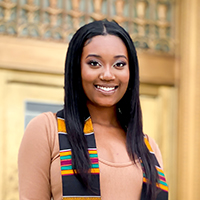
 Mone’ Warrenopens in new window is a recent graduate of Bowie State University, having earned her degree in child and adolescent studies. She is a member of the National Honor Society and graduated summa cum laude. As she moves forward in her professional career, her goals are to make mental health resources more accessible to children and to help implement trauma-informed curricula into school systems. She wants to become a child and family counselor and eventually transition into a role offering the opportunity to shape social policy.
Student Researcher of Color:
Mone’ Warren
Research
Tell us about your research.
The name of the project I work on is Reimagine Policing: What are African Americans’ Perceptions about What is a Just Criminal Justice System?
We were exploring how to move forward with a criminal justice system without excessive police force and looking at whether a retributive or restorative criminal justice system is more beneficial, meaning, should the offender be directly punished and put in jail for the crime that they committed, or should the offender and the victim come together and mediate the situation, create a resolution? We approached this question through focus groups, including with the law enforcement personnel—so, police officers—criminal justice students at Bowie, and members of the community, including people who were formerly incarcerated or were victims of police brutality.
The highlight of conducting research for me was taking part in focus groups. Our research was centered around criminal justice reform. I did the literature review before we began the focus groups, but when we were talking to the law enforcement personnel or talking to men who were formerly incarcerated, I learned so much about policy and how it works, and how certain policies target specific demographics.
Prior to this project, I had the most experience with qualitative data. Conducting the focus groups allowed me to step outside of my comfort zone—talking to the focus groups and transcribing was new for me. I appreciated getting that experience.
Area of study
What inspired your interest in this area of study?
I was initially inspired by my mother and my grandmother. I come from a line of women in human services. My mom is a social worker, my grandmother was a counselor, and so that is how I was introduced to the field. Initially, I was an education major. That is how I wanted to work with children. While working in the classroom, I was commended more on how I dealt with the children behaviorally, and I noticed that when it comes to children, I had more of a passion for mental health advocacy as opposed to an academic approach.
That is what led me to child and adolescent studies, because I like that it gave me the opportunity to explore different fields. With the education major, I was limited to an academic setting, but with child and adolescent studies, I was able to take various classes. I took a policy class. I took a class in occupational therapy. I took a bunch of different classes to help me properly align my goals.
My area of focus was more on the practitioner side; I explored a couple of different routes. I was looking at play therapy, occupational therapy, and traditional mental health counseling, which is where I ended up. I was interested in public policy, and I still am. I think that is my ultimate career goal. I think that I want to start my career by doing hands-on work and then move to a career where I can make an impact on the community as a whole.
Field of psychology
How do you see your research moving the field of psychology?
I think the African American community deserves to have a platform where our feelings are validated. As a community, we have had so much trauma across generations. For us to heal as a community, we first must acknowledge and validate the experiences that we have had. The research we did helped me to look outside of myself and my community, get a glimpse into the reality of others. It enforced the importance of cultural competence.
It is especially important that post pandemic school curricula are trauma informed, prioritizing the social and emotional aspects of student development over the academic aspect. Post Pandemic, it is more important to teach children how to process what they are feeling in the midst of what has been happening rather than solely placing the focus on academics. This is an imperative part of eliminating the school-to-prison pipeline.
Interviewing African American men who were formerly incarcerated was the most informative. What stood out to me is that after they were released from jail, they took time to do their own research about how the system was created to target minority demographic groups and how the criminal justice system could be reformed. I appreciated learning about how they reclaimed their power after a traumatizing situation.
Significance
What policy, practice, public health significance does your research have?
I think our research can help shape criminal justice reform. When we spoke with law enforcement personnel, they made it very clear that their job was to enforce the policy. They were not the initial creators of the policy. Our research can help the policymakers reform the structures in place that have police officers without cultural competencies going into these overpoliced communities. Lack of cultural competencies is the major issue, I think, and our research can help address that.
Process
What is something you wish you knew about the research process before you started?
I wish I would have known that there were so many different variations of research. The research that I was exposed to growing up was only related to STEM. I never got to explore the social sciences. My fifth grade science fair project was the only exposure to research that I got before college. Knowing that there is such an interdisciplinary approach to research, that there are so many different fields you can tap into, is exciting. I also found myself taking information that I learned from my general education—like science—classes and my department classes and merging them together. That is what I wish I would have known earlier: that we can draw on so many different types of research and knowledge to inform the research that we do.
Plans
What’s next for you?
I work at an occupational speech and physical therapy office. It is more down the practitioner route, but my work deals with patient care management. I see myself going back to school and getting a degree in mental health counseling. My ultimate career goal is to be a policymaker. I want to help implement trauma-informed curricula, because I think that they can help eliminate the school-to-prison pipeline. Through our research, I saw again something I have always seen just growing up being a Black woman, but it was highlighted to me more through the focus group members: Children of color and Black children are criminalized from a young age. I think that implementing a trauma-informed curriculum can help these children be seen as human and as children, which they are not always seen as.
My next steps are getting my master’s degree in mental health counseling and becoming a licensed clinician.
Representation
To what extent do you feel mentoring has made a difference for you in that representation of seeing yourself in these places and spaces in the field?
Mentoring has helped me expand my possibilities. I do not always give myself as much credit as I could. My mentor, Dr. Barnett, has been my biggest supporter, providing me with connections. Mentoring helps me to see my own potential.
It was also great having women in my family like my mother. My mom was also taught by Dr. Barnett. She was one of the first students in the Bowie State University child and adolescent program, part of the first graduating class. Dr. Barnett knew me from those days—my mom sometimes had to bring us to class! My mom always says to me that I have no excuses, and I can’t disagree with her. Having role models in my life to help me understand that I can overcome any obstacle has made a world of a difference to my college experience and even my postgraduate experience.
I love that story about my mom and me. That is a bond that we will have forever. I appreciate that.
Advice
What advice would you give people who may not think research is for them?
One of the most important things to remember about research is that it is something you already do daily. Even if it is not formal, you are always observing; you are always collecting your thoughts, thinking about how you can apply the information you have learned in one area to another area.
And another important thing about research is to home in on what your passion is. That is another thing about policy, too—if you are removed from what you are working on in policy or even in the human services field, if you are not passionate about it, the days can get rough. It can get tiring; it can get discouraging. Being passionate about what you are working on is what will fuel success in a field like this.
Date created: April 2022