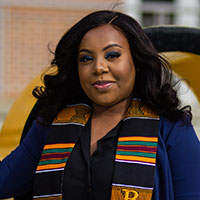
 Shannel Blake is a May 2020 graduate of the Department of Psychology at Bowie State University. She is a native New Yorker, and proudly represents the Bronx. Shannel decided to further her education at the first historically Black college in Maryland, Bowie State University. She majored in psychology with aspirations to become a forensic psychologist. Beginning in her freshman year, Shannel had the opportunity to be immersed in several mentored research experiences at Bowie State. Additionally, as a Ronald McNair Scholar, Shannel spent two summers immersed in diverse research topics, from correlates of academic persistence to distinctions in dolphin communication. Each of these helped her embrace her identity as a social scientist and refine her personal research ideas. Currently, she is interested in exploring how social media affects perceptions of law enforcement, juvenile delinquency in minority communities, and the effectiveness of police psychological evaluations in the United States. She plans to use her gap year to prepare for graduate school and aims to connect with mentors that can elevate her career to the next level.
Student Researcher of Color:
Shannel Blake
Research
Tell us about your research.
My research was about the influence of social media on people of color’s perception of police misconduct. I wanted to assess if social media plays a role in how people perceive the police. I worked alongside faculty from the Psychology, Child and Adolescence Studies, and Criminal Justice departments to put together a research study. Since this was an ongoing study in the spring 2020 semester, during the COVID-19 pandemic, we were only able to obtain a small sample size from a historically Black university. The randomly selected participants were given a survey that assessed their attitudes toward the police, their use of social media to follow the news, their age when they became aware of police misconduct, and experience with police misconduct. The findings of this study revealed that (a) increased consumption of social media news leads to a less favorable impression of the police; (b) the younger participants were when they experienced police brutality, the greater their consumption of social media news; and (c) experience with police misconduct is associated with increased consumption of social media news.
Area of study
What inspired your interest in this area of study?
This research was inspired by my dream of becoming a licensed forensic psychologist and by seeing the impact of being a minority in America during the digital era. I want to work within police departments and administer psychological evaluations to those who want to become police officers. I believe there is a relationship between police officers’ policing and psychological evaluations. If there are more effective psychological evaluations for police officers, then there will be more competent officers helping communities regardless of their ethnic background. I also wanted to do research on this because I am apart of the digital era where everything is being recorded. Police brutality cases are not being swept under the rug because minorities are starting to record and post their encounters with police officers. I wanted to examine the relationship between people of color’s perceptions of the police and social media.
Field of psychology
How do you see your research moving the field of psychology?
I can see this research shedding light on how minorities’ negative encounters with police at a young age can create a mentality that police officers should not be trusted. This mentality increases the chances of social activism. This research can also bring attention to stressors faced by young minorities when it comes to law enforcement and how they use social media as a weapon to fight against corrupt cops.
Significance
What policy, practice, public health significance does your research have?
This research can help police departments develop better training for officers so that they do not use excessive force unnecessarily, create effective disciplinary actions, and boost educational requirements for becoming an officer. Police officers can use forensic psychologists to monitor effective strategies for interacting with civilians and pinpoint gestures that may trigger a negative mental reaction from minorities. This can also push politicians to create legislation that will hold police officers accountable. Officers who commit murder, use excessive force, or racially profile civilians should receive punishment without pay. Education may also be an alternative route for police officers to interact with civilians. Since the police academy is not an effective training tool, police departments could look at this research and opt for individuals to complete a 4-year degree in criminal justice.
Process
What is something you wish you knew about the research process before you started?
Before I started this research, I wish I knew more about starting a study from scratch. In the past, I was assigned to research projects that had already collected data. I wish I knew more about organizing data, constructing survey questions, and how to make sure that the scale of measurements for the surveys are appropriate.
Plans
What’s next for you?
The next step for me is to take a gap year to prepare for graduate school and search for a forensic related internship. I want to make sure that when it’s time to go to grad school, I am confident with my decision.