

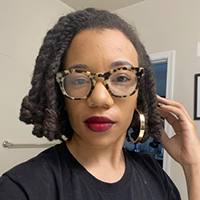
 Tiffany Cunningham is a native of Washington, DC, and a senior in the Department of Behavioral Science & Human Services at Bowie State University in Bowie, Maryland. She is currently pursuing a bachelor of science degree in child and adolescent studies while working as an educational aide for DC Public Schools. Cunningham is a Ronald E. McNair Scholar and also serves as a BlackBoard Peer Mentor, assisting fellow BSU students with all problems pertaining to the BlackBoard platform. During the spring semester of 2021, Cunningham was actively involved in research on advancing the demarginalization of students of color.
Student Researcher of Color:
Tiffany Cunningham
Research
Tell us about your research.
I am currently a research mentee working with Dr. Ruth Ann Leslie and Dr. Kim Barnett from the Department of Behavioral Sciences and Human Services at Bowie State University. I have been assisting with research for a chapter in “The Black Experience and Navigating Higher Education Through a Virtual World” on advancing the demarginalization of African American students. It has to do with the intersection of class, gender, and mental health issues. All of these things have been affected by COVID-19 and students’ experiences with online learning. The chapter is a theoretical discussion, but we conducted focus groups with students from historically Black colleges and universities (HBCUs) to get their perspectives about the effect of the pandemic on education.
Area of study
What inspired your interest in this area of study?
This is my first real research project, besides working on papers for classes. It originally started as graded assignment in the winter, but, because of my interest, it continued as a formal research assistant position this spring. The time and effort I put into it now is greater than when it was for a grade—before, I just passed the time to get it done. Now, I am genuinely invested. My first task was doing cross-references for my research team. The more connections I made, the more interested and invested I became in what we were doing. I used to dread having virtual meetings and talking about the research. Now, I am on top of the reading. Assisting with the focus group was a really good experience. I was able to hear other people’s experiences and perspectives. It was interesting to see how some are different and others are the same—there were even similarities between the perspectives of students and my mentors.
As an educational aide in the DC Public Schools, I am on both sides of the fence: I see first-hand how students are struggling with online learning. However, I am a college student, too, and it has been hard. So, it was good to hear how my peers feel and then hear from my mentors, too. It gave my mentors a better understanding of why some students cannot get online for their virtual classes. For example, some students told us they did not turn on the camera during class, because the connection became unstable when the camera was on. Even on an individual level, I felt like every participant got something out of it. We are currently in the process of analyzing the data—finding themes and supporting quotes.
Field of psychology
How do you see your research moving the field of psychology?
Our study will help others understand how HBCU students have experienced the pandemic and their perspective on online learning and how it affected their grades. It will also inform others about mental health issues among students of color and different genders and give other people an understanding of the bittersweet effects of online learning. The experiences vary widely—seniors and freshman have very different perspectives and abilities to adapt.
Significance
What policy, practice, public health significance does your research have?
Our research will also help on an academic level. Lots of students are doing the assignments but not learning or retaining the information. It’s not that the professors are not doing everything right—it has just been hard for many students. That perspective would be good for professors to have. Having the focus groups was very helpful. This will help students and professors better understand online learning and a virtual world in the future, if a crisis like this ever happens again.
Process
What is something you wish you knew about the research process before you started?
I wish that I had realized sooner that everyone is a researcher—they just don’t know it! Even when people look up information on Google and go from article to article, they are engaging in research. The Ronald E. McNair Scholars program is very focused on research. Even when you are applying to grad school, research is the focus of everything. I really appreciate being in the McNair program. It helps us learn about research through hands-on experiences.
I wish I had known that actually conducting research was a time-consuming process. Previously, I only did research for school, and it was never really intense. It primarily consisted of researching scholarly articles. Hosting focus groups while being in a pandemic, working, and doing other things put it all into perspective. Conducting research is a very involved process. I also did not think that qualitative research would be as relevant.
Before this experience, when I thought of research, I only thought of STEM. I never realized that social science researchers present their research. I did not see it as being on the same scale as natural science or STEM. Recently, I did my first research presentation. It made me realize that even small research projects matter—social science matters! You don’t really hear much about social science unless you are in the field. For example, in grade school you don’t have classes about psychology; the focus is only on math and science. Our yearly science projects were never about the research of everyday life or people, like how kids feel. You do not grow up learning about how social science shapes our everyday life. Even though my passion is about people’s experiences and that is the focus of my major, I did not realize how important social science was until I had the opportunity to actually participate in this research.
Plans
What’s next for you?
I am working on another research project this summer with Dr. Barnett and Dr. Leslie to support a chapter about retributive versus restorative justice for an upcoming book, Reimagining Policing. I will be organizing and facilitating focus groups with criminal justice majors, parents, and law enforcement and will help with analyzing the transcripts. I am not certain yet about my career. However, I think I want to go into social work. As an educational aide, I cannot have as intimate a relationship with clients as I would like. Being born and raised in Southeast DC, I have a strong passion to work with this population on a socioemotional level. Many students in public schools need more than they are getting. However, I have other interests: Some days I want to go into education policy, some days I want to go into social work. I am really torn between both because I feel that there are not enough Black and Brown people working in public policy. Until then, I am looking forward to graduating in December 2021.
Date created: October 2021
