

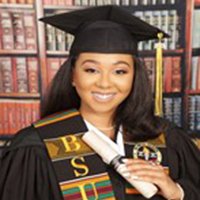
 Tiffany Eller is a recent graduate of Bowie State University (BSU), having earned a master’s degree in counseling psychology in the fall of 2020. She also earned a bachelor’s degree in psychology with a minor in philosophy from BSU in 2014. Her research interests include generational trauma, family and interpersonal relationships, personality development, assessments, and parenting styles. Eller plans on pursuing a doctorate in clinical psychology. She hopes to start a private practice, conduct research, and teach. In her personal time, Eller enjoys painting, yoga, cooking, and cleaning.
Student Researcher of Color:
Tiffany Eller
Research
Tell us about your research.
Throughout my graduate career, I worked on a few research projects. My first research assignment was my seminar paper. I examined father involvement and how it relates to adult self-esteem. This interest was sparked by reading a book by a past professor, Dr. Petty. The book, Thug Love: Why Women Are Attracted to Bad Boys (Petty, 2014), examined stories of women in abusive relationships in an attempt to find some of the reasons why women tend to stay in them. He found one of the common themes with the women he interviewed was low self-esteem. In doing my own research about self-esteem, I noticed that parental relationships play a part in levels of self-esteem. So, my study examined father involvement during childhood and adolescence to determine whether there is a relationship between that and adult self-esteem. My second research project, the one I am most proud of, is featured in a book called The Black Experience and Navigating Higher Education Through a Virtual World (Hairston et al., 2021). My chapter, titled “Transitioning During a Pandemic to Maintain Mental Health” (Eller, 2021), highlighted Black student perspectives of the pandemic. Whenever people talk about how challenging the pandemic has been, you mostly hear about younger students or working adults, so I thought it was important to shed light on university students’ experiences—particularly those of Black students.
Area of study
What inspired your interest in this area of study?
My first study ties into my general research interest in family and interpersonal relationships and parenting styles. During my senior year as an undergraduate student at BSU, I studied relationship satisfaction and self-esteem and really became fascinated with how people interact in relationships. So I knew for my graduate research I wanted to look at family and interpersonal relationships. For my second research project, I was asked by my mentor, Dr. Hairston, to be a part of her book The Black Experience and Navigating Higher Education Through a Virtual World (Hairston et al., 2021). I wanted to contribute to the book in a personal and authentic way. So I thought the best way to do that would be to share other students’ experiences that showcase what a lot of us dealt with and are still dealing with. What I really loved about my chapter was offering mental health advice to other students who may be struggling during the pandemic. I think a common theme for most students is that they feel alone or that they might be the only person struggling. So I hope that students who read my chapter will know they are not alone and use some of my tips, like deep breathing, creating a self-care plan, and staying active.
Field of psychology
How do you see your research moving the field of psychology?
Right now, everything is changing because of the pandemic. A lot of people are struggling with adjusting to a new normal. For students, that means online classes, no face-to-face interaction—and half the time when we are in virtual calls or classes, cameras are off and microphones are muted. It can be very challenging to interact with a blank computer screen. I can imagine especially for underclassmen how frustrating it is starting off their university experience under these conditions. I see my chapter opening the door for Black research and for minority students and their mental health. In general, there is a lack of representation on Black experiences in higher education—hence why our book was so important. I hope my chapter encourages more conversations about student experiences during the pandemic and even afterward to really look at how we can help students succeed.
Significance
What policy, practice, public health significance does your research have?
COVID-19 hit us 2 years ago, so the research on the effects the pandemic has had on students is fairly new. However, I think it shines a light on students’ mental health as a whole. In my chapter, I discussed one student whose prepandemic struggle with anxiety was heightened when we went into lockdown. My hope is that my research sheds light on how important therapy is not only for ourselves but as a community, to help it progress. I see research like mine becoming more prevalent in hopes that it is conclusive enough for politicians or those in charge of school systems to take mental health just as seriously as physical health. That would look like creating laws and funding programs to help minority communities deal not only with the pandemic but also with the underlying issues the pandemic has brought out. Although my research is primarily for students, it can also be applicable for working adults. Right now, government employees are beginning to transition to in-person work after being completely remote for 2 years, and with that comes a lot of hesitancy.
Process
What is something you wish you knew about the research process before you started? Were there things you wish you had greater access to that may have helped to make the experience easier for you?
I really love doing research. For me, it is like doing a puzzle. I love coming up with theories or questions and then doing the research to find some answers. The hardest part about doing research is the unexpected turns it can take. I am a person who likes to have a plan and stick to it, but oftentimes I have found myself having to adjust my plan of action based on how the study is going.
Plans
What’s next for you?
I plan on getting my doctorate in clinical psychology. As a master’s student, I became intrigued with examining family systems and how they work together. More specifically, I am curious about how previous generations affect the family systems of today. Studying generational trauma will also help other families and cultures to resolve their trauma. I intended to focus on communities that have experienced tremendous amounts of generational genocide, such as BIPOC (Black, Indigenous, and people of color) communities, as well as those who are Jewish. Examining the trauma experienced by these specific cultures will offer insight to explain the behaviors of people today. Being able to investigate this phenomenon will promote generational and cultural healing while also advancing this field of research. In the long term, I am interested in doing psychological assessments—personality tests, intelligence tests, aptitude assessments, and so on. I see myself starting my own practice while conducting research and possibly teaching part time.
Citations
Eller, T. (2021). Transitioning during a pandemic to maintain mental health. In K. R. Hairston, W. M. Edmonds, & S. P. Clark (Eds.), The Black experience and navigating higher education through a virtual world (pp. 185–199). IGI Global. https://doi.org/10.4018/978-1-7998-7537-6.ch010opens in new window
Hairston, K. R., Edmonds, W. M., & Clark, S. P. (Eds.). (2021). The Black experience and navigating higher education through a virtual world. IGI Global. https://doi.org/10.4018/978-1-7998-7537-6opens in new window
Petty, R. D. (2014). Thug love: Why women are attracted to bad boys. Xlibris.
Date created: April 2022
