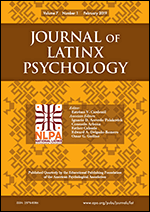


This special issue highlights how methodological advances can advance research on parenting, relationships, community contexts, intersectional identities, intersectional oppressions, and international contexts
Three empirical examples demonstrate methodology with Latinx populations of children and parents, romantic partners, and adults in community contexts.
Three conceptual papers provide guidelines on effective implementation of qualitative methods with Latinx populations, an overview of intersectional approaches to quantitative analyses, and insight into how international collaborations can advance global Latinx psychology.
Guest Editors
Table of contents
View the table of contents with abstracts on APA PsycNETopens in new window
- Introduction to Special Issue on Research Methods and Design Considerations With Latinx Populations
Andrea J. Romero and Adriana J. Umaña-Taylor - Associations Between Maternal Control and Child Defiance Among Puerto Rican-Origin Adolescent Mothers and Their Toddlers: A Person-Centered Examination
Lauren E. Wood and Josefina M. Grau - A Dyadic Data Analytic Primer: An Illustration With Mexican-Origin Couples
Lorey A. Wheeler, Kimberly A. Updegraff, and Adriana J. Umaña-Taylor - Engaging Promotora-Led Community-Based Participatory Research: An Introduction to a Crossover Design Focusing on Reproductive and Mental Health Needs of a Latina Community
Ada M. Wilkinson-Lee, Alexandra M. Armenta, Velia Leybas Nuño, Martha Moore-Monroy, Allison Hopkins, and Francisco A. R. Garcia - Intersectionality Research Within Latinx Mental Health: Conceptual and Methodological Considerations
Lucas Torres, Felicia Mata-Greve, Claire Bird, and Erick Herrera Hernandez - Cuéntame: The Promise of Qualitative Research With Latinx Populations
Edward A. Delgado-Romero, Anneliese A. Singh, and Jhokania De Los Santos - Scaling Out Evidence-Based Interventions Outside the U.S. Mainland: Social Justice or Trojan Horse?
Melanie M. Domenech Rodríguez, Ana A. Baumann, Alejandro L. Vázquez, Nancy G. Amador-Buenabad, Natalie Franceschi Rivera, Nydia Ortiz-Pons, and J. Rubén Parra-Cardona