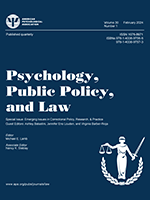

The year 2017 marks the 125th anniversary of APA's founding. Like many other APA journals, Psychology, Public Policy, and Law is marking this occasion by publishing a special issue highlighting significant contributions by legal and psychological scholars to the development of policy and law while outlining fruitful directions for future research.
The articles are focused on topics about which psychology has made substantial contributions to policy and/or law, as well as on topics where psychological scientists and legal scholars have so far failed to shape policy and practice, despite solid relevant research.
Each article in this issue is best characterized as a forward-looking piece that both reviews the important research that has been conducted and helps frame the agenda for future policy/practice-focused research.
Table of contents
View the table of contents with abstracts on APA PsycNETopens in new window
Introduction
- Psycho-legal Researchers' Impact on Policies and Legal Practices: Past and Future
Michael E. Lamb
Articles
- The Psychological Science of Racial Bias and Policing
Jillian K. Swencionis and Phillip Atiba Goff - Adolescent Brain Science and Juvenile Justice Policymaking
Laurence Steinberg - The Case for Double-Blind Lineup Administration
Margaret Bull Kovera and Andrew J. Evelo - Developing an Evidence-Based Perspective on Interrogation: A Review of the U.S. Government's High-Value Detainee Interrogation Group Research Program
Christian A. Meissner, Frances Surmon-Böhr, Simon Oleszkiewicz, and Laurence J. Alison - Understanding Guilty Pleas Through the Lens of Social Science
Allison D. Redlich, Miko M. Wilford, and Shawn Bushway - Cross-Examination: A Defense
John E. B. Myers - The History and Future of Prison Psychology
David M. Bierie and Ruth E. Mann - Promises and Pitfalls of Evidence-Based Policymaking: Observations From a Nonpartisan Legislative Policy Research Institute
Rebecca Goodvin and Stephanie C. Lee - Psychology and Child Protection: Promoting Widespread Improvement in Practice
Theodore P. Cross and Irit Hershkowitz