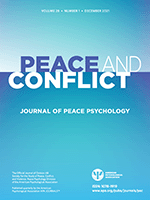


Table of contents
View the table of contents with abstracts on APA PsycNet
Introduction
- Putting Science to Work for Peace: A Special Issue in Honor of Emile Bruneauopens in new window
Samantha L. Moore-Berg, Boaz Hameiri, and Laura K. Taylor
Articles
- Translating Social Science for Peace: Benefits, Challenges, and Recommendations
Samantha L. Moore-Berg, Karen Bernstein, Roman A. Gallardo, Boaz Hameiri, Rebecca Littman, Siobhan O’Neil, and Michael H. Pasek - Giving Peace a Chance: Lessons From Translational Research in Colombia
Andrés Casas and Boaz Hameiri - Putting Theory Into Peaceful Practice: Insights and Reflections on the Process of Coproducing a School-Based Intergroup Relations Intervention With Teachers
Shelley McKeown, Thia Sagherian-Dickey, Jasmine Kwong, and Jaysan J. Charlesford - Harnessing the Power of Group Norms to Improve Children’s Intergroup Relationships
Carmelle Bareket-Shavit, Michelle M. Wang, and Steven O. Roberts - Understanding Intergroup Conflict: How Do Children in a Divided Society Perceive Group Differences?
Lipaz Shamoa-Nir, Irene Razpurker-Apfeld, Jocelyn B. Dautel, and Laura K. Taylor - Leveraging Knowledge About Historical Diversity: A Meta-Analysis of Findings From the School of Dialogue Intergroup Intervention
Anna Stefaniak, Michael J. A. Wohl, Michał Bilewicz, and Jakub Petelewicz - Inventing New Road Paths for the Contact Theory Through Contact With a Puppet (a “Syrian Refugee Child”) via a Teacher-Led Intervention in a Greek Primary School
Pavlina Charalampidou and Charis Psaltis - Do Infrahumanization or Affective Prejudice Drive Teacher Discrimination Against Romani Students? A Conceptual Replication of Bruneau et al. (2020) in Germany
Sauro Civitillo, Francesca Ialuna, Dwayne Lieck, and Philipp Jugert - Hierarchies of Being Human: Intergroup Dehumanization and Its Implication in Present-Day South Africa
Melike M. Fourie, Melanie Deist, and Samantha L. Moore-Berg - The Role of Empathy in Reducing Hate Speech Proliferation. Two Contact-Based Interventions in Online and Off-line Settings
Wiktor Soral, Katarzyna Malinowska, and Michał Bilewicz - How Intergroup Contact Shapes Intergroup Attitudes and Construals of Relations Between Ethnic Groups: Evidence From Bosnia and Herzegovina
Brooke Burrows, Linda R. Tropp, Trisha A. Dehrone, and Sabina Čehajić-Clancy - Coming Together After Genocide: How Openness to Communication About Conflict Experiences Shapes Willingness for Social Integration in Post Genocide Rwanda
Trisha A. Dehrone, Linda R. Tropp, Brooke Burrows, Rezarta Bilali, and Joel Ginn - Deeds, Not Words: Understanding Intergroup Apology and Forgiveness From Different Sides of Conflict
Marina Štambuk, Dinka Čorkalo Biruški, and Iva Kapovic´ - When an Injured Group’s Socio-Economic Status Signals Forgiveness Expectancy in Perpetrators: The Moderating Role of SDO
Masi Noor and Jane Quek - Peace Psychology in Kashmir: Reflections of a Frontline Practitioner
Ufra Mir and Paul Bueno de Mesquita