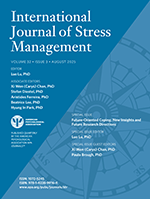

This special issue responds to recent discussions concerning the limited quantity of published scholarly research on occupational stress-management interventions. It has two purposes:
- to showcase research discussing recent innovations in stress management and how best to provide evidence that these innovations are actually having an impact
- to highlight the "global" quality of occupational stress-management research by encouraging submissions from both developed and developing countries
Guest Editors
Table of contents
Theory and Methods to Prevent and Manage Occupational Stress: Innovations From Around the Globe
Pages 1–6
Brough, Paula; Dollard, Maureen F.; Tuckey, Michelle R.
Tackling Psychosocial Risks and Work-Related Stress in Developing Countries: The Need for a Multilevel Intervention Framework
Pages 7–26
Kortum, Evelyn; Leka, Stavroula
Evaluation of a Participatory Risk Management Work Stress Intervention
Pages 27–42
Dollard, Maureen F.; Gordon, Jacqueline A.
Enhancing Work-Related Attitudes and Work Engagement: A Quasi-Experimental Study of the Impact of an Organizational Intervention
Pages 43–68
Biggs, Amanda; Brough, Paula; Barbour, Jennifer P.
Intervention Studies on Enhancing Work Well-Being, Reducing Burnout, and Improving Recovery Experiences Among Hong Kong Health Care Workers and Teachers
Pages 69–84
Siu, Oi Ling; Cooper, Cary L.; Phillips, David R.
Process Evaluation for Organizational Stress and Well-Being Interventions: Implications for Theory, Method, and Practice
Pages 85–111
Biron, Caroline; Karanika-Murray, Maria
Advancing Occupational Stress and Health Research and Interventions Using Latent Difference Score Modeling
Pages 112–136
Eschleman, Kevin J.; Lahuis, David