

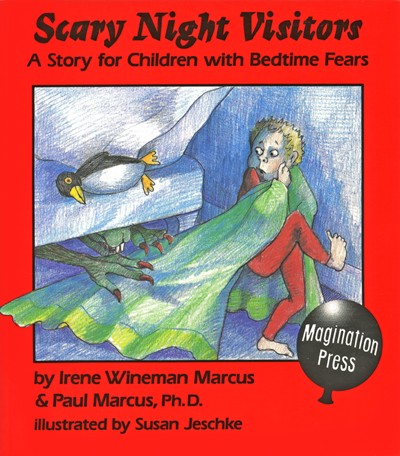
Scary Night Visitors
Many children have bedtime fears, starting as young as two years old and sometimes lasting several years. Scary Night Visitors helps parents explain the origins of these fears to their children.
Instead of describing monsters as clothes on a chair or ghosts as wind in the trees, this lively story presents them as projections of a child's own anger and jealousy. Davey—and through him the reader—learns that thoughts and wishes are not as powerful as he fears, so he can feel safe enough to let himself experience his emotions directly without imagining scary creatures.
Parents and mental health professionals will find this book an engaging tool for ameliorating this common but troubling childhood problem.
Irene Wineman Marcus is a child psychoanalyst trained under the directorship of Anna Freud at the Hampstead Child Therapy Clinic. She is a member of the Association for Child Psychoanalysis and the New York Freudian Society and is in private practice.
Paul Marcus, PhD, is a clinical psychologist and psychoanalyst in private practice in New York City, and a member of the National Psychological Association for Psychoanalysis.
Susan Jeschke is an award-winning author and illustrator of books for young readers. Among her many titles are Firerose, an ALA Notable book, and The Devil Did It, a winner of the Dorothy Canfield Fisher Children's Book Award.
—Jules Glenn, MD, clinical professor of psychiatry, former president, The Association for Child Psychoanalysis