


According to APA’s 2026 Chatbots and Mental Health Survey, psychologists are reporting that patients are starting to look beyond traditional psychotherapy to manage their mental health. Patients are turning to artificial intelligence (AI) and chatbots to supplement their relationships with licensed mental health professionals.
As millions of people engage with generative AI to assist with their work, their personal lives, and their mental health, APA surveyed more than 1,200 licensed psychologists in the U.S. who are directly involved in patient or client care to understand how this reliance on AI is affecting mental health care.
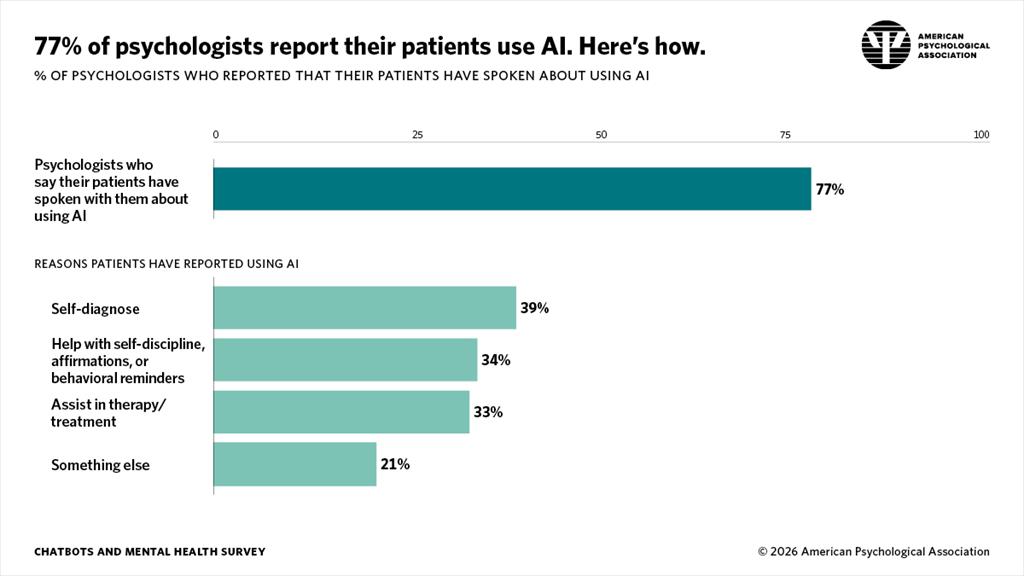
The survey found that a vast majority of psychologists (77%) have spoken with patients who have used AI for support, engagement, or other reasons.
This may not reflect the true percentage of people turning to chatbots for mental health advice, as the survey only captures psychologists’ interactions with existing patients. Many people—especially teens and adolescents—may be using AI as a more affordable and accessible option for mental health advice.
However, AI is not a safe or effective replacement for a qualified mental health provider and should be used carefully. To that end, APA created a guide to navigating AI-generated advice thoughtfully and safely to provide users with evidence-based suggestions on appropriate and inappropriate uses of AI to address mental, emotional, and behavioral health issues.
Related
Further reading
Practice Update

Majority of psychologists say patients are using AI
When asked whether AI has come up over the course of their practice, more than three-quarters of psychologists (77%) said that they have patients who have spoken with them about using AI to find a diagnosis, seek emotional support, or just as a conversational partner. Notably, nearly two in five psychologists (39%) have had patients who said they used AI to self-diagnose—even though commonly used AI chatbots are not designed to interpret psychological tests or diagnose mental health or medical conditions.
A third of psychologists (33%) reported that their patients are using AI as a tool to assist in their therapy or treatment, and a similar percentage (34%) said that they have patients who use AI to help with self-discipline, affirmations, or behavioral reminders.
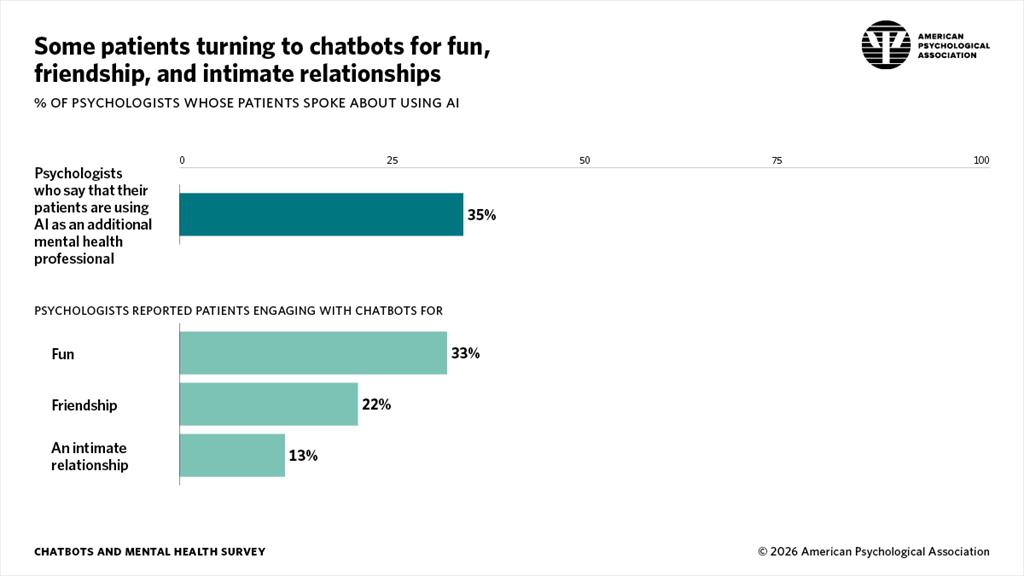
More than a third of psychologists (35%) also said their patients are using AI as an additional mental health professional, though it is unclear whether they are using validated technologies grounded in psychological research and tested by experienced clinicians or consumer-facing chatbots designed for entertainment or other general uses. There were indications that patients may see AI as more than a therapeutic tool; psychologists reported they had patients who engaged in conversations with chatbots for fun (33%), for friendship (22%), and for intimate relationships (13%).
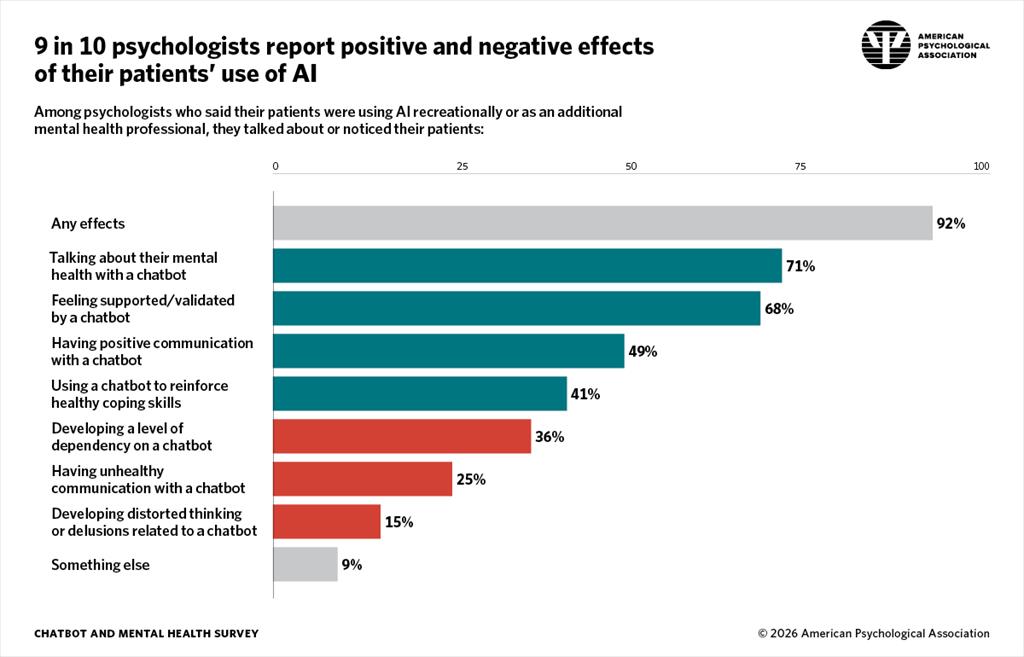
Among psychologists whose patients developed a relationship with a chatbot—as an additional mental health professional or as a conversation partner—many psychologists noticed positive effects. Close to three-quarters (71%) of these psychologists said their patients talked about their mental health with a chatbot and 68% said they noticed their patients felt validated or supported. Psychologists were mixed on whether these conversations were helpful for patients or not; half of psychologists (49%) said they talked about or noticed their patients having positive communication with a chatbot, but 25% said the communication was unhealthy.
Though few psychologists reported their patients using chatbots in unhealthy ways, more than a third (36%) said they noticed their patients developing a level of dependency on a chatbot and 15% talked about or noticed their patients developing distorted thinking or delusions related to a chatbot.
Before using AI: What you should know about how AI works
- AI tends to agree with you. It is designed to reinforce your perspective rather than challenge it.
- AI can sound confident, even when it’s wrong. AI often presents information clearly and decisively, which can make that information seem more accurate or credible than it is.
- AI generates responses, but it doesn’t reason like a mental health professional. AI answers are based on patterns in language, not in understanding your personal context or research-based clinical judgment.
From APA guide to navigating AI-generated advice thoughtfully and safely
A lack of trust in the safety and effectiveness of chatbots
Psychologists’ attitudes toward the use of chatbots for mental health advice are characterized by significant caution regarding safety and privacy. Almost every psychologist (97%) felt that chatbots may inadvertently reinforce negative behaviors or delusional beliefs and 94% said that the current version of chatbots cannot treat conditions with an appropriate amount of nuance.
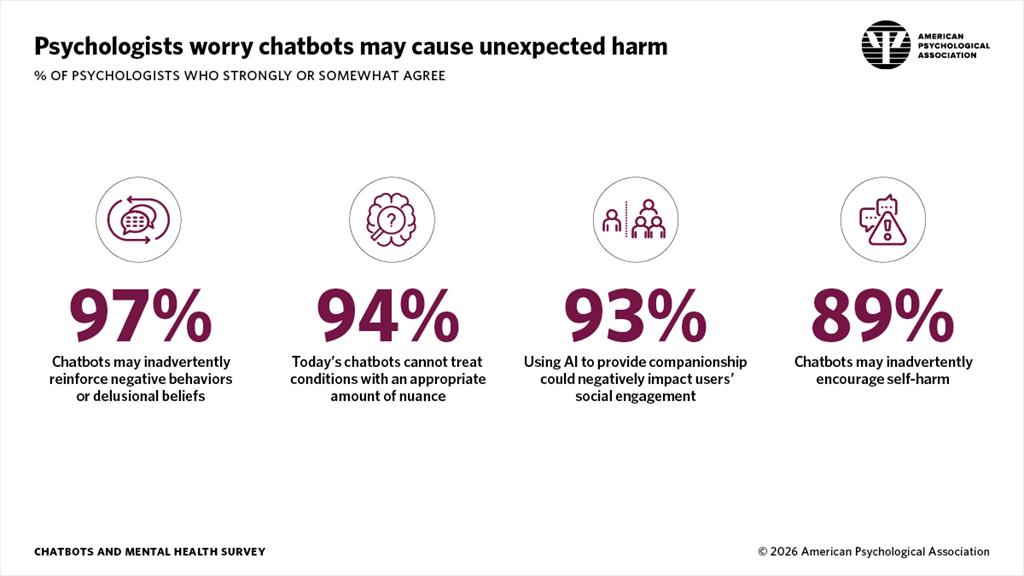
Psychologists raised concerns about more severe consequences if patients rely on AI for mental health advice, since most chatbots lack the legal and ethical guardrails of a mandated reporter. Close to nine in 10 psychologists (89%) worried that chatbots may inadvertently encourage self-harm, underscoring instances where AI failed to properly identify when users were experiencing a crisis.
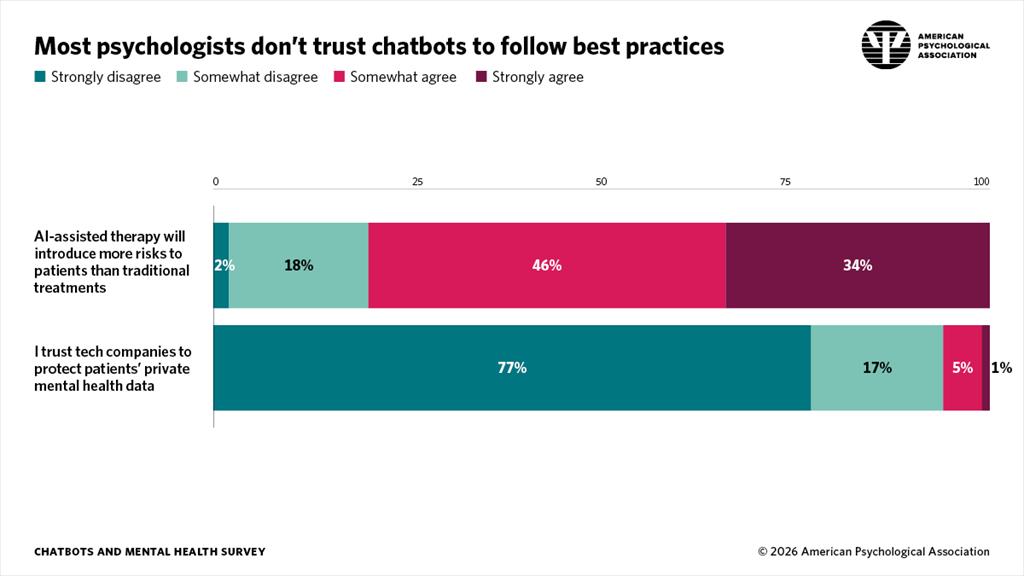
At the root of these concerns may lie significant distrust in the tech companies designing these chatbots. More than nine in 10 psychologists (94%) do not trust tech companies to protect patients’ private mental health data; more than three-quarters (77%) said they strongly feel that way.
How to improve safety while using AI
- AI can offer guidance on how to find a licensed mental health professional, including helping you brainstorm questions to ask about training, specialty area, and expertise when selecting one.
- AI can help you practice therapeutic homework exercises you learned in treatment with a human mental health professional.
- Ask AI to challenge your thinking or provide alternative perspectives—for example, “What might I be missing?”
- Ask for several options instead of a single answer. This allows you to see different possibilities rather than getting one fixed response.
From APA guide to navigating AI-generated advice thoughtfully and safely
Questions remain about AI’s potential to provide support—or reinforce bad habits
Given their concerns about the overall safety and effectiveness of chatbots, more than nine in 10 psychologists (94%) reported they have concerns about some of their patients engaging with chatbots—emphasizing the risks of relying on AI as a sole resource for mental health advice or guidance.
One reason psychologists cited for their concern is that AI may be too convenient, making it easier for patients to turn to AI rather than exercising their own creativity or decision-making skills. More than four in five psychologists (83%) felt that patients’ use of AI to perform tasks could lead to reduced critical-thinking skills. And while 55% of psychologists agreed that chatbots have the potential to reduce loneliness, 93% said that using AI to provide companionship could negatively impact users’ social engagement.
Psychologists commonly worried about patients falling into the “sycophancy trap,” where the agreeable nature of AI’s design reinforces a patient’s maladaptive thoughts, cognitive distortions, and avoidant behaviors. Patients who seek advice or a diagnosis from AI before consulting with a psychologist may also be less open to considering information that contradicts their preconceived ideas.
However, more than half of psychologists (54%) said they felt comfortable with some of their patients engaging with chatbots. This may be attributed to the increasing availability of products that have been designed to improve well-being based on psychological research and expertise. Especially when used in consultation with a licensed psychologist, these products may be able to help patients practice therapeutic exercises or consider new perspectives.
How to think critically about AI advice
- Do not accept AI advice at face value. Many chatbots were not created or tested with health care in mind.
- Any advice from AI that points toward harm to yourself, others, or anything living is a clear signal to step away. There are no circumstances under which anyone should follow such advice.
- Do not make major life decisions based solely on what a chatbot says without discussing the decision with trusted people first.
From APA guide to navigating AI-generated advice thoughtfully and safely
Familiarity with AI shapes psychologists’ perceptions
Among psychologists, a minority have adopted AI tools into their professional and personal lives, which may explain why only a quarter of psychologists (26%) consider themselves very or extremely knowledgeable about AI. Approximately a quarter of psychologists (24%) use AI at least weekly for work, though a slightly larger percentage (32%) use AI at least weekly in their personal lives.
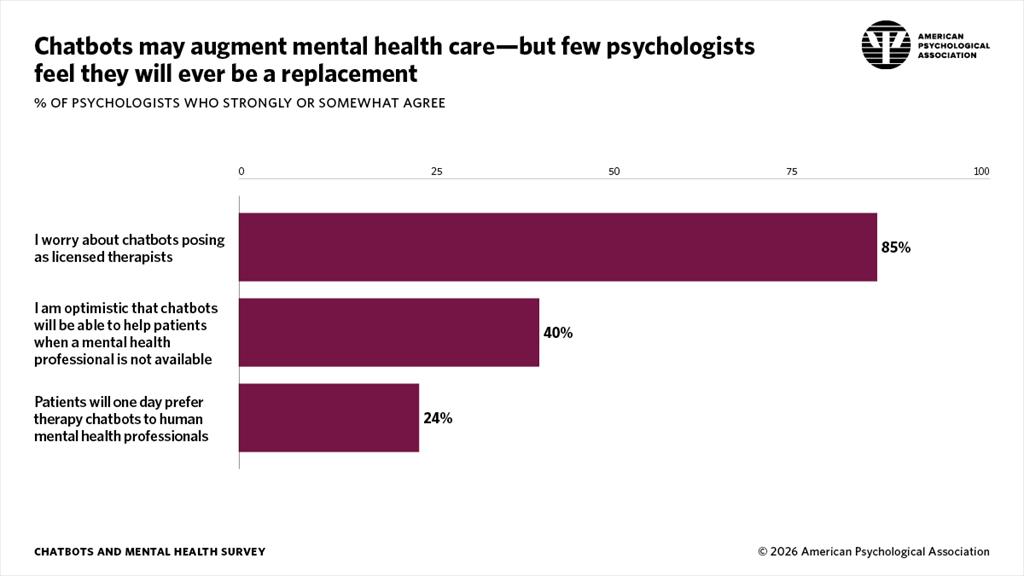
Psychologists who use AI frequently in their personal and professional lives tend to hold more positive views of the use of AI in psychological practice. Almost half of psychologists (47%) said that AI will likely make mental health professionals more effective in treating patients and 40% felt optimistic that chatbots will be able to help patients when a mental health professional is not available. For psychologists who use AI at work at least monthly, these percentages rise to 79% and 59%, respectively.
There is still some doubt amongst psychologists about the impact of AI on psychology. While 50% of psychologists have used AI at work at least several times—for writing emails or taking clinical notes among other tasks—they appear to be less confident that chatbots can handle sensitive patient relationships. More than four in five psychologists (85%) said they worry about chatbots posing as licensed therapists.
Early career psychologists (those who earned their doctoral degree within the last 10 years) were less likely than psychologists in advanced career stages to believe that AI can be used safely and effectively in a clinical setting. When considered with the fact that less than a quarter of psychologists (24%) believed that patients will one day prefer therapy chatbots to human mental health professionals, this suggests that psychologists are generally confident that human relationships between mental health professionals and their patients provide benefits that AI cannot yet replicate.
APA guide to finding safe support from AI
For people already working with a licensed mental health professional, AI can be helpful for organizing thoughts, generating ideas, and prompting reflection. However, it is not a safe or effective substitute for care from a trained professional, especially for mental health needs.
The APA guide to navigating AI-generated advice thoughtfully and safely offers evidence-based suggestions on appropriate and inappropriate uses of AI to address mental, emotional, and behavioral health issues.
- AI should not be your only resource to relieve mental health symptoms. When possible, consult a licensed health care provider about your mental health needs. Instead of using AI to supplement professional care, consider engaging a trusted friend or family member.
- Verify any mental health or medical information you receive from AI with a health care practitioner. AI may use a confident or supportive tone, and even cite legitimate sources, but can still be wrong or missing key information.
- AI is not an accurate way to diagnose mental health or medical conditions. AI is known to mistake routine difficulties and problems for mental health symptoms and may offer misleading or inaccurate diagnoses or treatment options.
- AI can help you come up with questions or organize your thoughts before an appointment with a mental health professional. Be mindful that the information you share with AI is not kept private, including test results and other health-related information.
- Be honest with your mental health professional or health care team if you are using AI for support, so they can ensure what you’re learning aligns with your treatment goals.
- Remember: Feeling better does not always mean getting better. AI is designed to respond in ways that feel validating or relieving in the moment. That does not necessarily mean the response is accurate, safe, or helpful for your long-term well-being.
View the full APA guide to navigating AI-generated advice thoughtfully and safely