


For some workers, technological advancements—especially artificial intelligence (AI)—are leading to concern about what the future may hold. Some people worry about AI replacing their job, while others are concerned about being monitored by technology at work and the ways that might invade their privacy.
APA’s 2023 Work in America™ survey data showed connections between these worries and psychological well-being. The findings revealed that those who report having concerns related to AI and monitoring technology in the workplace were more likely to also report certain signs of diminished psychological and emotional well-being, although there is no confirmation of the root cause of these feelings.
More Work in America
The impact of artificial intelligence on psychological well-being
Close to two out of every five workers (38%) reported worrying that AI might make some or all of their job duties obsolete in the future. These worries, which may be similar to what the media has labeled “AI anxiety,” are important because the data also revealed correlations between these feelings and other mental health concerns, as well as general workplace concerns.
[Related: Worried about AI in the workplace? You’re not alone]
Worry about AI in the workplace associated with negative mental health
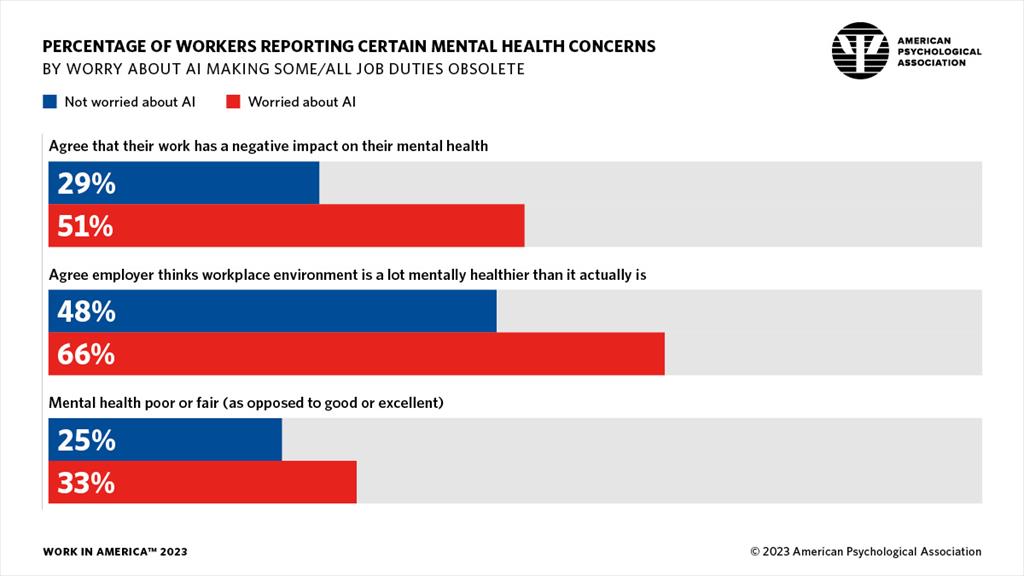
Around half (51%) of those who reported being worried that AI might make some or all of their job duties obsolete also reported that their work has a negative impact on their mental health, compared with 29% of those who did not report being worried about AI. Similarly, 66% of those who said they were worried about AI reported believing that their employer thinks their workplace is a lot mentally healthier than it actually is, compared with 48% of those who did not report being worried about AI. In addition, 33% of those who reported being worried about AI also reported that their general mental health is poor or fair (as opposed to good or excellent), as compared with 25% of those who did not report being worried about AI.
In one striking example, when asked, “What are the most important things your employer either is doing or should be doing to help protect and foster your emotional and psychological well-being?” a male worker from the Midwest said:
“No more robots and AI crap.”
Worry about AI associated with stress and other feelings often associated with burnout
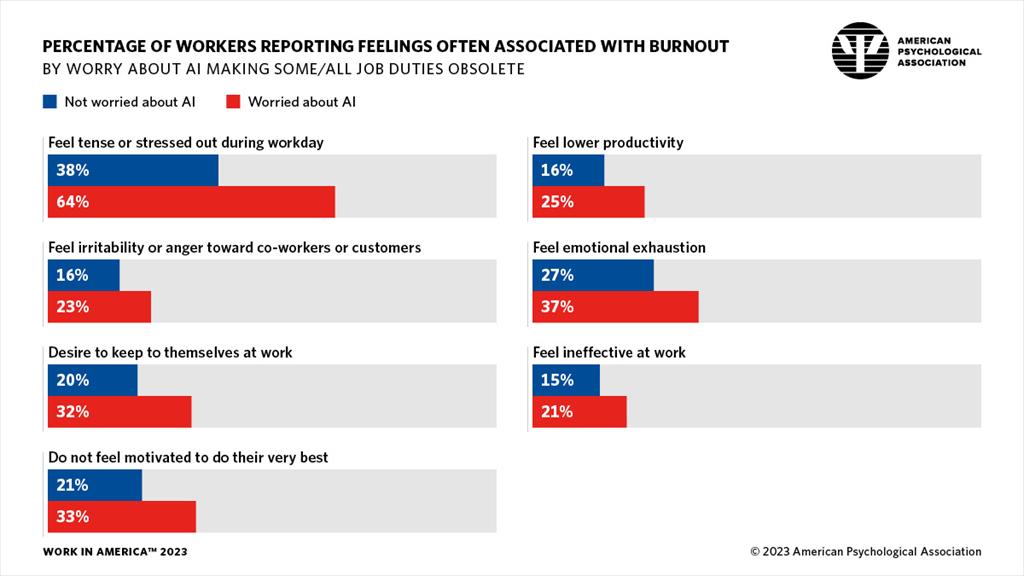
Survey data also revealed relationships between worries about AI and stress as well as other negative feelings often associated with workplace burnout. Nearly two-thirds (64%) of those who reported being worried about AI possibly making some or all of their job duties obsolete also reported typically feeling tense or stressed during the workday, compared with over one-third (38%) of those who did not report being worried about AI.
Compared with those who did not report being worried about AI, those who reported concern also more frequently experienced feelings at work that are often associated with workplace burnout, such as irritability or anger toward coworkers or customers (23% vs. 16% of those who do not worry about AI), a desire to keep to themselves (32% vs. 20%), not feeling motivated to do their very best (33% vs. 21%), feelings of lower productivity (25% vs. 16%), feelings of emotional exhaustion (37% vs. 27%), and feelings of being ineffective (21% vs. 15%).
“It’s very important that workplaces communicate information regarding any changes related to AI clearly and honestly. Fear of the unknown and loss of a sense of control are directly related to psychological distress, occupational stress, and strain, as well as negative physical health outcomes. Providing information about the use of AI and allowing employee input into such changes will significantly alleviate these outcomes.”
- Leslie Hammer, PhD, emerita professor of psychology at Portland State University and codirector of the Oregon Healthy Workforce Center at the Oregon Health and Science University
Worry about AI associated with not feeling valued at work
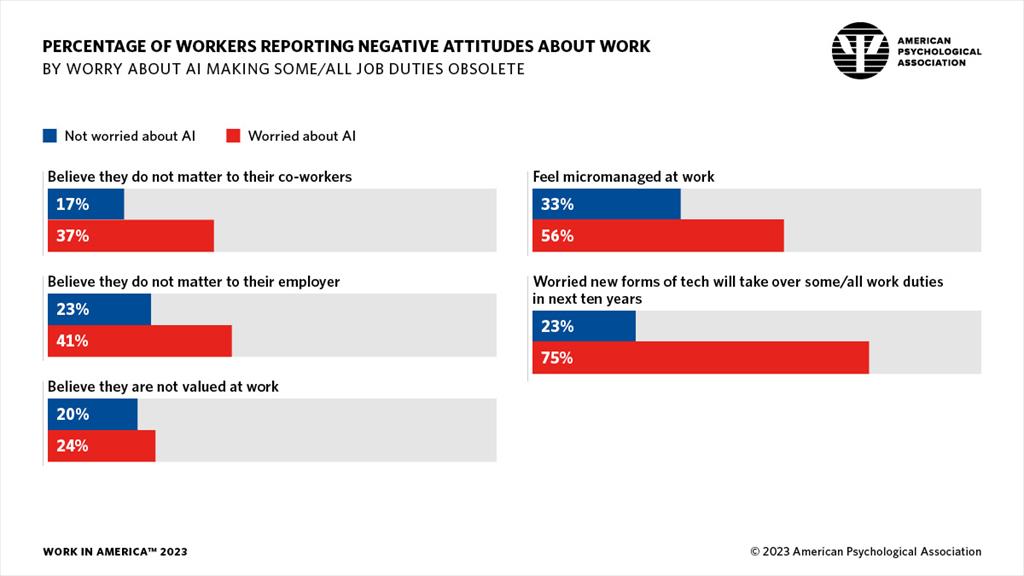
Workers who reported being worried about AI possibly making some or all of their job duties obsolete in the future more often reported feeling that they do not matter at their workplace (to their employer [41% vs. 23%] or their coworkers [37% vs. 17%]), that they are not valued at work (24% vs. 20%), that they are micromanaged (56% vs. 33%), and that they are worried new forms of technology will take over some or all of their work duties within the next 10 years (75% vs. 23%), compared with those who are not worried about AI. Mattering at work has been identified by the U.S. surgeon general as one of the “Five Essentials for Workplace Mental Health and Well-Being” in his report released in October 2022opens in new window.
Worry about AI associated with intent to seek a new job with a different employer
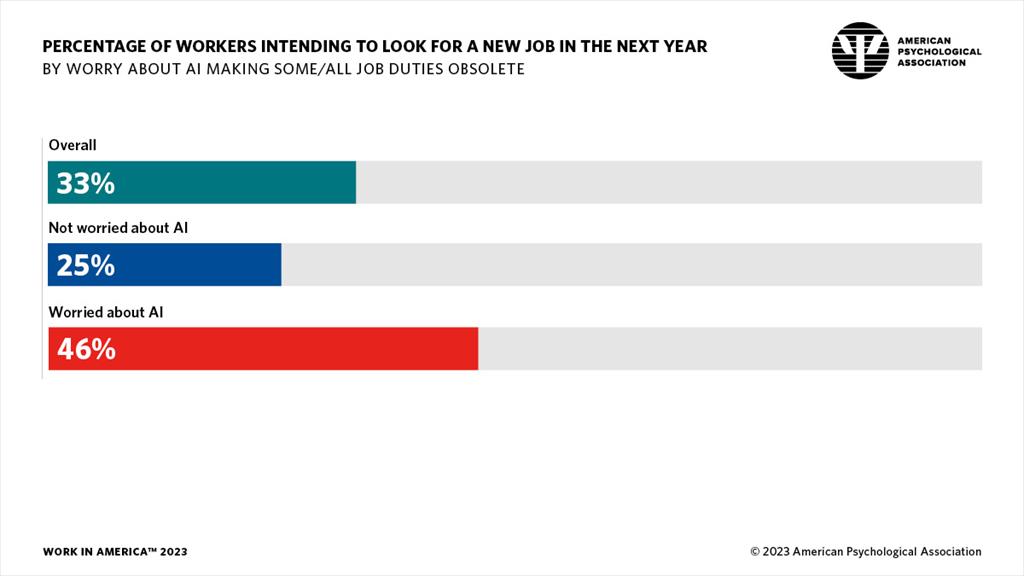
Employee retention is crucial for organizations. It is cost effective due to reduced recruitment burden, and it also helps maintain institutional knowledge, stabilize organizational culture, promote team cohesion, and maintain customer/client relationships. Among all workers surveyed, 33% reported that they intend to look for a new job at a different company or organization within the next year. However, the number was higher among those who reported being worried about AI possibly making some or all of their job duties obsolete in the future: 46% of those individuals intend to look for a new job, compared with 25% of those who did not report being worried about AI.
Certain groups more likely to express worry about AI
Worries about AI are disproportionately associated with some groups of workers more than others, such as people concerned about the potential of a future economic slump, workers under age 58, and people of color.
Workers concerned about an imminent economic slump
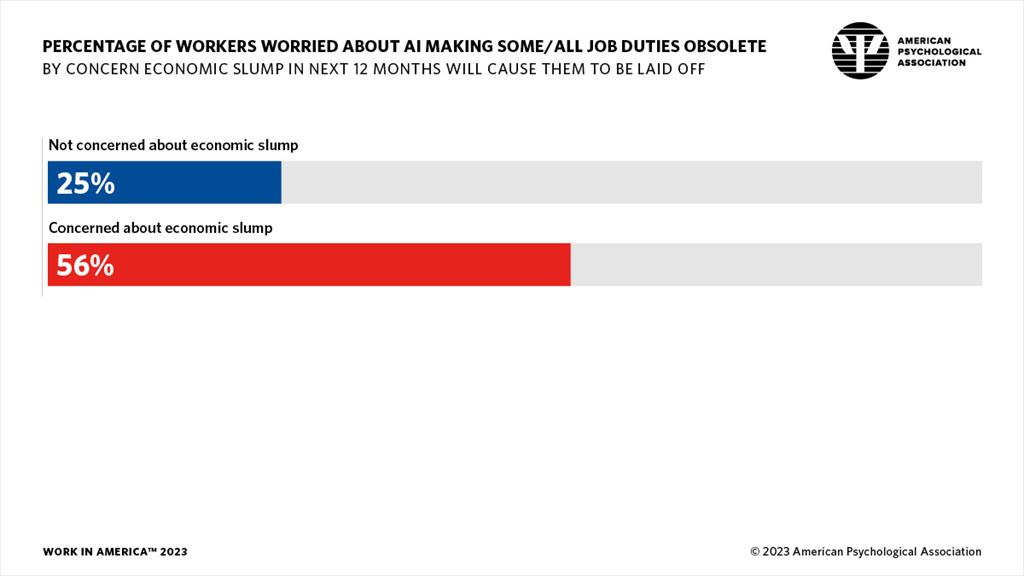
Workers who reported being concerned that an economic slump, downturn, or recession will cause them to be laid off, furloughed, or lose their job in the next 12 months more often expressed worry about AI. Specifically, 56% of those concerned about an economic slump also expressed concern about the possibility of AI making some or all of their job duties obsolete in the future, compared with only 25% of those who reported not being worried about an economic slump.
Younger workers more concerned about AI replacing their jobs
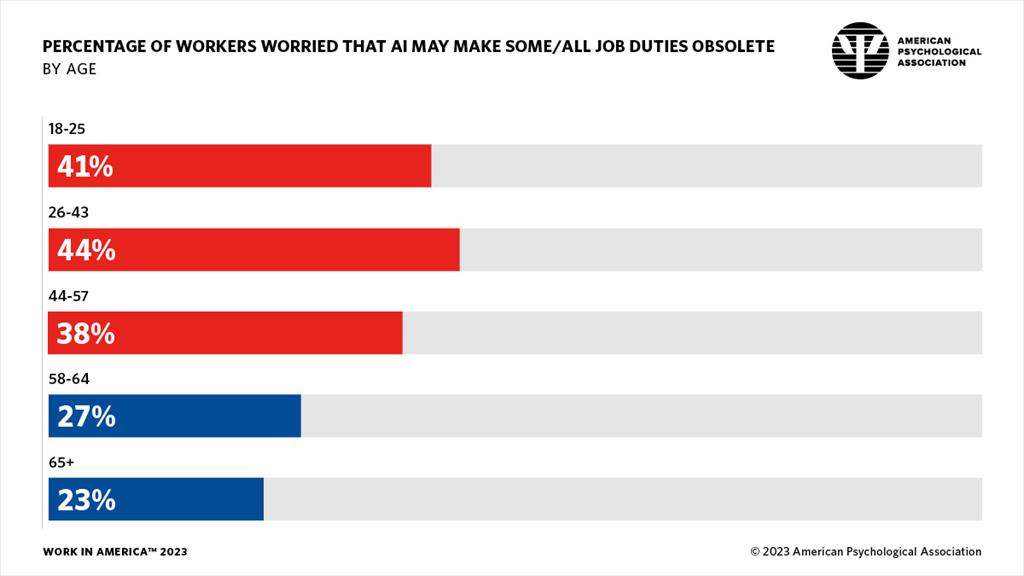
Age was also found to be related to worry about AI possibly making some or all of their job duties obsolete in the future. Worry was more prevalent among workers under age 58, compared with workers age 58 and older.
People of color more worried about AI’s effect on jobs
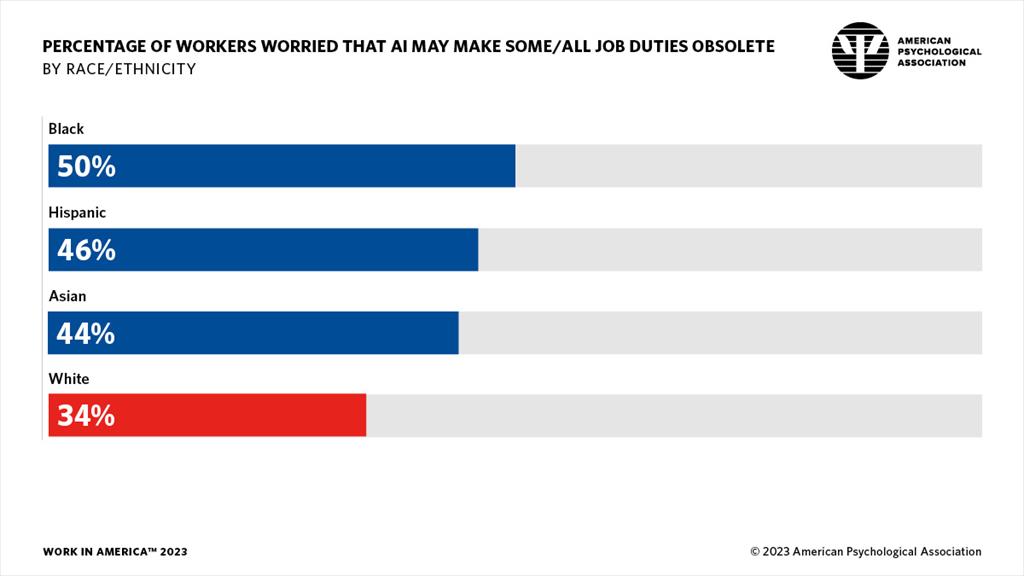
A smaller percentage of White respondents (34%) than Hispanic (46%), Black (50%), or Asian (44%) expressed worry about AI possibly making some or all of their job duties obsolete in the future. Hispanic, Black, and Asian workers’ levels of concern did not significantly differ from one another.
Workers with a high school education or less more worried about AI
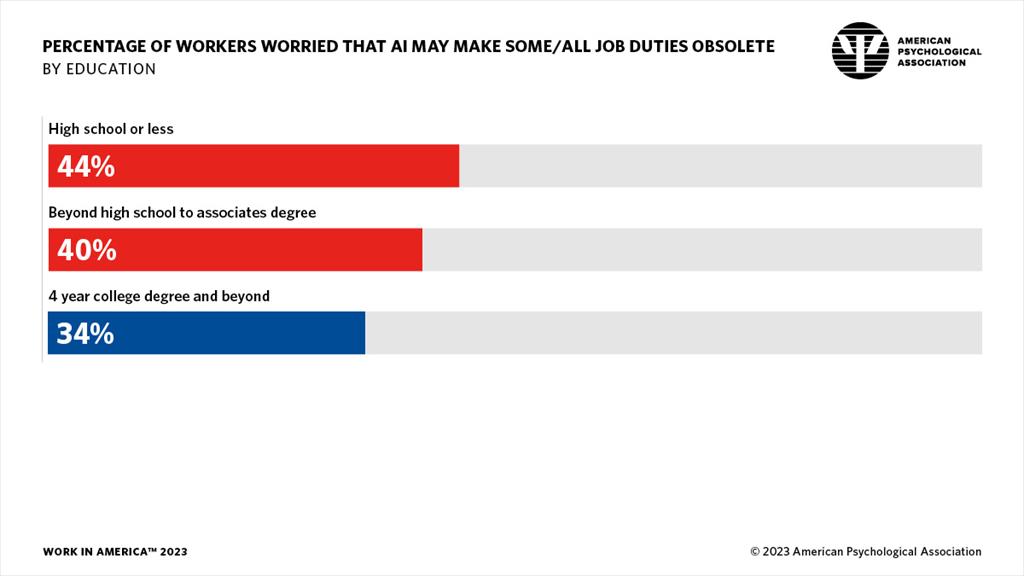
Worry about AI also was related to education level. Those with a high school education or less (44%) were significantly more likely to express worry about AI possibly making some or all of their job duties obsolete in the future than those with at least a 4-year college degree (34%).
The impact of monitoring technology on psychological well-being
The issue of being monitored with technology by their employer during the workday also raised concerns among survey respondents. Workers were asked, “As far as you’re aware, does your employer use technology (e.g., computers, software, cameras, bar-code scanners, etc.) to monitor you while working?” In response, around half of workers (51%) said they are aware that their employer uses technology to monitor them while they are working. The percentage of people being monitored was relatively steady across different types of workplace settings, such as office work (49%), manual labor (49%), and customer/client/patient services (55%).
[Related: Electronically monitoring your employees? It’s impacting their mental health]
Concern about monitoring associated with negative mental health
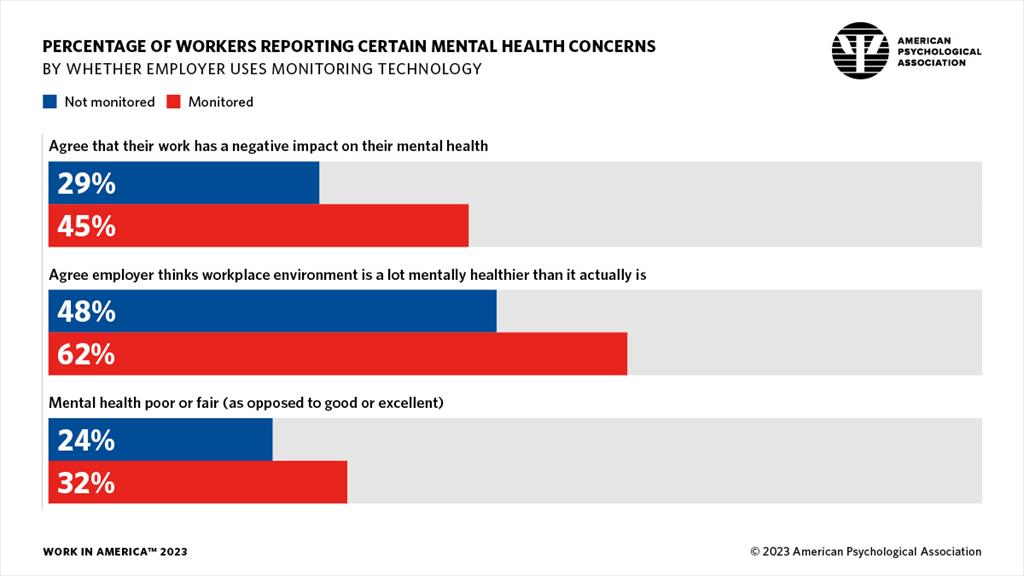
A larger percentage of workers who know they are monitored while working (32%), compared with those who are not monitored (24%), reported that their mental health is poor or fair, as opposed to good or excellent. Those who are monitored were more likely (45%) than those who are not monitored (29%) to say that their work environment has a negative impact on their mental health, and that their employer thinks their workplace environment is a lot more mentally healthy than it actually is (62% vs 48%).
Monitoring worries correlated with stress and other feelings often associated with burnout
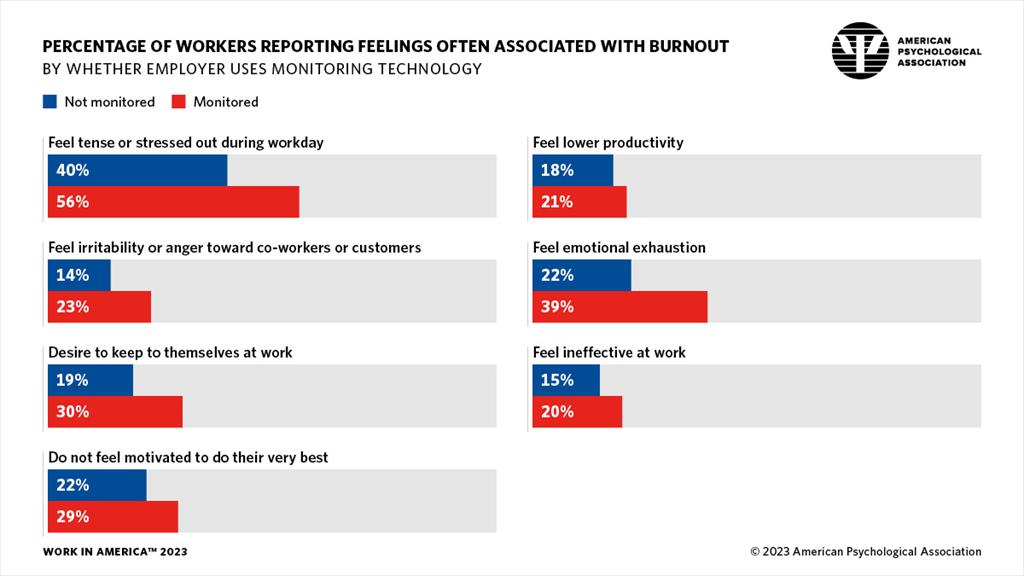
The survey results also revealed correlations between the use of monitoring technology and stress. More than half (56%) of those who reported being monitored while working also reported typically feeling tense or stressed during their workday, compared with closer to 40% of those who reported not being monitored.
Compared with those who are not monitored, those who are monitored also more frequently expressed feelings often associated with burnout, such as irritability or anger toward coworkers or customers (23% vs. 14% of those not monitored), a desire to keep to themselves at work (30% vs. 19%), not feeling motivated to do their very best (29% vs. 22%), feelings of emotional exhaustion (39% vs. 22%), and feelings of being ineffective at work (20% vs. 15%).
Concern about monitoring associated with not feeling valued at work
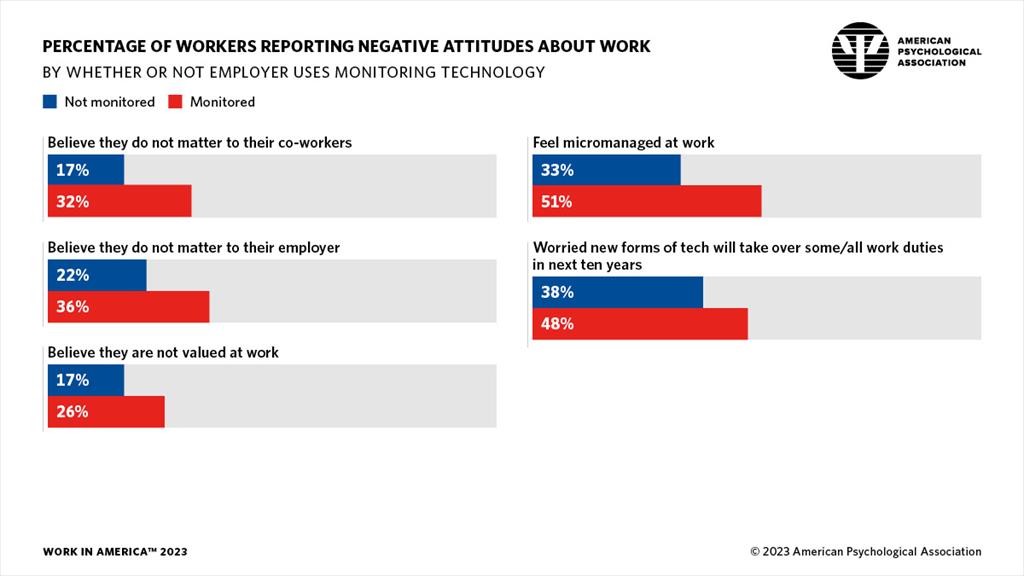
Compared with workers who are not monitored, workers who are monitored while working more often reported feeling that they do not matter at their workplace (to their coworkers [32% vs. 17% of those not monitored] or to their employer [36% vs. 22%]), that they are not valued (26% vs. 17%), that they are micromanaged (51% vs. 33%), and that new forms of technology are likely to take over their job (48% vs. 38%).
Some workers believe their employers “spy” on them
Regardless of whether they know they are being monitored, slightly more than a third of respondents said they worry that their employer uses technology to spy on them during work hours (34%), and that they are uncomfortable with the way their employer uses technology to track them at work (35%).
Not surprisingly, those percentages were higher among those who know that their employer uses technology to monitor them: 47% reported being worried about spying (vs. 22% of those not monitored) and 46% reported feeling uncomfortable (vs. 23% of those not monitored).
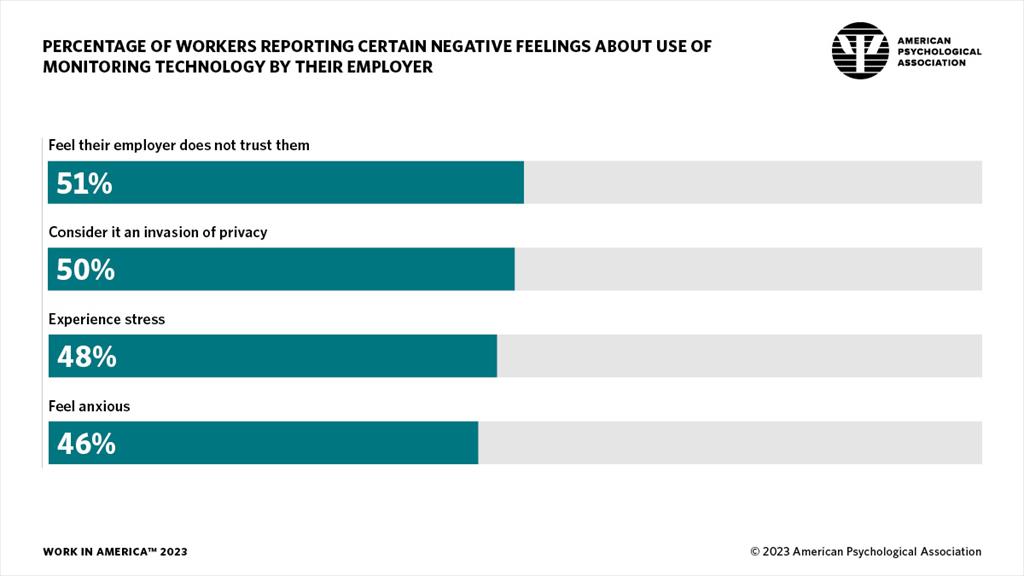
Further, among those who believe they are monitored, more than two in five workers reported that it causes them to experience negative feelings.
Some workers commented about monitoring and privacy issues even in response to questions that did not specifically ask about those topics. For example, when asked for the most important things their employer should be doing to help protect and foster their emotional and psychological well-being, a female, full-time worker from the Northeast stated:
“Being nice, not spying on me, and just saying meaningful things to each other.”
A male, full-time worker from the Northeast stated:
“I do not need monitoring.”
A male, full-time worker from the Midwest said:
“Ease up on the productivity monitoring.”
Multiple respondents made statements such as:
“Stop invading my privacy.”
“Respect my work and my privacy.”
“Respect my privacy and personal life.”
“Just respect my privacy.”
“Give encouragement and recognition for doing a good job, respect your privacy, to listen and respond to issues at work.”
“To respect my rights and my privacy.”
Upper management more likely to have positive sentiments about monitoring
There also were some positive sentiments expressed about monitoring. However, to some extent, the views of upper management drove the more positive sentiments.
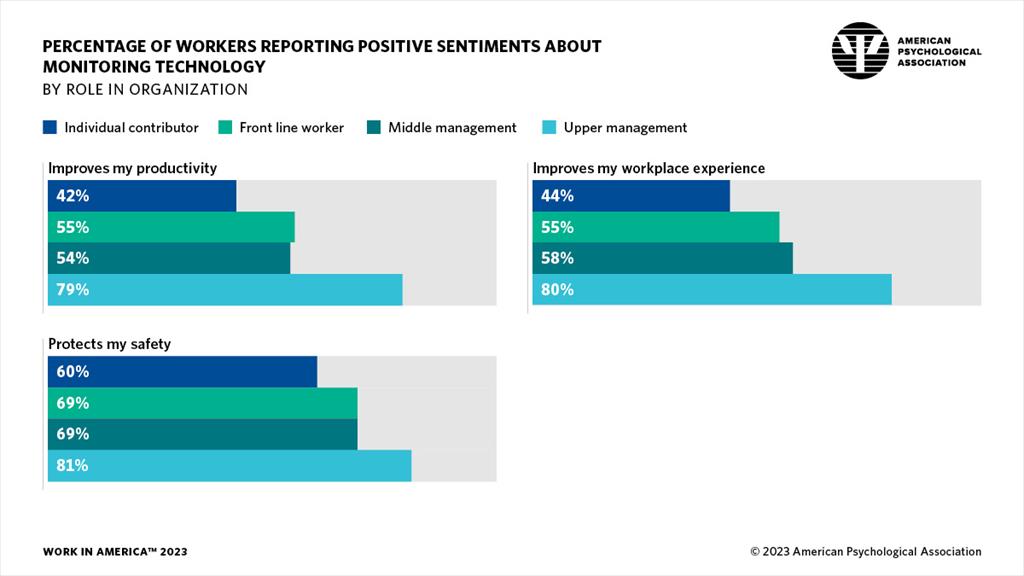
For example, upper management was significantly more likely to state that monitoring makes them more productive (79%) than either middle management (54%), front line workers (55%), or individual contributors1 (42%).
Upper management also was significantly more likely to say that monitoring improves their workplace experience (80%) than either middle management (58%), front line workers (55%), or individual contributors (44%). Similarly, upper management was significantly more likely to say that monitoring helps protect their safety while they are at work (81%) than either middle management (69%), front line workers (69%), or individual contributors (60%).
1 Individual contributor is defined as someone with a middle level or senior position who does not have management responsibilities.
Positive sentiments about monitoring were not, however, confined exclusively to upper management. For example, a female teacher from the South said that one of the most important things her employer is doing to help protect and foster her emotional and psychological well-being is:
“They monitor classes for any bad events.”
Another respondent—a female, full-time worker from the South—suggested that some tracking is a reasonable tradeoff for being allowed to work at home.
“Working remotely helps control my time; although my work time is tracked, it is more productive, saves time driving, transporting from one place to another.”
There may also be other reasons that some employees may respond positively to monitoring.
“For workers who feel their efforts are not noticed or who feel uncomfortable with self-promotion, the data from monitoring could help them demonstrate their impact in a positive way. But all of that depends on a culture of respect and trust. If data from monitoring is used to punish people or justify treating them like machines, it will not have any benefit.”
-Tara Behrend, PhD, John Richard Butler II professor of human resources and labor relations at Michigan State University and president of the Society for Industrial and Organizational Psychology
Concern about monitoring associated with intent to seek a new job
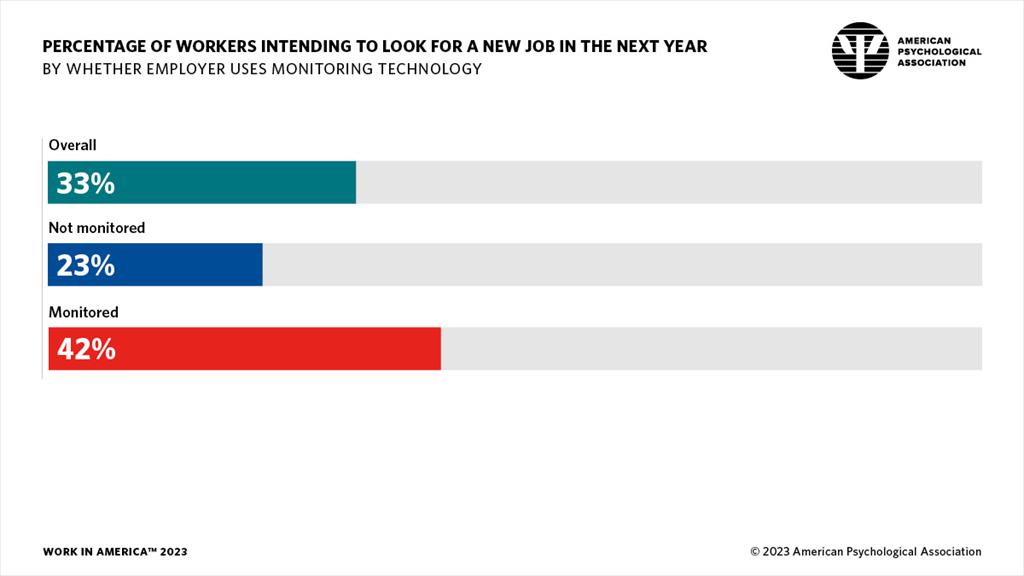
Among all workers, 33% reported that they intend to look for a new job at a different company or organization within the next 12 months. However, among those who are monitored, 42% reported their intent to look for a new job, compared with 23% of those who are not monitored.
Methodology
The research was conducted online in the United States by The Harris Poll on behalf of APA among 2,515 employed adults. The survey was conducted April 17–27, 2023.
Data are weighted where necessary by age, gender, race/ethnicity, region, education, marital status, household size, full-time/part-time employment, employment sector, industry, household income, and propensity to be online to bring them in line with their actual proportions in the population.
Respondents for this survey were selected from among those who have agreed to participate in our surveys. The sampling precision of Harris online polls is measured by using a Bayesian credible interval. For this study, the sample data is accurate to within ±3.1 percentage points using a 95% confidence level. This credible interval will be wider among subsets of the surveyed population of interest.
All sample surveys and polls, whether or not they use probability sampling, are subject to other multiple sources of error which are most often not possible to quantify or estimate, including, but not limited to coverage error, error associated with nonresponse, error associated with question wording and response options, and postsurvey weighting and adjustments.