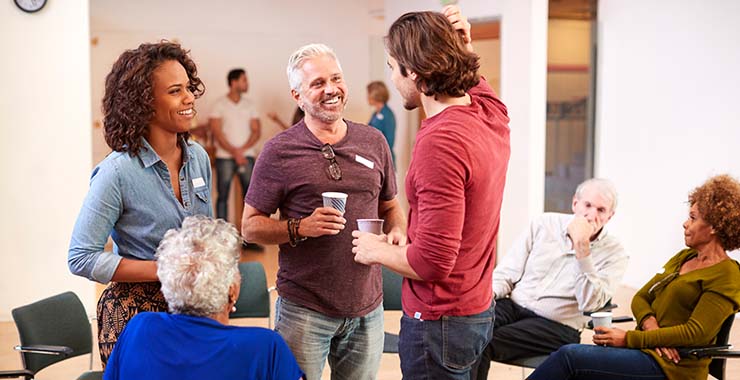
Thanks to declining birth rates and increasing life expectancy, for the first time in history there are relatively equal numbers of people in every age group in the United States. Yet, the generations in American society today are segregated more than ever.
Psychologists are among those pioneering a multigenerational movement that connects different age groups in work, communities, and schools in an effort to improve people’s well-being and tackle societal challenges such as climate change.
“It’s important not to sleepwalk through this opportunity to put teams of people together that combine the skills of young people, who are ambitious and energetic, with older people—who are experienced and motivated to address societal needs—to solve today’s pressing problems,” said Laura Carstensen, PhD, a psychology professor at Stanford University and founding director of the Stanford Center on Longevity.
Finding more ways to connect the generations could vastly improve the nation’s mental health, say psychologists. Greater intergenerational connectedness has the potential to mitigate the public health crisis of loneliness and isolation (PDF, 8.4MB)opens in new window—an epidemic that can increase the risk of mortality as much as smoking up to 15 cigarettes a day. In response to this crisis, the Sesame Workshop Alumni Network recently launched a three-generational mentoring program, and Carstensen’s team is studying how the program affects emotional well-being, confidence, development of a growth mindset, and feelings of intergenerational connectedness.
Robust evidence suggests that intergenerational programs can improve reading, socioemotional learning, depressive symptoms, and numerous other benefits for kids and teens. And older volunteers in multigenerational programs often experience decreased social isolation, greater life satisfaction and cognitive functioning, and reductions in falls and frailty (Gonzales, E., et al., Making the Case for Intergenerational Programs, Generations United, 2021opens in new window).
In addition, data from a recent survey by the nonprofit organization CoGenerateopens in new window, an organization dedicated to bridging generational divides, suggests a pent-up demand for more cogenerational action in the United States, with more than 96% of respondents agreeing that they want to work with other generations to help America better solve its problems. The environment was the highest priority for older generations, while mental health topped the list for Gen Z, Millennials, and Gen X.
[Related: Generations unite to address loneliness, climate change, other global challenges]
Here are some of the ways psychologists are connecting the generations:
To strengthen marginalized communities
Creating spaces for multigenerational connection is particularly important in marginalized communities because passing down wisdom can help people navigate life at the margins of society, said Nic Weststrate, PhD, an educational psychology professor at the University of Illinois Chicago. He and his colleagues launched The LGBTQ+ Intergenerational Dialogue Projectopens in new window, a group of 15 older adults and 15 college students, all from the LGBTQ+ community, who meet biweekly in Chicago during the school year. In the meetings, members share stories from their lives related to topics such as HIV/AIDS, ageism, and media representation, and others are invited to respond. Studies of the project have shown that valuing intergenerational storytelling was associated with positive psychosocial identity (Weststrate, N. M., et al., Journal of Homosexuality, 2023opens in new window).
To improve work
The workplace is one setting where different age groups frequently interact; workplace conflicts can be fueled by generational differences. To help leaders foster productive intergenerational conversations, Miami University’s Megan Gerhardt, PhD, a professor of management, visits companies to teach managers and employees how to cultivate generational intelligence, or “Gentelligence” as she calls it. They learn to identify and challenge assumptions about younger or older colleagues and take time to be curious rather than judgmental (Gerhardt, M., et al., Gentelligence: The Revolutionary Approach to Leading an Intergenerational Workforce, 2021opens in new window).
Taking time to understand different age groups will help workers accept one another and generate creative solutions to problems. She also teaches the value of “reverse mentoring,” or fostering a company culture in which older workers are encouraged to learn from younger ones, and vice versa (Stockkamp, M., & Godshalk, V. M., Mentoring & Tutoring: Partnership in Learning, Vol. 30, No. 2, 2022opens in new window).
To tackle societal problems
College campuses are also creating multigenerational programs that allow young people and retirees to learn together in classes and develop innovative solutions to problems. Retired leaders who are part of Stanford University’s Distinguished Careers Institute (DCI) have launched projects that address issues such as the need for more leadership training for girls and women in Africa. One DCI fellow founded a company that produces a natural seaweed supplement for cattle that reduces methane, a greenhouse gas emission.
Psychologist Mick Smyer, PhD, an emeritus professor at Bucknell University, is leading multigenerational groups in discussions about how they can take action to combat climate change. As part of his nonprofit Growing Greeneropens in new window, participants join 40-minute discussions and learn how to be climate action leaders. They identify a place they care about and then decide on a positive step they could take to protect it. Growing Greener groups have organized projects such as a recycled clothing drive and solar panel installations. Smyer also trains people to lead sessions in their communities, schools, workplaces, and other settings, and several thousand people have participated. “There is a belief that older people don’t care about [climate change], but this is a myth,” said Smyer. “People quickly realize that they can make a bigger impact by doing something together.”