skip to main content
Integrated care

Guiding the hardest recoveries

Meet a trauma psychologist who helps patients address the emotional impact of a severe injury 

APA Style leaf logo Cite This Article in APA Style
Abramson, A. (2025, October 8). Guiding the hardest recoveries. https://www.apa.org/topics/health-care/traumatic-injury

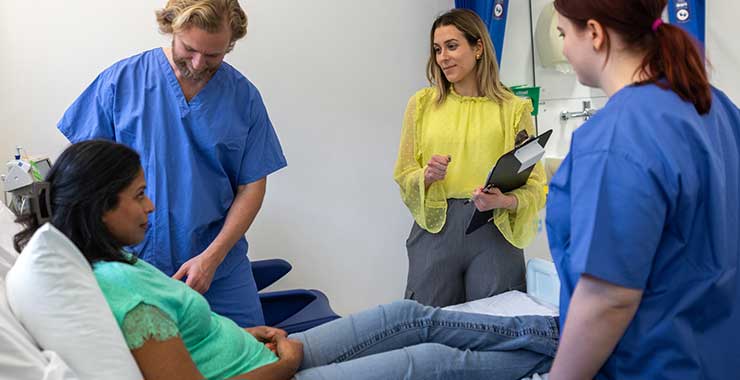
patient in a hospital bed being seen by a doctor

Dr. Schramm Psychologist Andrew Schramm, PhD,opens in new window is part of an interdisciplinary care team at Froedtert Hospital in Milwaukee, a Level 1 trauma center that treats the most severe injuries throughout the region, ranging from gunshot wounds to workplace and car accidents.

Froedtert is also one of the few hospitals in the United States with a trauma center that embeds trauma psychologists in its teams, which can strengthen patient outcomes and improve overall team functioning. Schramm’s work involves a mind-body approach that incorporates principles of health and rehabilitation psychology as he helps patients process their injuries and readjust to their lives outside the hospital. “If we can intervene early on and apply psychological principles, we can help improve someone’s mental health and physical health following injury,” said Schramm.

We spoke with Schramm about how he collaborates with medical providers and patients and how interdisciplinary care promotes positive patient outcomes after a traumatic injury.


First, tell us what health psychologists working in trauma centers do

This is a fairly new subspecialty, despite a significant need. Rehabilitation psychologists often work with patients later on in recovery from an injury, such as a spinal cord or orthopedic injury. Psychologists in trauma centers reach injured individuals earlier in their recovery and work with patients who may not discharge to rehabilitation settings. Psychologists like me can make a difference in improving patients’ physical and mental health trajectories by intervening even earlier in the hospital setting after these life-threatening or life-altering injuries.

When someone is early in recovery, small nudges toward support and adaptive coping can make a big difference in their outcomes. The availability of a caring person can be critical during that window from a psychodynamic, attachment-based perspective, and in terms of cognitive-behavioral strategies we employ. We want to reach patients in their greatest time of need, and when they’re a captive audience.

What is your role in the care team for traumatic injury patients?

We see patients after they receive immediate emergency medical care. So, if a patient needs emergency surgery, my team could see them as early as the same day or the next day.

First, we help people process memories of the injury with the goal of preventing full-on posttraumatic stress disorder and introducing healthy ways of coping with emotions. We know social support plays a major role in this, so we also help patients get in touch with loved ones when we can.

Along with helping patients cope emotionally with their injury, we want to help set them up for success with their medical journey. Incorporating health psychology principles, we collaborate with nurses and occupational and physical therapists to help support adherence to their recommendations. So many predictors of health outcomes are behavioral, and we want to help ensure people can get better if possible.

How does this type of integrated care improve outcomes for traumatic injury patients?

Mental health is interwoven with physical health. We know that untreated mental health issues can worsen physical conditions, whether traumatic injuries or diabetes. On the other hand, physical injuries and pain can cause or exacerbate mental health symptoms. It’s our goal to apply psychology to improve both outcomes. Even in the absence of mental health, health psychologists improve patients’ health by supporting health-promoting behaviors and removing barriers to engaging in their treatment.

Here’s an example: I once had a patient who was injured by a piece of machinery at work. To care for him, the nursing team needed to roll him on his side because his back had wounds they needed to wash. That act of lying on his side triggered panic because it reminded him of being pinned down by the equipment. He wasn’t letting nursing care for him, and he was at risk of an infection. We worked with him to overcome that avoidance, cotreating him with physical therapy colleagues, which improved his ability to receive that care.

In what ways do you collaborate with other providers?

One of my favorite parts of this job is the cross-disciplinary nature. We are sought after by the other members of the team, and we don’t have to sell the value of psychology to them.

I often meet with other treating providers to get a holistic view of each patient. We talk about the injury and prognosis along with the person’s current functioning in the hospital. We also discuss any other specific concerns, such as grief or safety concerns at home. Fairly often, we have patients who survive traumatic injuries where loved ones didn’t survive. If the injury was an assault, then there may be concern for domestic violence.

I also work with nurses, physical therapists, and occupational therapists to understand barriers to care. We’ll often cotreat in the same session, where I’m using psychotherapy principles during the medical treatment. With that patient who had a work injury, we engaged in mindfulness and visualization exercises to help him tolerate the medical team cleaning his wounds and in working with physical therapy.

How do you help patients adjust to the reality of life following a traumatic injury?

Once we address the immediate injury and any issues affecting the hospitalization, we want to help people adjust to life after a traumatic injury. The fancy term is “promotion of prognostic awareness.” There’s a lot of uncertainty about how someone’s life will be after an injury. They could walk again and return to their previous level of functioning, or they could be diagnosed with paraplegia.

I often work on helping patients tolerate that uncertainty. Sometimes I coach the medical team on how to be honest with the patient about the prognosis while honoring their desire for how much information they want about the condition. Having an expert in emotion and behavior can really influence the actions of the team.

Working closely with families is also part of it. We want to help patients actively think and talk about their experience. We know that when they can process it, their risk for PTSD goes down. Supporting families can reduce long-term mental health risks for loved ones, too. So, I may encourage a patient’s loved ones in how to respond to the patient as they recover from the injury. It’s easy to avoid the difficult emotions in situations like this or focus on silver linings. But it can really help when family and friends can hold space for these hard feelings so the patient can express what they’re experiencing.

What happens after someone is discharged?

We have an outpatient clinic where we can follow up with patients after they leave the hospital. This helps eliminate barriers to care and keep up our momentum from the hospital, because patients don’t have to worry about finding a new provider or scheduling appointments when they’re adjusting to life at home. It can also be helpful to continue the relationship with the same provider who knew them during one of the most difficult times in their lives.

Sometimes I do one or two sessions to check in and make sure they’re maintaining progress on the work we started in the hospital. Other times I see patients in outpatient therapy for more than a year.

What should other clinical psychologists know about treating patients with traumatic injuries?

Serious injuries can affect someone’s life and mental health in significant ways. Even if someone doesn’t have a visible injury or doesn’t disclose it, I encourage psychologists to include a history of traumatic injury in an assessment. In taking patients’ history, if they describe a traumatic injury, I would encourage psychologists to assess the circumstances around this, potential posttraumatic stress symptoms, and how they are coping with any changes in their functional abilities. Family members of people who have experienced this type of trauma can also benefit from support as they process their loved ones’ experience, so it can be helpful to attend to that information, too.

Recommended Reading

Speaking of Psychology

Subscribe to APA’s audio podcast series highlighting some of the most important and relevant psychological research being conducted today.

Subscribe to Speaking of Psychology and download via:

Appleopens in new window
Apple podcast logo

Spotifyopens in new window
Spotify logo

Related and recent