

This voter guide was prepared by APA, a Section 501(c)(3) organization.
APA nonprofit voter guide
APA does not support or oppose candidates for public office or political parties. This guide is intended to provide nonpartisan voter education.
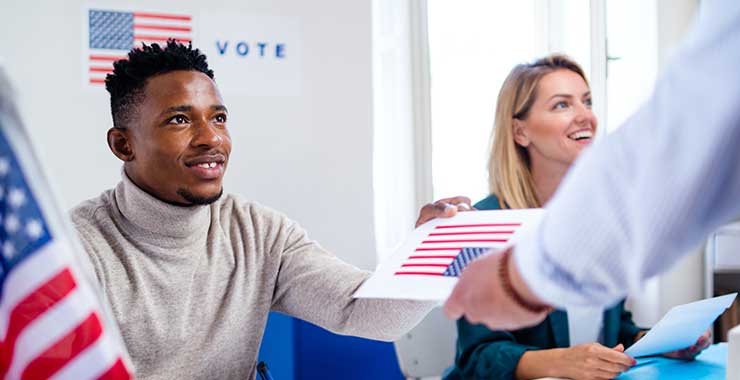
Depending on the election cycle, American voters could be deciding the next U.S. President, all 435 members of the House of Representatives, a third of U.S. Senators, governors in various states, and hundreds of state and local officials. The outcomes of these elections could affect the field of psychology, patients, and the communities where we live and work for years to come.
As clinicians, researchers, applied psychologists, educators, students, members of the mental health community, and current and potential patients and families of patients, you have expertise and experience that give you unique insights into the issues facing the nation and the steps needed to address them. Elections are an important time to lean into your experiences and share your perspective as a constituent- do not sit them out!
This guide gives you tips on how to participate in elections and educate candidates and communities about issues important to you.
Voting is not the only way to participate in an election.
Regardless of your voting eligibility, you may
- Educate eligible voters on voting processes, and encourage them to vote through social media, by volunteering with a campaign (on a personal, voluntary and nonreimbursed basis), or signing up to be a poll worker.
- Educate candidates on the importance of pursuing evidence-based policies, and access to mental and behavioral health services for all.
Understanding voting rights
Knowing your rights ahead of time will ensure a successful voting experience
There are multiple types of laws that may impact your ability to vote, including: voter ID laws, voting process laws (e.g. surrounding voting by mail/in person, early voting, etc.), and laws around voting accommodations (e.g. disability accessibility, translation needs, etc.).
These resources will help you.
Find up-to-date information on voting laws in your state
Understand voter ID laws
Voter ID laws require voters to present a form of identification before they may cast their ballot; form of such identification varies by state. Learn what forms of ID your state accepts on the Ballotpedia websiteopens in new window.
Keep in mind that voter ID laws may apply differently to first-time voters. First-time voters may be asked to present a valid form of ID even in states where identification is not generally required to vote. First-time voters may also be asked to provide additional information such as proof of address (e.g., a piece of mail from a utility company or bank).
Learn about laws concerning how and when you can vote
Every state has different laws that dictate how and when voters may cast their ballots, including:
- Whether you may submit a ballot by mail or if you must cast your vote in person
- Deadlines for mailing in ballots
- Whether your state allows early voting, and whether that may be done by mail or in person
Know voting rights of people with disabilities
One in five eligible voters has a disability. This section aims to help people with mental or physical disabilities, whether visible or not, identify resources to help them cast a ballot.
Laws concerning voters with disabilities and the accommodations offered during elections vary from state to state. Find more information on your rights as a voter with a disability on these websites:
- U.S. Vote Foundation Disability Voting Guideopens in new window
State-specific guides to help voters with disabilities understand their rights and learn about accommodations available to them as they cast their ballots. - Vote.gov Guide to Voting with a Disabilityopens in new window
A federal guide to voting for people with disabilities.
Election actions and voting plans
Forming a plan for how you will cast your ballot may help you feel less anxious about the voting process and make it likelier that you will successfully vote. Additionally, research has shown that voter turnout increasesopens in new window when would-be voters are encouraged to plan for how they will vote.
So please also consider talking to your peers about their voting plans.
Register to vote
Registering is the first step toward voting.
See if your state allows same-day voter registration
24 states allow same-day voter registrationopens in new window, but most require advance registration. If you have moved to a different county/locality since the last election, you may need to re-register. If you are an overseas or military voter, please consult the U.S. Election Assistance Commission military and overseas votersopens in new window.
Find state-specific registration, voting process, and ballot information
Both the U.S. Vote Foundationopens in new window and the Vote411opens in new window registration process pages have state-specific information.
Keep track of important deadlines
Election processes, including registration, early voting, or vote-by-mail, vary from state to state. This information can be found on the U.S. Vote Foundationopens in new window and the Vote411opens in new window election deadline pages.
Learn who is running for office
Learning about the candidates and their proposed policies will help you make an informed decision. The Vote411 ballot tool will help you identify races in your jurisdiction.
Make your voting day plan
Research shows you are more likely to vote if you make a step-by-step plan to do so. To build your plan, ask yourself:
How will you submit your ballot?
Will you be doing so…
By mail
Check your state’s vote-by-mail deadlines and requirementsopens in new window. Some states require ballots to be received before Election Day while others count ballots postmarked on Election Day. Additionally, some states allow mail-in ballots to be hand-delivered, while others do not.
Early and/or absentee
Check where your local election office is conducting early/absentee voting. Early voting locations are often different than Election Day polling locations.
In-person
Think about where and when you will be voting and know your rights.
- Look up your polling location in advance to plan your voting schedule. For example, will it be easier for you to go before or after work/class/errands? Will you walk, bike, or drive yourself, or will you need a ride? Is there someone who you might volunteer to drive with you to the polls?
- Learn your polling location’s hours. If you are in line before polls close, you may vote even after closing time.
- Check voting requirements in your state. You may need to bring an ID or proof of residency to receive your ballot.
- Will you need assistance at the polls? Voters with disabilities or who have difficulty reading or writing English have the right to receive assistance at the polls from the person of their choice. Learn more about your voting rightsopens in new window on the Elections Assistance Commission website.
- Consider whether you need to request time off from work to vote. 28 states and the District of Columbia require employers to give employees time off to voteopens in new window.
Save information on where to find help on Election Day
While we hope your voting experience will be smooth, there are nonpartisan voter hotlines that can help you navigate the unexpected. Several nonprofit, nonpartisan hotlines are available on Election Day in case you forget your polling location, need help asking for a provisional ballot, or need legal assistance (e.g., a polling location is non-compliant with federal law or you encounter voter intimidation):
- 1-866-OUR-VOTE (866-687-8683)
- 1-888-VE-Y-VOTA (en Español)
- 1-888-API-VOTE (Asian multilingual assistance)
- 1-844-YALLA-US (Arabic)
Remember: voting is not the only way to participate in an election. Regardless of your voting eligibility, you may:
- Educate eligible voters on voting processes and encourage them to vote through social media
- Volunteer with a campaign (on a personal, voluntary, and nonreimbursed basis)
- Sign up to be a poll worker
Opportunities to educate and engage with candidates
Some of you may have opportunities to interact with candidates when they canvas for votes in your neighborhood, host town halls, or attend public events. This provides you—whether you are psychologist, individual in a health-affiliated profession, or member of the public—with an opportunity to educate candidates on the importance of pursuing evidence-based policies.
This dialogue with candidates could include your experience—whether professional or personal—about which you believe candidates should be aware, including but not limited to:
- Needing to turn down families in need of mental health care, having few if any referrals who you know are accepting patients, or the frustration of seeking affordable, quality mental health care in your community
- Contending with the high rate of suicide among veterans and the impact on families
- Struggling with meeting the needs of communities, including children dealing with the psychological trauma caused by violence, natural disasters, poverty, and/or family separation
You may also have the opportunity to ask questions. If you speak with candidates, you are encouraged to ask about issues that affect your community and learn about their approaches.
Below are some open-ended questions you might consider or could use to generate your own queries to enable you to assess candidates’ approaches to policy, so you can make informed decisions as a voter.
- What are your thoughts about artificial intelligence and what role, if any, it should have in delivering mental health services?
- Given the recent changes by the federal government in the funding and treatment of science, what are your thoughts about ways to avoid a “brain drain” in the U.S.?
- Are there any mental and behavioral health issues you would prioritize if elected?
- What issues affecting the health and well-being of people in this community would you prioritize if elected?
- How do you seek and evaluate input from constituents, subject-matter experts, and available evidence when developing policy priorities?
- What factors guide your approach to public health, health care, and community well-being policy?
Remember that your discussion will be more meaningful and instructive for the candidates if you personalize the questions by connecting them to your own experiences as a constituent.
Copyright 2026. This material may be copied and distributed for noncommercial purposes only, if acknowledgment is given to APA and/or the material is reproduced in its entirety. This material may not be translated without prior permission in writing from APA and then final review.
Date created: August 2026