skip to main content

The devastating psychological impact of hate crimes

APA CEO denounces shooting at San Diego’s largest mosque, emphasizing “there is no place for religiously motivated violence in our society.”

APA Style leaf logo Cite This Article in APA Style
Novotney, A. (2026, May 19). The devastating psychological impact of hate crimes. https://www.apa.org/topics/gun-violence-crime/hate-crimes

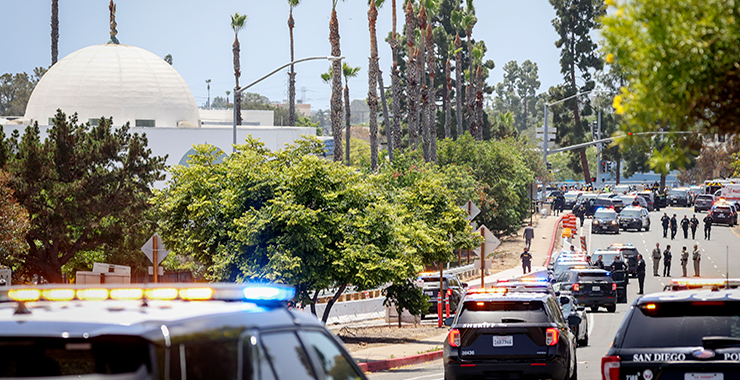
Police and other first responders on scene at the Islamic Center of San Diego.

Hate crimes and bias-motivated violence such as the May 2026 shooting at the Islamic Center of San Diego have become an increasing source of fear and psychological distress for many communities in the United States. Psychologists warn these incidents can have effects that extend far beyond those directly targeted, contributing to anxiety, trauma, and a diminished sense of safety across entire communities.

The Department of Justiceopens in new window defines hate crimes as those “committed on the basis of the victim’s perceived or actual race, color, religion, national origin, sexual orientation, gender, gender identity, or disability.”

“Hate-motivated violence against religious communities doesn’t just harm those directly targeted—psychological research shows the fear and trauma ripple far and wide,” said APA CEO Arthur C. Evans, Jr. “The shooting at the Islamic Center of San Diego—now being investigated as a hate crime—is a devastating reminder of the real psychological toll of anti-Muslim hate. Let’s be clear: there is no place for religiously motivated violence in our society.”

Threats and violence against religious institutions and communities, including the December 2025 antisemitic attack at Bondi Beach in Sydney, Australia, and the January 2026 arson fire at Beth Israel synagogue in Jackson, Mississippi—the oldest and largest synagogue in that state—have prompted increased security at mosques, synagogues, and churches across the country and around the world.

Evans has also condemned antisemitic violence, emphasizing that these bias-motivated crimes harm not only their immediate victims, but also entire communities.

“When violence targets people because of their identity, communities experience fear, trauma, and lasting harm. There is no place for antisemitism in our society, and the psychological toll of the Bondi Beach tragedy underscores the urgency of addressing hate-motivated violence,” Evans said after the attack.

The Federal Bureau of Investigation’s Uniform Crime Report Programopens in new window showed 11,679 hate crime incidents in 2024. That number has been steadily increasing over the years, up from 7,314 hate crimes taking place in 2019. In 2024, the FBI said more than 53% of victims were reportedly targeted because of their race or ethnicity, and more than 23% were targeted because of their religion.

Prejudice and discrimination are typically the foundation of hate-based violence. This type of violence can take the form of verbal violence, which may include degradation, harassment, humiliation, and threats. Hate-based violence may also take the form of physical violence, such as bullying, sexual violence, and maiming, and can go as far as murder and genocide.

Man walks by Sydney Opera House, which is illuminated with a blue menorah to honor the victims of the Bondi Beach shooting.

[Related: Hate, bias, and intolerance—Antisemitism]
What are the mental health effects of hate crimes?

Experiences of racial discrimination are consistently linked with mental health issues such as depressionopens in new window, anxietyopens in new window, and posttraumatic stress disorder (PTSD), as well as physical ailmentsopens in new window such as diabetes, hypertension, and obesity.

Young adults who faced discrimination frequently—at least a few times per month—were around 25% more likely to be diagnosed with a mental health disorderopens in new window and twice as likely to develop severe psychological distress than those who hadn’t experienced discrimination or did less often, according to a 2021 study in the journal Pediatrics.

Hate crimes can lead to a wide range of mental health issues, including increased rates of depression, anxiety, suicidal ideation, post-traumatic stress disorder, and substance use. A 2020 study found experiences of hate are associated with poor emotional well-being such as feelings of anger and shameopens in new window. Victims tend to experience poor mental health, including depression, anxiety,opens in new window and suicidal behavioropens in new window. Some research also points to the finding that the experience of hate-motivated behavior can result in blaming of and lower empathy towardopens in new window fellow victims.

Entire communities can feel the impact of victimization. Members of the targeted community may experience vicarious traumaopens in new window symptoms resulting from witnessing others being victimized. A 2025 study in Psychological Trauma: Theory, Research, Practice, and Policyopens in new window explored changes in Northern Californian Jewish participants’ mental health before and after the Hamas massacre on October 7, 2023. Findings showed significant increases in stress, anxiety, and depression symptoms from before to after October 7.

Psychologists emphasize recovery from hate-based violence requires both individual and community support. Public condemnation of hate crimes, culturally responsive mental health care, and strong community connections can help reduce feelings of isolation and fear after traumatic events. At the same time, mental health experts say preventing hate crimes also means addressing the prejudice and misinformation that often fuel them.

Recommended Reading

You may also like