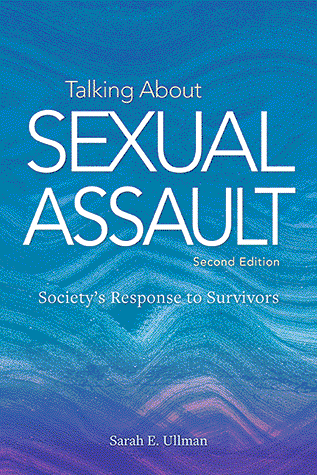
Talking About Sexual Assault
This second edition provides a comprehensive, social ecological review of women's rape and sexual assault disclosures and how support providers can better respond to them and challenge rape culture.
Women who have been raped and sexually assaulted are often retraumatized by negative social reactions from family and friends, healthcare professionals, institutions, and society at large.
Sarah Ullman educates supporters on more appropriate responses that empower survivors and help them heal. Drawing on interviews with survivors and support providers, she offers powerful, provocative insights to therapists, other frontline workers assisting survivors, researchers, and students.
She reviews transtheoretical research on why, how often, and to whom women disclose; the impact of social contexts on disclosures; and social reactions from informal support networks and professionals in a variety of institutional settings.
New to this edition is updated research addressing social media, social phenomena like the MeToo movement, and informal supporters’ experiences with survivors. While most research still focuses on White, heterosexual, and cisgender women, emerging findings on LGBTQ+ individuals, cis males, people of color, and people with disabilities are reviewed where available.
Series Foreword
Acknowledgments
An Introduction to Helping Sexual Assault and Rape Survivors
- Chapter 1. The Social Context of Talking About Sexual Assault
- Chapter 2. Theories of Women’s Rape Disclosure
- Chapter 3. Why, How Often, and to Whom Do Women Disclose, and What Factors Influence Whether Disclosure Is Healing?
- Chapter 4. What Social Reactions Do Victims Receive When Disclosing Sexual Assault?
- Chapter 5. Impacts of Social Reactions on Survivors
- Chapter 6. Informal Supporter Providers’ Experiences Responding to and Helping Survivors
- Chapter 7. Formal Supporters Helping Survivors: Advocates and Clinicians
- Chapter 8: Conducting Interviews With Survivors of Sexual Assault
- Chapter 9. Challenging the Rape Culture: Recommendations for Change
References
Index
About the Author
Sarah E. Ullman, PhD, is professor of criminology, law, and justice at the University of Illinois, Chicago. Her research focuses on sexual victimization of women and rape’s impact on mental and physical health.
Dr. Ullman has conducted multiple longitudinal studies on sexual assault survivors and how social reactions from support sources affect their coping and recovery. She also interviewed survivors and service providers about their disclosure and help-seeking experiences and codeveloped an informal support network intervention for survivors and their social networks.
She is conducting a large multimethod, dyadic study to better understand disclosure, social reactions, and their impacts.
Survivors tell us that support is their primary need. Sarah Ullman is the undisputed expert on social support after disclosure. This compact book is a comprehensive yet accessible sharing of knowledge learned from her years of speaking with survivors during the months and years following sexual assault, often demonstrated in their own words. It all comes together in the final chapters, which focus on therapeutic application and prevention.
—Mary P. Koss, PhD, Regents’ Professor of Public Health, Mel and Enid Zuckerman College of Public Health, University of Arizona, Tucson, AZ, United States
For more than 2 decades, Sarah Ullman has been the most insightful and influential investigator of social response to disclosures of sexual assault. Her work has revealed that social response to disclosures can have a tremendous impact on survivors of sexual assault—for better or for worse. This second edition of Talking About Sexual Assault is a highly readable tour de force, explaining how and why social response to disclosure matters so very much and what we can do about getting that response right.
—Jennifer Joy Freyd, PhD, Professor Emerit, Psychology, University of Oregon, Eugene, OR, United States; Founder and President, Center for Institutional Courage
Readers familiar with Sarah Ullman’s extensive research on sexual assault disclosure will be rewarded by this book, which brings together findings from her multiple studies into one updated volume. This new edition is a must-read for researchers, students, policy makers, legal and medical professionals, and victim advocates.
—Claire M. Renzetti, PhD, University of Kentucky, Lexington, KY, United States
Talking about sexual assault can be an important act that signals a survivor’s empowerment as they take control of their narrative and reclaim the sociopolitical context in which the assaults occurred. As a leader in the field of sexual assault disclosure research, Dr. Ullman is ideally suited to provide this overview. Through a combination of empirical research and personal reflections, she provides guidance on responding to disclosures in both formal and informal settings while also highlighting directions for future research and intervention.
—Anna Jaffe, PhD, Assistant Professor, Psychology, University of Nebraska–Lincoln, Lincoln, NE, United States
Dr. Sarah Ullman is the leading expert on this topic. This updated volume will be useful to researchers and practitioners alike.
—Lindsay M. Orchowski, PhD, Associate Professor, Psychiatry and Human Behavior, Brown University, Providence, RI, United States
This book is an excellent synthesis of a vast multidisciplinary literature on societal responses to sexual assault survivors. This volume is well-written and meticulously researched, and it presents compelling new data. The central ideas are clearly explained without unnecessary jargon. This is an essential resource for academics as
well as frontline staff (e.g., rape crisis center advocates, counselors, clinicians).
—Rebecca Campbell, PhD, Professor, Ecological/Community Psychology, Michigan State University, East Lansing, MI, United States