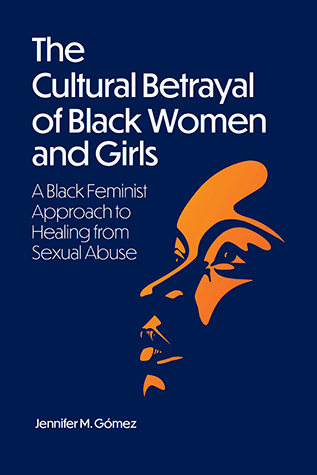
The Cultural Betrayal of Black Women and Girls
Available formats
Also available from
This book provides a theoretical framework for empirically examining the impact of violence on marginalized peoples across the lifespan.
With anti-Black racism uniquely impacting Black women and girls who are sexually victimized, a unifying, empirically testable framework with a critical race perspective to examine Black women and girls' experiences of sexual violence is warranted. Dr. Jennifer M. Gómez created cultural betrayal trauma theory (CBTT) to expand the limiting assumption in the dominant theoretical and methodological literature on the impact of violence that traumas, such as rape, are solely interpersonal. In CBTT, Dr. Gómez builds on Black feminist scholarship, ethnic minority trauma psychology, and betrayal trauma theory to provide a theoretical framework for examining the impact of violence on marginalized peoples across the lifespan.
The Cultural Betrayal of Black Women and Girls is the first book to use the CBTT research to contribute to academic and national discussions regarding anti-Black racism and sexual abuse. Using CBTT as a foundation, this book incorporates transdisciplinary scholarship on racism, intersectional oppression and intersectionality, sexual abuse against Black women and girls, cultural competency and critical consciousness in therapy, and healing in the community into a single resource for understanding and addressing oppression and sexual abuse on individual, institutional, and societal levels.
Foreword: Thema Bryant
Preface
Acknowledgements
- Chapter 1: What's Racism Got To Do With It? Black Women & Girls, Sexual Abuse & Liberation
- Chapter 2: Black Women & Girls: Racism & Intersectional Oppression
- Chapter 3: The 'Rape Problem' & Secondary Marginalization Against Black Women & Girls
- Chapter 4: Cultural Betrayal Trauma Theory: Framework, Evidence, & Future Directions
- Chapter 5: Culturally Competent Trauma Therapy: Holistic Healing
- Chapter 6: Radical Healing in the Black Community
- Chapter 7: Institutional Courage to Change the World
Conclusion: What Does It All Mean? From Micro- to Macro-Level Change
Jennifer M. Gómez, PhD, board member and chair of the research advisory committee at the Center for Institutional Courage, is an assistant professor at Boston University School of Social Work and Center for Innovation in Social Work & Health.
She is also a member of the Scientific Committee at the International Society for the Study of Trauma & Dissociation (ISSTD) and the APA Presidential Task Force for Culturally Informed Trauma & Grief Kits. Additionally, she is a guest coeditor of two special issues in Journal of Trauma & Dissociation: Discrimination, Violence, & Healing in Marginalized Communities (2021) and Self Injury & Suicidality: The Impact of Trauma & Dissociation (2015).
Finally, she is a former fellow at the Center for Advanced Study in the Behavioral Sciences (CASBS) at Stanford University (2021-22), National Academy of Sciences (NAS) Kavli Fellow (2019), and Ford Fellow (2015–16; 2018–19).
Having published over 100 peer-reviewed journal articles, book chapters, other scholarly writings, professional development documents, and pieces for the general public in the areas of violence and inequality, Dr. Gómez created cultural betrayal trauma theory (CBTT) as a Black feminist theoretical framework for empirically examining violence and mental, physical, behavioral, and cultural health outcomes for Black and other marginalized youth, young adults, and elders within the impactful context of structural inequality.
Her work has already advanced thinking in violence research, with invitations to share her research and its implications as a plenary speaker at the International Society for the Study of Trauma & Dissociation (ISSTD) International Conference (2021), panelist at the Stanford University CASBS' Social Science for a World In Crisis Series (2021), invited speaker at the National Academies of Sciences, Engineering, & Medicine (NASEM) Action Collaborative on Preventing Sexual Harassment in Higher Education Public Summit (2019, 2020), and invited speaker at University of Toronto (2019, 2021) and University of Michigan (2019, 2021), among others.
Her work has had a demonstrative public impact, with over 638,000 readers of her article (2019) detailing CBTT and sexual abuse in the Black community in The Conversation.
It is rare to find a book that offers the reader a seamless, yet powerful, integration of Black liberation theory; intersectional feminism; and illustrations of the stark, intergenerational, and persistent effects of the sexual assaults that have been perpetrated on Black women’s bodies from the moment they were hauled onto slave ships 400 years ago. Yet The Cultural Betrayal of Black Women and Girls: A Black Feminist Approach to Healing From Sexual Abuse does all of these things, and eloquently. Any therapist who works with women of African descent, any woman of African descent healing from trauma, any ally to these women, should be reading this book, because it is transformative, and what Jennifer Gómez has to say matters.
—Laura S. Brown, PhD, ABPP, Independent Intersectional Feminist Practice, Seattle, WA
In The Cultural Betrayal of Black Women and Girls: A Black Feminist Approach to Healing From Sexual Abuse, Jennifer M. Gómez, PhD, brilliantly articulates a widely known phenomenon that often goes unnamed—that the trauma following sexual abuse is exacerbated when those we trust, those from our own cultural group, are our perpetrators. Dr. Gómez reviews how cultural betrayal sexual trauma complicates nearly every part of surviving sexual abuse, from our freedom to seek safety from family members, our church homes, or the legal system to our ability to seek medical and therapeutic care even decades after the abuse has ended. This book is a must-read for anyone who works with Black women and girls who have experienced sexual trauma and wants to offer culturally competent trauma therapy that contributes to our holistic healing. Equally important, Black survivors of cultural betrayal sexual trauma will benefit from this book, seeing the complexity of their abuse and their pain named and validated. Finally, Dr. Gómez encourages all of us to think beyond the individual to consider how each and every one of us can strive for radical healing in our communities and in the world.
—Nicole T. Buchanan, PhD, Professor of Psychology, Michigan State University, East Lansing, MI; Fellow of the Association for Psychological Science and the American Psychological Association