

skip to main content

Establishing clear communication of terms between training programs, students, professional organizations, and the public.

What is the taxonomy?

A Taxonomy for Education and Training in the Health Service Specialties in Professional Psychology (PDF, 255KB)opens in new window (“the taxonomy”) provides consistent descriptions of specific program offerings in education and training programs in health service psychology.

The taxonomy addresses the issue of training programs using inconsistent labels to describe very different program offerings. This inconsistency has been confusing to the profession and the public, especially to students seeking to evaluate doctoral program offerings beyond the program’s declared specialty.
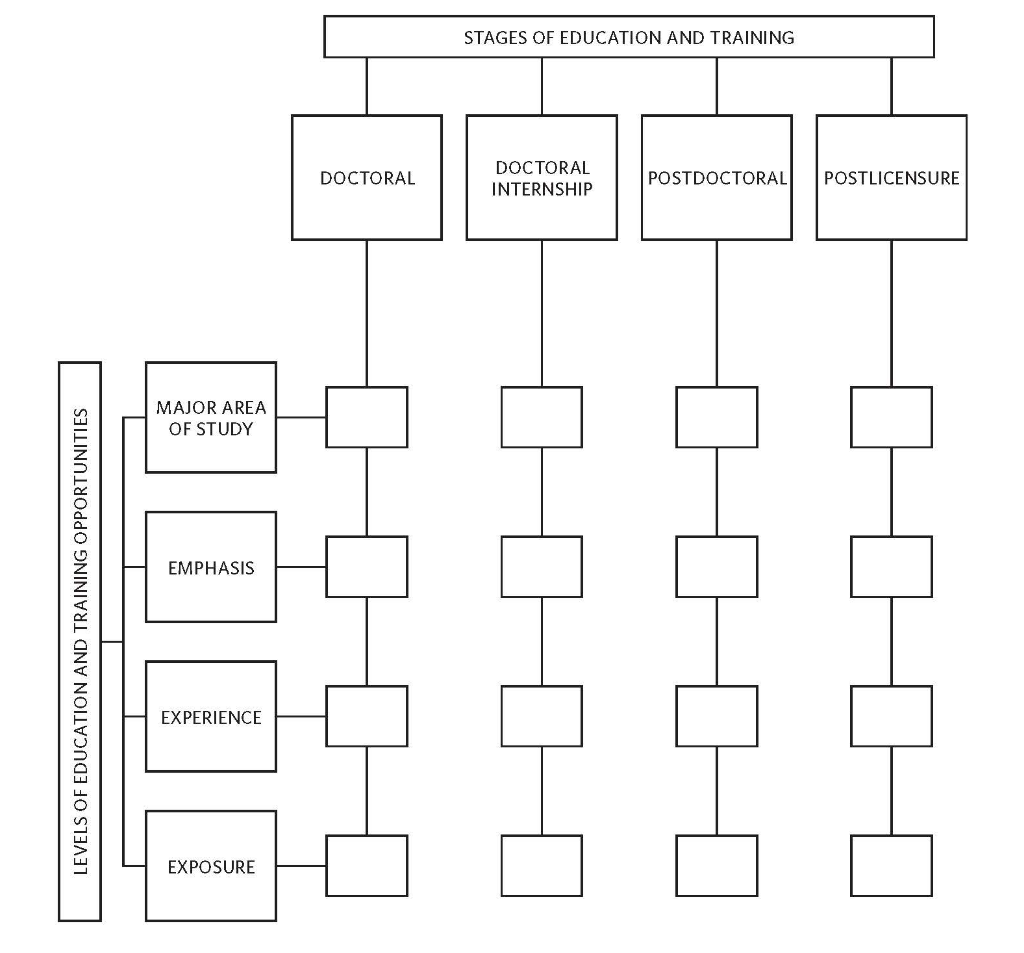
Definitions of training levels

To ensure consistency, APA strongly encourages doctoral, doctoral internship, postdoctoral, and postlicensure education and training programs to use the terms exposure, experience, emphasis, and major area of study exclusively in public training descriptions within APA-recognized specialties. Programs should use the word focus to describe opportunities in training areas outside of APA-recognized specialties.

The levels listed below are in order from lowest to highest intensity of training. Each recognized specialty is responsible for providing its own recommendations for the amounts of education and training required for each level. Please refer to the full taxonomy guidelines for complete definitions of each level.

  1. Exposure: Represents an education and training opportunity that is limited in type and intensity. Exposure is a structured learning activity and serves as an opportunity to acquaint an individual with that specialty area.
  2. Experience: A programmatic experience goes beyond simply acquainting a student with a specialty and allows more knowledge and experience acquisition than exposure to that area.
  3. Emphasis: Describes the level of education and training just below major area of study and permits a structured, in-depth opportunity for knowledge acquisition, practical experience, and scientific study in a given specialty area. A program stating that it offers an emphasis on a recognized specialty is expected to follow the guidelines established by that specialty for the program’s level of education and training.
  4. Major area of study: Describes the highest level of education and training available in that specialty area of study. A program stating that it offers a major area of study in a recognized specialty is expected to follow the guidelines established by that specialty for the program’s level of education and training.
expand all

A doctoral program might list its criteria for each education and training level as:

  • Major area of study: 2–3 years of didactics, supervised practicum, and dissertation or research project in the specialty 
  • Emphasis: At least four courses and two practica in the specialty 
  • Experience: One to two courses and practica in a specialty 
  • Exposure: At least one to two courses in a specialty

The website description of a fictitious doctoral program could read:

“In our APA-accredited doctoral program at Our University, we offer a Major Area of Study in Clinical Psychology with at least three years of didactic coursework and supervised clinical training in that Major Area of Study which includes a dissertation or research project. We offer students an Exposure to Clinical Neuropsychology with one course in that area and an Experience in Child Clinical Psychology with two courses and two semesters of supervised practicum in that area. We offer a Focus in personality assessment as part of our advanced practicum, wherein an advanced assessment course and two additional practica semesters are available.” (Rozensky, Grus, Nutt, Carlson, Eisman, & Nelson, 2015, p.30).

  • It standardizes the programs available for potential students, making it easier for students to be informed consumers and choose a program more likely to aid them in reaching their personal and professional goals. 
  • It outlines clear expectations for advancement in a particular area of study, which will aid students with career planning and specialization in the current workplace environment where psychologists’ roles are continually evolving. 
  • It ensures standards for consistency at all levels of training, which protects mental health care consumers and applied psychology services.
Last updated: March 2021Date created: 2016

From the Commission

Specialties

Specialty/Specialization FAQs

  • FAQs for students
    Responses to questions about specialties/specialization that are commonly asked by students and trainees.
  • FAQs for psychologists
    Responses to questions about specialties/specialization that are commonly asked by psychologists.
  • FAQs for the public
    Responses to questions about specialties/specialization that are commonly asked by the public.