Reviewed by Sophia Habler. Sophia is a student at Glen Rock High School in Glen Rock, New Jersey.
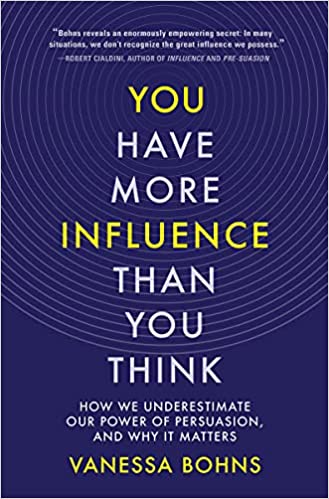 Author: Vanessa Bohns
Publisher: W. W. Norton & Company
Copyright Year: 2021
ISBN Number: 978-1-324-00571-1
Number of Pages: 256
Price: $28.95
You Have More Influence Than You Think, by Vanessa Bohns, a psychology professor at Cornell University, describes how challenging psychological topics can be applied to everyday life. If you have ever felt awkward asking someone for something, had a hard time saying “no,” or felt like everyone was staring at you, this book will show that while legitimate, these feelings are usually unnecessary. Unlike most books about influence, Bohns aims to understand the influence one already has rather than describing how to gain it. We underestimate the positive influence we have on people in our lives and overestimate the negative. It is easy to be unaware of the greater impact we have on people.
Many of us spend time scrolling through social media looking at other people’s posts and forget that other people do the same to us. Researchers from Stanford surveyed Facebook users about their perceptions of the size of their audiences and concluded that they “substantially underestimated the number of people who saw their posts, guessing their general audience to be just 27% of its true size.”
It is easy to think that people are watching us when in fact they typically are not paying attention to us, conversely when people are watching us, we do not realize this. Bohns describes a study conducted to see whether students in a dining hall felt more invisible than they were. She assigned students leaving the dining hall into different groups; while eating one was asked how much they observed those around them while the second group was asked how much they thought they were being observed. In the end, the ratings of how often the students found themselves observing others were 67% higher than how much they thought they were being watched.
Another topic in the book is the ability to say “no.” When we ask a favor from someone, face-to-face is more “awkward” or “embarrassing,” and it is easier to ask via text message or email. Although it is easier to send a request for a favor through a message, the person on the other end has more time to contemplate their response so they are more likely to decline. The idea that saying “no” is harder in person was shown in one variation of Milgram’s obedience experiment where participants were told to administer an electric shock to other participants for wrong answers, with shocks intensifying each time. When the researcher was absent, the rate of disobedience decreased greatly; when the researcher was present, obedience increased. In another study, they had participants email a request to strangers, which resulted in more strangers saying “no” than when asked in person (Bohns 81–84).
You Have More Influence Than You Think is organized into seven chapters. Each one discusses a different aspect of social psychology, however, some of the information overlaps to emphasize the main point. Bohns tells stories from her own life, right from the beginning, and relates them to different concepts. By mixing anecdotes with research and analysis, she makes it more personal and relatable. For instance, in the introduction, Bohns talks about her experience hearing from a student on whom she had a positive impact without realizing it. After this she worked with psychologist Erica Boothby to see if a simple interaction with a stranger would have a bigger impact than previously thought. They selected participants who were told to predict their impact on a stranger they encountered, and then approach them with a compliment. Afterward, the strangers reported how the compliment made them feel, and the strangers said that they felt much better than the participants had predicted (Bohns x-xi).
Many of the ideas presented are things that every person goes through on a daily basis as we often do not think about the motivations behind our actions, but this scholarly book allows one to make meaningful connections to the ideas in the book. We miss opportunities because we are afraid of rejection, and Bohns discusses why we should not worry about hearing the word “no,” and therefore should take more risks. Additionally, she challenges the way scholars think about “power” and “influence.” After reading You Have More Influence Than You Think, one will gain a more in-depth understanding about the effects of influence.